Many parents have described the same scene to us: their child has been playing a piece smoothly at home for two weeks, but when playing it back to their teacher, taking a graded music exam, or performing for friends and relatives, one wrong note brings everything to a halt. Once the child stops, they cannot pick up from the mistake. They can only return to the first bar and start again. Sometimes they restart two or three times, only to get stuck in the same place.
A parent’s first thought is often, “They’re too nervous,” or “They haven’t mastered the piece yet.” Either may be part of the picture, but there is another common reason that is easier to overlook: the child has learned only one route through the piece: from beginning to end.
01 Why One Mistake Means Starting Over
When children repeatedly practice a piece from beginning to end, their fingers remember it much like a string of beads: one note leads to the next, and one phrase leads to the next. Pick up the first bead, and the whole string comes up with it.
But if the string breaks in the middle, the beads that follow lose their connection. It is not that the child cannot play the third line. They have simply never practiced starting from the third line. As far as their hands are concerned, the third line exists only after the second. So they have to go back to the beginning and pick up the whole string again.
This also helps explain why children who habitually restart after every mistake at home find it harder to keep going onstage. The habits children develop at home go onstage with them.
02 How Professional Pianists Give Themselves a Way Forward
Roger Chaffin, a psychologist at the University of Connecticut in the United States, conducted a long-term study with pianist Gabriela Imreh. As Imreh prepared the Presto movement of Bach’s Italian Concerto, she recorded every practice session over ten months. The researchers then analyzed the recordings section by section to understand how she committed the music to memory.
They found that Imreh did more than rely on fluent finger movements. She deliberately established “landmarks” at important points in the musical structure, such as the beginnings of sections and phrases. If something went wrong in performance, she did not need to return to the beginning. She could move to the next landmark and continue.
In other words, a professional performer has a map rather than just a string of beads. The clearer the landmarks on that map, the less unsettling a mistake becomes.
03 What Stops a Child Is Often That Moment in Their Mind
Beyond the memory in the hands, there is another, less visible factor. When children stop after a wrong note, it is often because their attention has shifted away from the music. First comes “I made a mistake,” followed by “What will the adults think of me?” By the time those two thoughts have passed, the music has already stopped.
Jazz pianist Herbie Hancock once recalled an incident in an interview. As a young musician, he was performing “So What” with trumpeter Miles Davis when, at an especially intense moment, he played a clearly wrong chord. Davis did not stop. He took a breath and played a few notes that made the chord sound as though it had been intentional. Hancock said it took him years to understand what had happened: Davis had not treated it as a mistake. Hancock himself was the one who had been troubled by it.
Children remember how adults react in the moment after a mistake. If every wrong note brings a sigh or “Wrong again,” that is the voice they may hear in their head when they make a mistake onstage.
04 How to Practice Keeping Going at Home
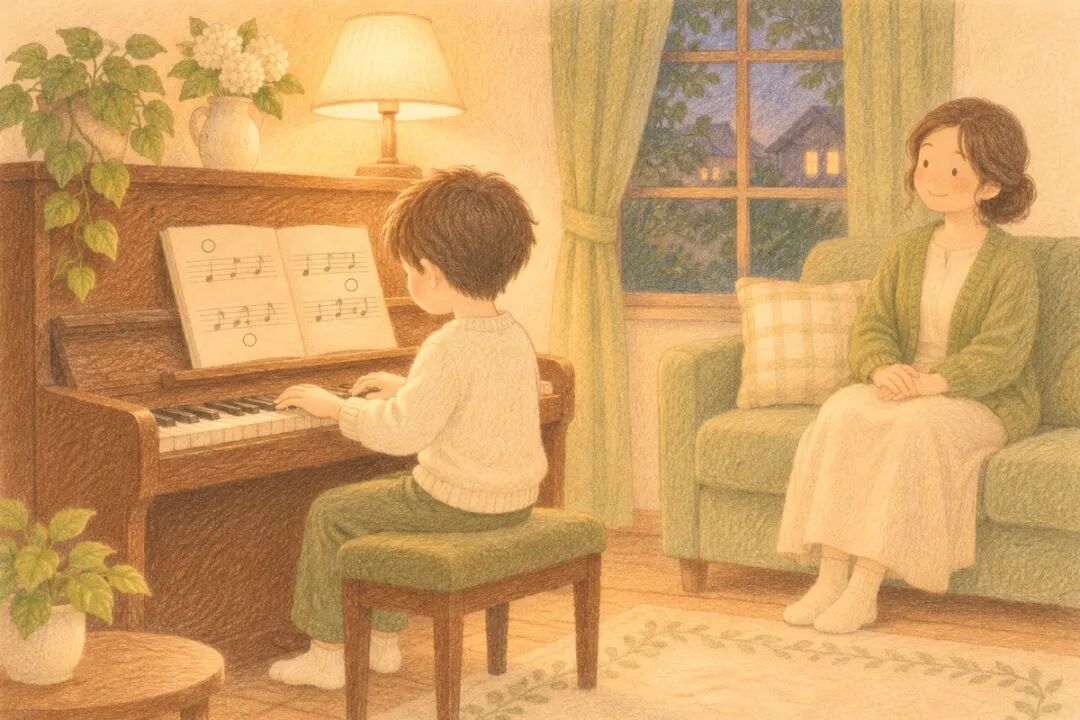
Start by drawing a map of the piece. Together with your child, use a pencil to draw a small circle at the beginning of each phrase. These are their landmarks. For a short piece of about one page, four or five will do. Then play a game of drawing starting points at random: number the circles, write the numbers on slips of paper, and have your child begin at whichever number they draw. After a few rounds, their hands will be familiar with each entry point in the piece.
Set aside one “performance run-through” each day. Treat the final run-through of the practice session as a real performance. Whatever goes wrong, keep going to the last note. Parents simply listen quietly, without speaking or frowning. Once your child is comfortable with this, try gently turning the pages of a book nearby or coughing once, so they can practice finishing despite a little distraction.
Finish first, then go back and fix things. After the performance run-through, ask your child to identify what they were unhappy with. Then take that passage out on its own, stop, and work on it slowly. Stopping to correct mistakes and playing through without stopping are both necessary skills. They simply should not be mixed into the same run-through.
05 Making the Results of a Performance Run-Through Visible
There is a practical difficulty with performance run-throughs: when a child plays all the way through, a parent may not be able to hear exactly where things went wrong. The feedback may amount to little more than “That was pretty good.”
This is one of the situations we considered when designing Challenge mode. A child plays from beginning to end on a real piano at home, without being interrupted by mistakes along the way. Afterward, they can see feedback on note accuracy, rhythm, tempo, and completeness. The results page marks the notes that caused problems, and they can also replay the performance they have just given. Recovering from a wrong note still takes those familiar landmarks and repeated performance run-throughs. What the tool can do is make it clearer where to go back and work after finishing.
Nobody can guarantee a performance without a single wrong note. Often, the child people remember is the one who makes a mistake and still brings the piece steadily to its conclusion.
During practice, stopping helps you get it right. Onstage, keeping going helps you finish.
#Piano #BeginnerPiano #ChildrenLearningPiano #PianoPracticeSupport #PianoFamilies
Wonder Piano provides AI-assisted support for piano practice at home. We write about practice methods and the challenges families encounter when putting them into use.