
Keywords: learning by example, parents and children learning together, lifelong learning
Translation context: This article was originally published in China on December 8, 2025. Its family stories, quotations, and reported outcomes are reproduced from the original article, rather than independently verified. Product descriptions reflect that historical Chinese context, not a promise of current Global features or results.

“Mom, I don’t want to practice today.” After dinner, seven-year-old Linlin was saying it again.
Her mother took a deep breath, ready for their daily “battle”: “You’ve only practiced for 10 minutes today! Your teacher said you need to get ‘Twinkle, Twinkle, Little Star’ ready this week.”
“But it’s too hard… My fingers keep hitting the wrong keys,” Linlin muttered.
“How will you learn if you don’t practice? Go on. You can watch cartoons when you’re finished.”
The parent keeps pushing, the child keeps stalling, and both end up upset. But what if they tried a different approach?
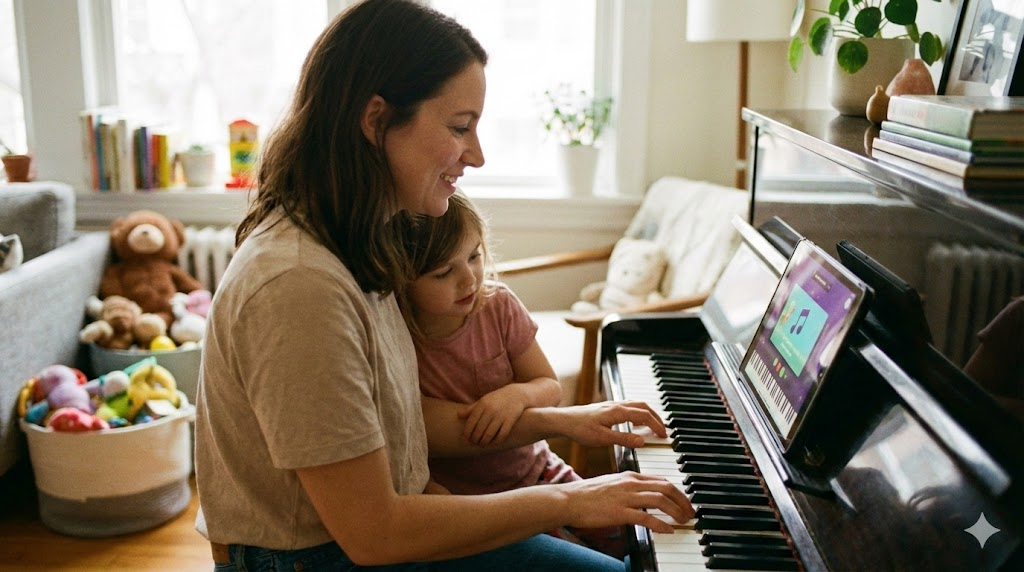
An Unexpected Role Reversal
One day, Linlin’s mother had a sudden thought: “Why don’t I try it too?”
She sat down at the piano and played a few notes from Linlin’s score. C with her right hand, G with her left—why wouldn’t her hands work together? After three attempts, her fingers still felt stiff.
“So… it really is this hard?”
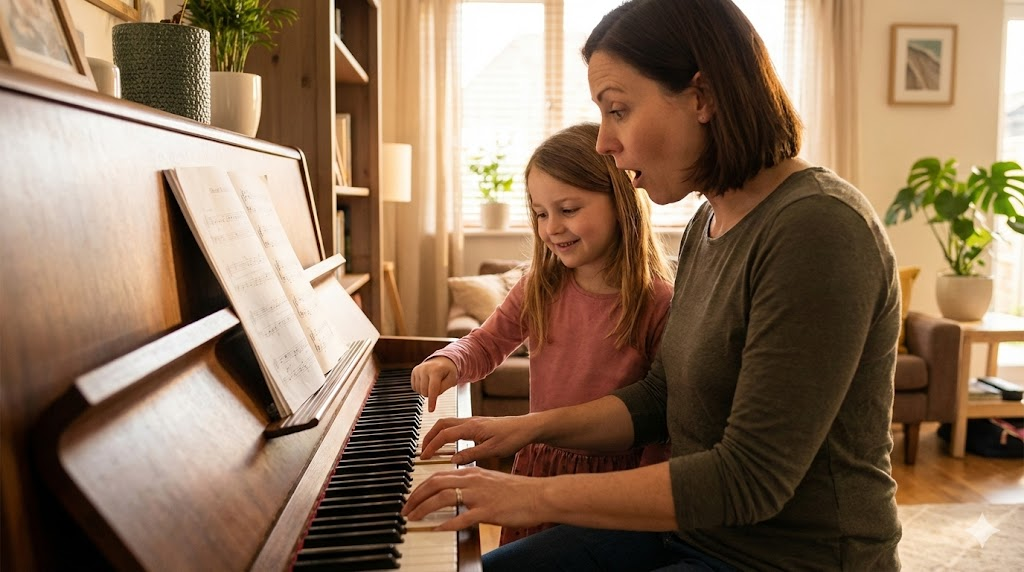
Linlin stood beside her, her eyes lighting up. “Mom, that fingering isn’t right. You should use finger 3 to play E.”
In that moment, the supervisor became a fellow learner.
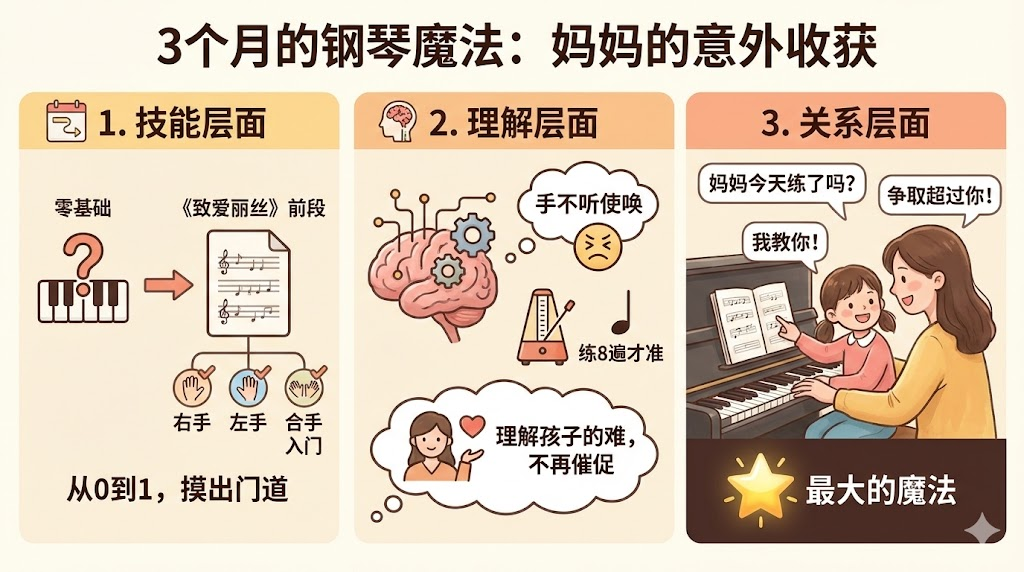
Unexpected Gains After Three Months
Linlin’s mother had never imagined that giving it a try would turn into three months of learning. According to the original account, the gains far exceeded her expectations:
Skills: Starting with no experience at all, she learned to play the whole opening section of “Für Elise” and began to understand how to put her right and left hands together.
Understanding: Coordinating both hands seemed to require her brain to “rewire” itself. No wonder her child kept saying, “My hands won’t do what I want.” Even apparently simple quarter notes took eight practice attempts to get on the beat. She could no longer bring herself to say, “Why can’t you play it right yet?”
Their relationship: Seeing her mother practice made Linlin less resistant. “Have you practiced today, Mom?” “Let me show you how to play this part.” Sometimes she even volunteered: “Mom, I want to practice a little longer today so I can catch up with you and do better.”
That was the greatest magic of all.
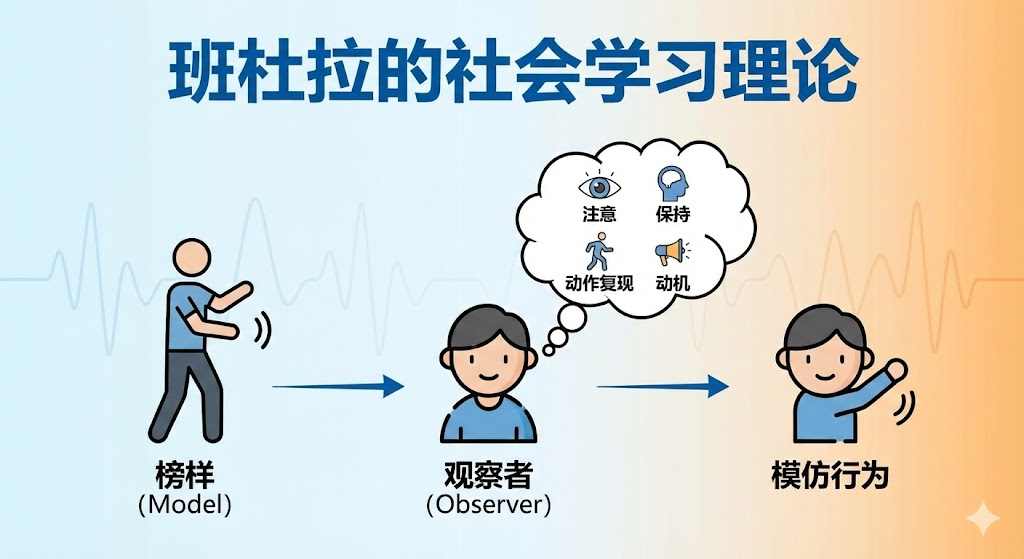
“I’m Learning Too” Is More Persuasive Than “You Must Learn”
The original author draws on psychologist Albert Bandura’s social learning theory, arguing that observation and imitation are children’s principal ways of learning.
Telling your child a hundred times that “learning piano is good for you” is less persuasive than letting them see you learning too.
Telling them a hundred times to “keep practicing” is less persuasive than letting them see you keep at it every day.
Words can only persuade so much; showing what you mean through your actions can be a powerful way to teach. When parents set aside the role of supervisor and join their children as beginners, the author argues, children experience companionship rather than pressure.
The difficulties you encounter while learning piano are difficulties your child will face too. The way you work through them becomes a vivid lesson.
Even Parents With No Experience Can Give It a Try
“But I don’t know any music theory. How can I learn?”
That is a concern for many parents. The article argues that technology had already made getting started much easier.
In its description of Wonder Piano in China at the time, the article presented a gradual practice path designed for beginners: practice the right hand first, then the left, and finally both hands together. Each main level was divided into short sections, with real-time feedback on each note. Correct notes brought encouragement; mistakes brought prompts. The author compared this to having a teacher beside you offering step-by-step help without pressure.
Translator’s note: The teacher comparison is a metaphor from the original article. Wonder Piano is a practice aid, not a replacement for a piano teacher’s guidance on technique or musical expression. See the canonical product overview.
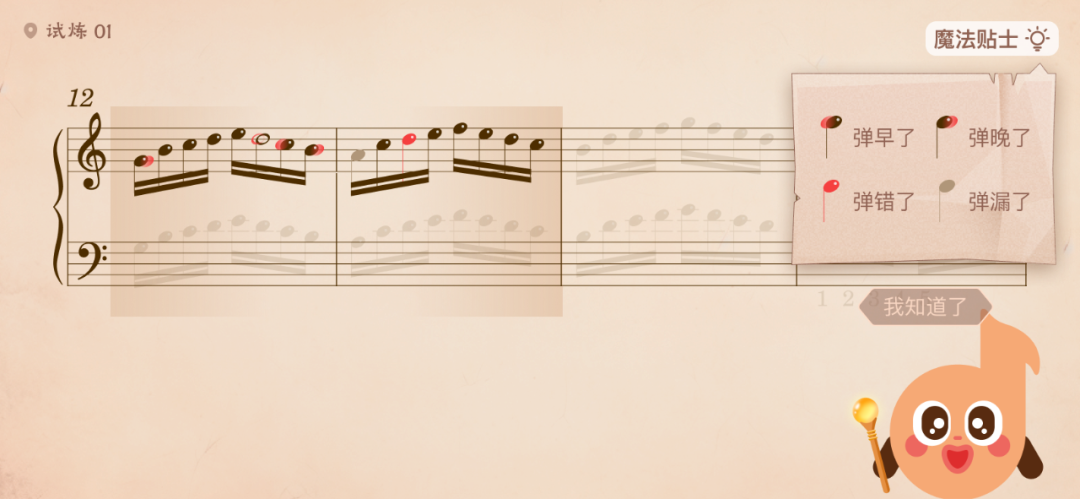
More importantly, the article described gamification as a way to make practice less repetitive: collecting Magic Stars, unlocking new stories, and exploring a magical world with Xixi. The author suggested that these designs could appeal to adults as well as children.
Translator’s note: Story unlocks are retained here as part of the December 2025 account. Story chapters and their audio playback were removed in a January 28, 2026 code change; they should not be read as a current feature promise.
The original article also described a 38-year-old father nicknamed “Pineapple Dad” who got started this way. “At first I was just playing along with my son. Then I found myself hooked too. Now we often compete to see who can clear the levels for a new score first.” After three months, the article reported, he had learned 10 pieces. More importantly, he said: “When my son saw me practicing every day too, I no longer had to keep reminding him.”
Lifelong Learning Starts With Parents
The answer to the pressure to push children to excel is not to push them further, but to learn alongside them.
If you want your child to be a lifelong learner, start by becoming one yourself.
If you want your child to persist through difficulty, first show them what persistence means.
If you want your child to love music, first experience its beauty yourself.
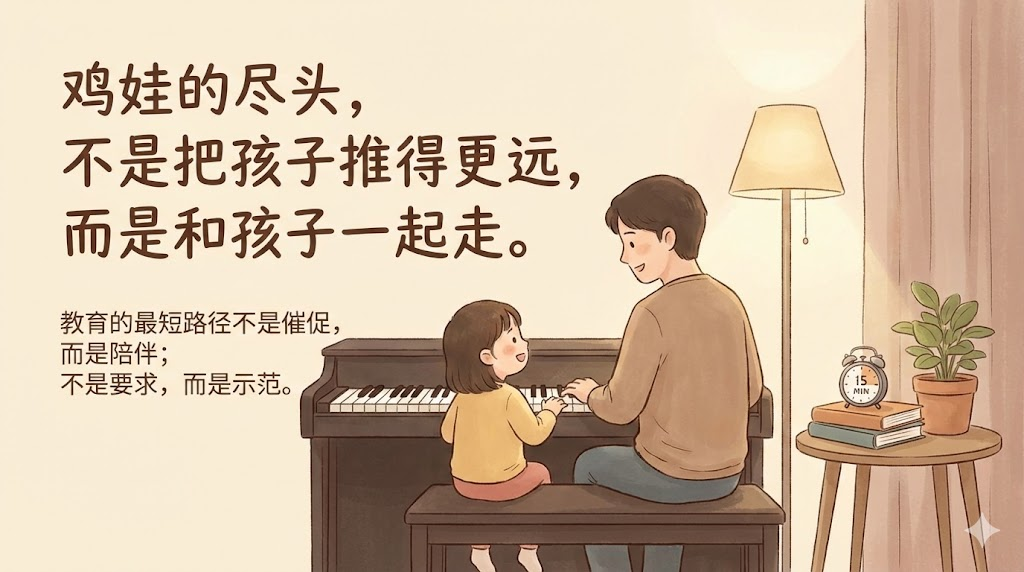
Instead of watching over your child’s practice every day, set aside 15 minutes to try the piano yourself. The author’s message is that the most direct path in education is companionship rather than constant reminders, and showing rather than demanding.
When your child sees you working hard to learn something new, they learn more than piano. They also see the courage to face challenges, a growth mindset, and a love of learning itself.
Those are the things education should pass on.
So, don’t just keep urging your child to practice. Why not sit down at the piano tonight and try playing a note together?
Q & A
Q1: If a parent starts learning piano with no experience, could they teach their child incorrect fingering?
A: 🙅♂️ The original article reassured parents: “There is no need to worry! Your role is to accompany your child, not to teach. Leave fingering correction to the intelligent system; you only need to offer emotional support and set an example of persistent learning.” 💪
Translator’s correction: The original claim that the system corrects fingering is inaccurate. Wonder Piano uses sound-based feedback and cannot observe which finger is used, hand shape, or physical technique. Fingering and technique require a teacher’s guidance; parents can focus on companionship and encouragement. This distinction is stated in the canonical product overview.
Q2: I’m too busy with work. Where will I find time to learn piano with my child?
A: ⏳ The original article argued that learning together could address a child’s tendency to stall: just 15 minutes fitted into the day, with meaningful shared progress, could be worth more than an hour of watching over practice. ✨ This is the author’s advice, not a measured or guaranteed time-saving result.
Q3: Wonder Piano has a cute visual style. Is it suitable for adults learning piano?
A: 🎵 The original article’s answer was that sound practice principles apply regardless of age. It described gamification as a way to reduce boredom and anxiety, helping adult beginners experience the satisfaction of playing a whole piece. 🚀 These are the historical author’s claims, not a guarantee of results or a complete piano course.
Reference:
- Albert Bandura’s social learning theory (Social Learning Theory)

Original article: Urging Your Child to Practice Piano Is Not as Good as Trying It Yourself—Do You Believe It?