
The original article describes two children who had been learning piano for about the same amount of time and received the same new piece in the same week. Three weeks later, one could play the whole piece, while the other was still on the first page.
The authors reviewed both families’ practice routines from the beginning. In their account, the difference was not in the three weeks that followed, but in the first ten minutes with the score.
The Family That Took Three Months Started Playing from the Beginning Immediately
The child in this family opened the new score and started playing from the first bar. When they got stuck on the third line, they went back to the first bar and started again. Another stumble, another restart. After ten minutes, they had played the first two lines seven or eight times and had not touched anything from the third line onward.
The next day was the same. So was the day after that. By the end of the week, the first two lines were thoroughly familiar, but the third still felt as unfamiliar as on the first day. By the third week, the parents began to wonder whether the piece was too difficult.
In the authors’ explanation, the problem was not the difficulty of the piece. Each day’s practice added more repetitions to passages the child already knew. The hard part always came after the third minute, and they never got to it.
The Family That Took Three Weeks Did Not Play Straight Away
The child in this family did not touch the piano during the first ten minutes with the new score.
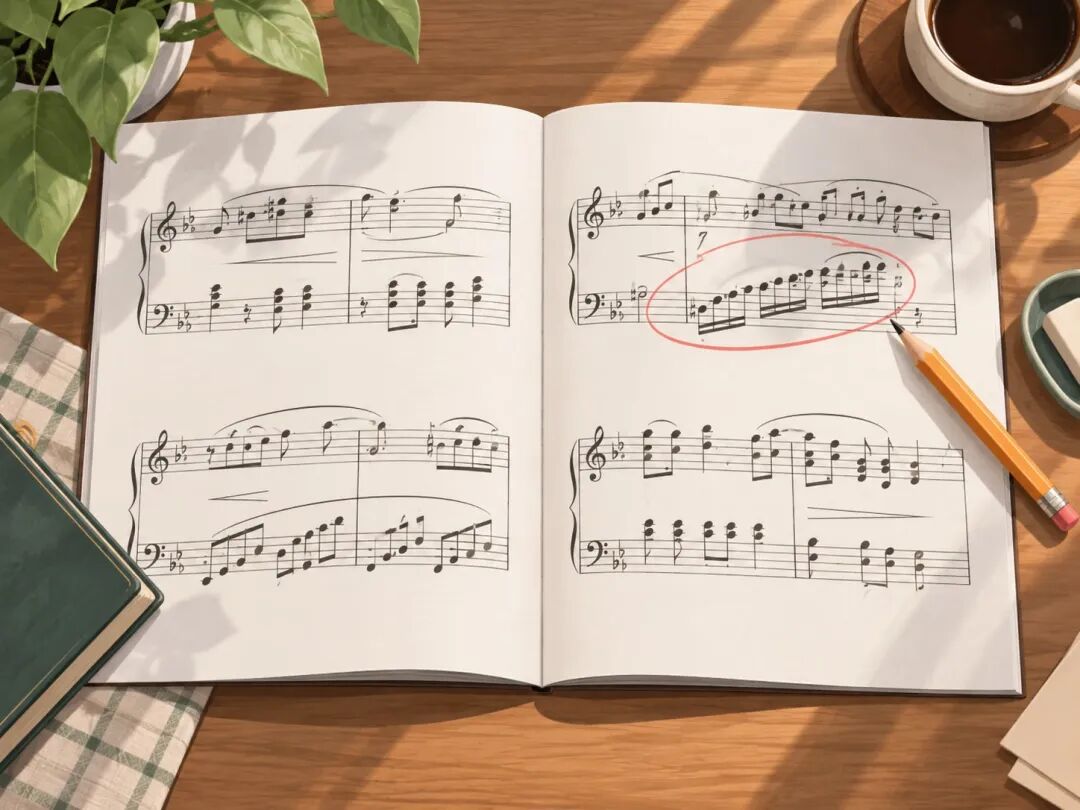
He counted how many sections the piece had. He looked for the section with the most hand-position changes, the one where the two hands had the most different parts, and any section with markings he had not seen before. Then he used a pencil to draw several vertical lines on the score, dividing the piece into four sections, and circled the hardest one.
On the first day, he practiced the circled section. He began with the hardest part, rather than the first bar. He played the easier passages at the beginning about once and left them for later.
After a week, he had worked through the hardest section. He then spent two days on each of the remaining three sections. Within three weeks, he could play the whole piece.
The Real Difference in Those First Ten Minutes
The family that took three months treated the new piece like a road to travel from beginning to end. The family that took three weeks treated it like a set of puzzle pieces and fitted the hardest one first.
The original article connects what teachers call “sight-reading” and “reading the score” with these ten minutes: first work out how many sections the piece has and which ones are difficult, then decide where to begin. Many children are never taught to do this, the authors argue, because their parents also start by playing from the beginning.
Translator’s note: Looking over and dividing a score before playing is score reading and preparation for sight-reading, rather than sight-reading itself. Sight-reading involves playing unfamiliar music, as illustrated by the unseen-music tests in ABRSM’s Piano syllabus.
This does not require music-theory knowledge. Counting sections, finding difficult spots, and drawing vertical lines are things a child who has been learning for six months can do.
How to Make Those Ten Minutes Part of Practice at Home
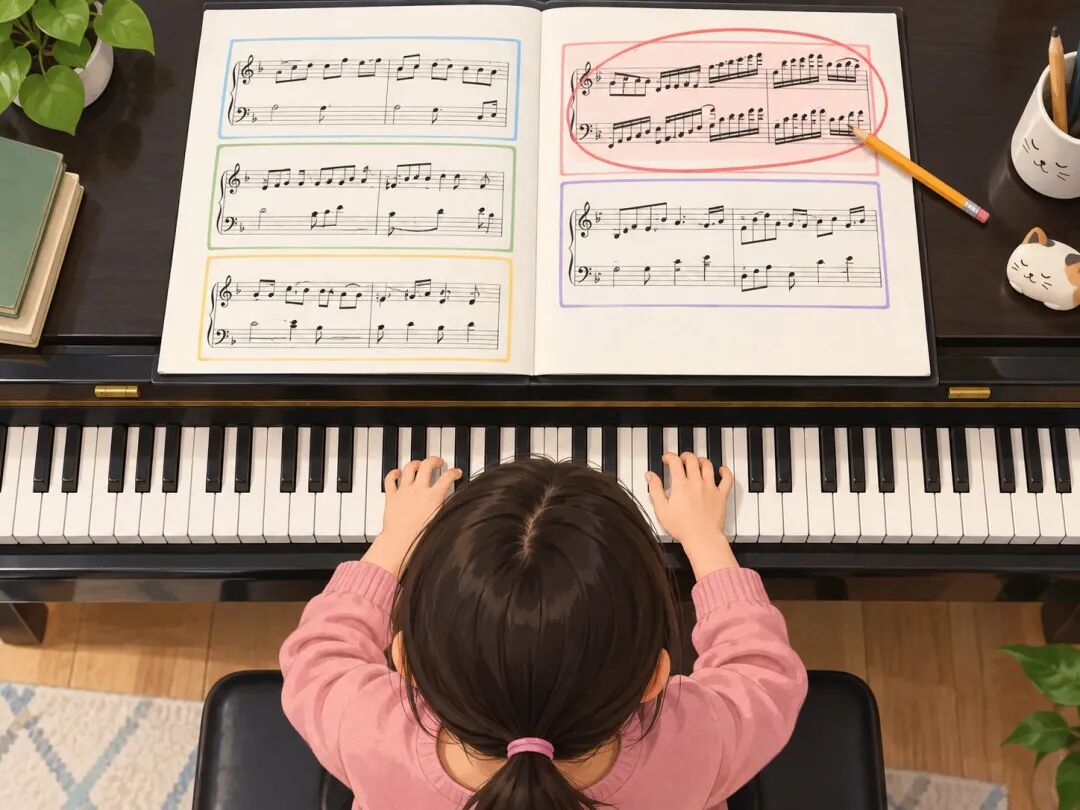
On the first day a new score comes home, there is just one rule: mark it before playing it.
Let the child count the sections, draw the vertical lines, and circle the hardest section themselves. It is fine if the divisions are imperfect: the section they find difficult is the one they should practice first. Once they have marked the score, they can begin playing, starting with the circled section.
Some families find marking a score inconvenient. In the original China-market article, Wonder Piano’s Adventure Mode is described as doing this step in advance: a piece is divided into major levels by musical phrase, and each major level is split into smaller segments. Instead of a whole page of music that feels impossible to finish, the child sees individual tasks they can choose from. Sometimes the difference between three weeks and three months begins with “I know which section to practice first.”
Translator’s note: The original article’s wording should not be read as unrestricted access to every Adventure level. The implementation snapshot checked on September 18, 2026 recorded that the experiment to remove unlocking requirements had been connected, but its new behavior was not yet implemented; see the implementation evidence. Selection in Adventure Mode was still subject to unlocking requirements in that snapshot. This paragraph describes the China-market article at the time of publication, rather than promising current Global functionality.
The Next New Piece
The next time the teacher assigns a new piece, do not rush to play it as soon as you get home. Give your child a pencil and ten minutes, and see how many sections they mark and which one they circle.
What is the first thing your child does when they receive a new score?
Wonder Piano is an AI practice companion for piano practice at home. Here, we write about practice methods and the difficulties families encounter when putting them into use.