
WONDER PIANO · Piano Teaching and Research Column · Practice Methods for Families · About 4 Minutes
Two children both spend a full 30 minutes at the piano every evening. Why does one spend three weeks working on a piece, only to stumble in exactly the same place at the next lesson, while another can play a new score cleanly and steadily after just one week?
When parents supervise practice at home, they often focus on two things: whether their child has put in enough time today, and whether they have played the piece ten times from beginning to end.
🔬 Music Education Research File · University College London (2012)
A team led by music education researcher Susan Hallam at University College London asked 3,325 young instrumental learners to complete a practice questionnaire. Participants ranged from beginners to students approaching the standard required for entry to a music conservatoire.
The survey focused on how they practiced, rather than simply how long they practiced. The researchers grouped their approaches into several categories, including systematic practice strategies, using recordings and a metronome for feedback, and a separate category: immediately correcting errors. See Hallam and colleagues, “The development of practising strategies in young people”.
What often makes the difference is how people who know how to practice respond when they get stuck. Look closely at what they do, and these six habits emerge in the practice routines of experienced piano teachers and children making rapid progress alike.
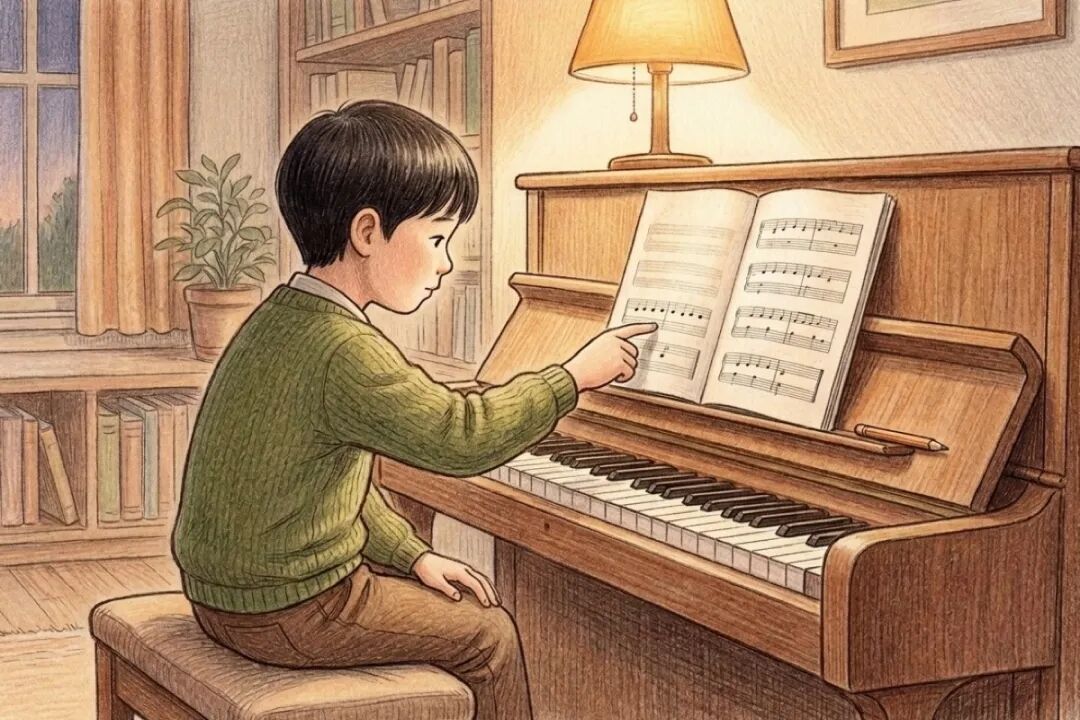
▲ Before the fingers play, let the eyes and ears follow the melody first (AI-generated illustration)
METHOD 01
Before Your Fingers Touch the Keys, Sing a Little from the Score
Many children sit on the piano bench, spread all ten fingers over the keyboard, and start pressing keys as soon as their eyes reach the first note. Their brains must read the staff, locate the keys, and work out the fingering all at once. There is little attention left for listening to the rhythm and melody.
“Try singing the melody directly from the score without an instrument; your musical ear will grow sharper… Spending all your time on mechanical finger exercises is like competing every day to recite the alphabet faster.”
— Adapted from two passages in Robert Schumann’s Advice to Young Musicians
People who know how to practice leave the keys alone for the first half-minute after opening a new score. They check the key signature and time signature, point along the score, and quietly hum the melody of a line, or tap the beat on their knees. When you can sing a phrase smoothly, your fingers have a clearer idea of what to do.
🎯 Practice Action 01:
For the first 30 seconds with a new score, leave the keys alone. Help your child point to the notes and hum the melody, hearing it internally before playing.
METHOD 02
Instead of Starting at Measure 1, Circle the Two Most Awkward Measures First
A familiar scene in supervised practice is a child who always starts with the first note of measure 1. The opening becomes smoother and smoother, but the wide leap in measure 12 still brings everything to a halt. Once stuck, the child returns to measure 1 and starts again.
Count the repetitions and the problem becomes clear. After “playing it ten times” in an evening, the child has carefully covered measures 1 through 11 ten times. The leap in measure 12 may have received only one or two focused attempts.
The Hallam team’s separate category of immediate error correction points to the same principle: stop where the mistake happens, isolate the few troublesome notes, and practice them on their own instead of going back to the beginning for another run.
🎯 Practice Action 02:
Sit down with a pencil and ask, “Which two measures in this piece feel most awkward?” Circle them and start there. Once they feel comfortable, add one measure before and one after to make the joins secure.
METHOD 03
When the Hands Keep Clashing, Practice the Left Hand Until It Can Find Its Way Without Looking
“Each hand is fine on its own, but everything falls apart when I put them together.” Teachers hear this complaint frequently, both in exam preparation and in regular lessons.
Often, the child simply cannot divide their attention far enough. The changing right-hand melody already occupies their eyes and mind. If they also have to decipher the left-hand accompaniment or bass notes and search for each key as they go, one hand inevitably loses out.
Before putting the hands together, effective practicers give the left hand some extra attention. They take those few measures and play them slowly, repeatedly, until the hand can find its positions reliably with very little need to watch it. Only then do they add the right hand. Once the left hand provides a steady foundation, the child’s eyes and ears are free to attend to the right-hand melody.
🎯 Practice Action 03:
If the hands will not work together, pause the right hand. Have your child practice the left-hand accompaniment alone until they can play it accurately and steadily while looking at the score rather than the keyboard. Then put the hands together again.
METHOD 04
Slow Down Until Every Note Is Right, Then Play It Correctly 3 Times Before Speeding Up
When children reach a difficult passage, impatience often makes their hands move faster. They want to charge through it in one go. Five attempts later, they have missed the same note all five times.
Your fingers do not decide which movements are worth remembering. Play the same wrong note five times, and you have rehearsed that mistaken movement five times. Effective practicers respond to a stumbling point by easing off the accelerator. They slow down enough to think of the next note and fingering before each key is pressed.
🎯 Practice Action 04:
Set one simple rule: better to play at a snail’s pace than to rush through a repetition with wrong notes. At that slow pace, play the passage correctly 3 times in a row, then raise the tempo by one small step.
METHOD 05
Let a Practice Tool Follow the Score and Catch Wrong Notes, Without Parents Calling Out “Stop”
The first four habits sound straightforward. In the living room every evening, however, a parent’s patience is often the real test. Ask a seven- or eight-year-old to stay with two measures, slowly practicing one hand at a time, and they may quickly become restless. But if a parent sits beside them and calls out “Stop! Wrong note! Again!” at every mistake, it may take fewer than three interruptions for the child’s tears and the parent’s frustration to rise together.
This is one of the burdens we wanted Wonder Piano to help families with: put a professional teacher’s approach to breaking down a score and practicing slowly into the system, and let the tool deliver the “Stop, that note needs correcting” prompt.
In the China-market practice experience described here as of November 11, 2026, a child sits at a real piano at home while the app listens. Adventure mode divides a piece into major levels based on musical phrases, then divides each major level into smaller segments and sub-levels. The child practices the right hand, then the left hand, and finally both hands together. “Circle two measures” and “make the left hand steady first” become ready-made practice steps. When a note is played incorrectly, the display stops at that note, giving the child time to look at the score and play it correctly before continuing.
Completing the target number of repetitions or earning a perfect score in a sub-level lights up Magic Stars on the screen. Completing a major phrase level also brings Magic Stones ranked S, SS, or SSS. The idea is that, instead of needing an adult beside them to scrutinize the score, children will stay with those few measures for extra practice because they want to light up the missing star.
METHOD 06
Spend the Last 3 Minutes Playing a Whole Piano Piece, Rather Than Picking at Wrong Notes, Before Closing the Lid
In many homes, practice ends on a sour note. A difficult passage has left the child exhausted, the parent checks the clock and says, “That’s enough. We’ll try again tomorrow,” and the child leaps off the bench as if escaping. When sessions repeatedly end this way, frustration can become the first thing a child associates with the piano.
Piano teachers who plan practice thoughtfully often remind parents to save the last 3 minutes. Stop picking apart the few new measures learned that evening. Let the child choose a piece they mastered last week, or a favorite, and enjoy playing it all the way through.
In the same China-market version of Wonder Piano, these final minutes can be spent in Challenge mode. Unlike Adventure, it does not interrupt the performance over small mistakes; the system follows the child’s playing throughout. Afterward, do not rush to check the score. Open the recording playback and let the child pick the phrase they liked best, then look at pitch accuracy, rhythm, tempo, and completeness on the results page.
When children close the piano lid with their own “best-sounding phrase” in mind, what they carry to bed is the feeling that the piano can respond to them.
📋 Save This Checklist · 6 Steps for Tonight’s Practice
1. Sing before playing: Leave the keys alone for the first 30 seconds with a new score. Hum the melody and check the time signature.
2. Circle two measures first: Instead of starting at measure 1, identify the two most awkward measures and practice them separately.
3. Make the left hand steady first: When the hands clash, practice the left hand alone until it can move reliably without watching the keyboard.
4. Play slowly and correctly 3 times in a row: Slow down to a snail’s pace. After 3 consecutive correct repetitions, increase the tempo by one small step.
5. Use a tool to catch wrong notes: Use Adventure to break the music into small sections and pause at wrong notes, reducing the need for parental reminders.
6. Finish with a 3-minute play-through: Use Challenge to play a familiar piece from beginning to end. Listen back, choose the best-sounding phrase, and finish there.
Knowing how to practice has never been a contest to see who can endure the longest on the piano bench. When you sit down with your child tonight, try just one or two of these habits and listen for the difference.
Wonder Piano provides AI-assisted support for piano practice at home. Here, we write about practice methods and the difficulties families encounter when putting those methods into everyday use.
#Piano #BeginnerPiano #ChildrenLearningPiano #PianoPracticeSupport #PianoFamilies