Your child has spent two weeks practicing a fast piece, yet the playing keeps getting slower and their wrists keep getting more sore.
Sitting beside them during practice, you hate to see them struggle, but you hesitate to suggest stopping. After all, isn’t working through a difficult piece simply a matter of practicing more?
A Japanese researcher who studies piano performance used instruments to measure pianists’ hand movements. His finding was somewhat unexpected: those who played quickly and with ease actually used less muscular effort to move their fingers.
Pianists Use Their Fingers More Efficiently
The researcher is Shinichi Furuya, who has long studied pianists’ movements. In 2011, he and his colleagues recruited five professional pianists and five amateur piano players. They asked them to alternate rapidly between two keys using the thumb and little finger, then measured hand and arm movements as well as muscle activity.
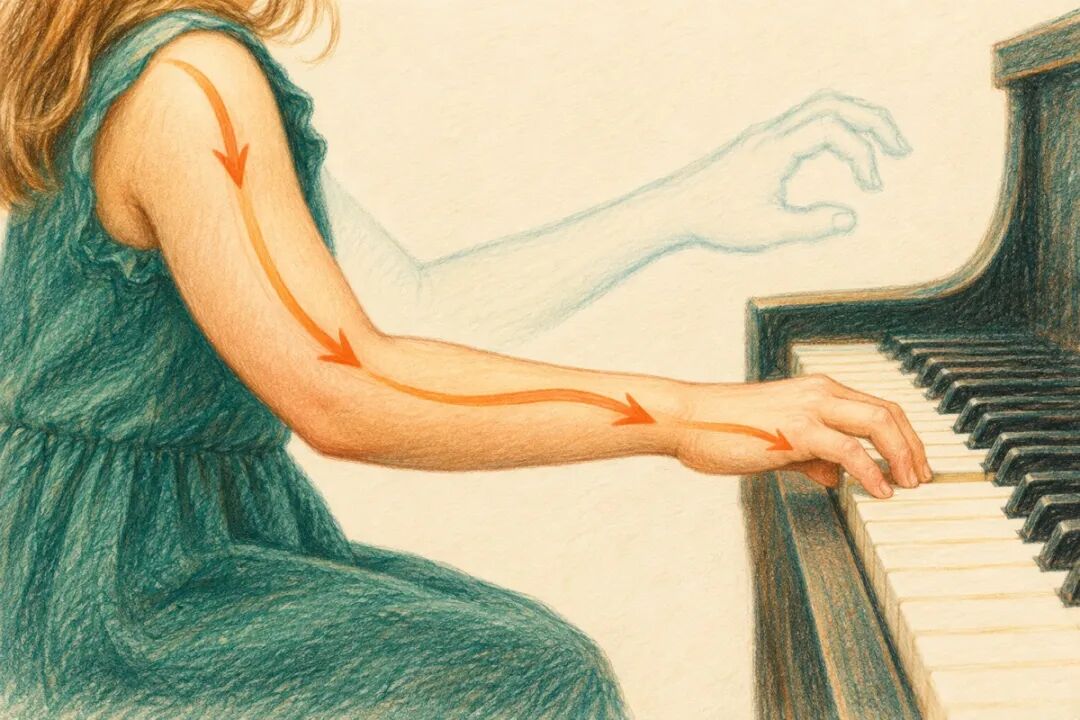
The professionals moved their fingers less and showed less activity in the forearm muscles that control the fingers. They relied more on rotating the forearm back and forth, shifting more of the work to larger joints. As the tempo rose, the amateurs showed a greater increase in muscle co-activation, which stiffens the fingers, than the professionals did. Furuya and colleagues’ 2011 study documents these findings.
The paper also summarizes earlier findings: pianists use movements of the shoulder and elbow to help move the wrist and fingers downward, reducing the effort required of the fingers themselves. Another study cited in the paper found that professionals spent less time continuing to press down after a key had reached the bottom.
If a difficult piece will not come together, insufficient practice may not be the only explanation. The effort may be going to the wrong places.
8 Simple Techniques for Applying Force
The first six reminders below reflect ideas found in these studies; the final two are familiar reminders from piano lessons.
1. Once the key reaches the bottom, release unnecessary effort. By the time the key reaches the bottom, the sound has already been produced. Continuing to push harder only wastes effort. After the finger goes down, promptly relax the extra effort and prepare for the next note.
2. In fast passages, let the forearm rotate. When rapidly alternating between two notes, such as an octave tremolo played with the thumb and little finger, avoid making the fingers do all the work one stroke at a time. Let the forearm rotate back and forth, as if turning a doorknob, with the fingers following the movement.
3. Do not lift unused fingers high. Holding idle fingers high in the air also takes effort. Let them hover lightly above the keys. Staying close to the keyboard makes it easier to reach the next note quickly.
4. Let the arm’s weight fall into the keys rather than pressing down. To produce a full sound, imagine the weight of the whole arm passing through the fingers into the keys. This takes much less effort than forcing the fingers downward on their own.
5. The faster the passage, the more important it is to stay relaxed. In fast passages, a child’s hand can easily tighten as though forming a fist. When increasing the tempo, first check whether the hand has become tense again. If it has, slow down.
6. Let the shoulders and arms support big chords. Trying to sustain loud, full chords through finger effort alone is tiring. Let the shoulders and arms provide support, while the fingers maintain a stable contact with the keys.
7. Let the wrist follow the melody. Avoid fixing the wrist at a single height. As a melodic phrase rises and falls, allow the wrist to move gently up and down with it, helping the effort flow through the movement.
8. After a phrase, relax the hand for a beat. Use rests or gaps between phrases to relax the wrist and fingers. There is no need to move away from the keyboard; prepare again for the next phrase. The aim is to finish the piece without the hands feeling knotted and sore.
You Do Not Need to Grind Away, but You Still Need to Practice
Not grinding away at practice every day does not mean giving up practice.
It means spending that daily practice time learning to use the hands efficiently. With less tension, fast passages can become steadier. When practice does not leave their hands sore, children have more reason to sit down at the piano again the next day.
Difficult passages can also be tackled in smaller sections. In the home-practice setting in China described here, Wonder Piano breaks a piece into short sections, each forming a level. At a real piano at home, a child can begin by slowly working through the hardest four measures with relaxed hands. The app listens to the piano, and when the child plays the level correctly, Wonderstars light up on the screen.
Imagine a day when a child finishes a level, shakes out their hands, and says, “My hands aren’t sore today.”
Difficult pieces become manageable when effort is used well. Brute force can leave you grinding away ever more slowly.
Wonder Piano is an AI practice companion for piano practice at home. Here, we write about practice methods and the difficulties families encounter when putting them into use.