
Keywords: musical expression, misconceptions about piano learning, developing children’s perceptiveness, interest in practice and intrinsic motivation
The original article, published in January 2026, describes a recent remark by Chen Lu Yu that many people had shared repeatedly. It quotes her as saying:
Everything that seems to have no barrier to entry actually has a very high one. That is because it cannot be quantified, has no standard, and can even feel a little like something mystical.

At first, these words seem to be about the humanities, literature, or presenting television programs.
But if you are a parent helping your child learn piano, you may suddenly wonder: why does this sound more and more like a description of piano education?
The More Something Seems Like “Anyone Can Do It,” the Fewer People Truly Do It Well
Let us start with the humanities.
In science and engineering, the barriers are clear: can you do it? Does it work? Is it correct?
The humanities are different.
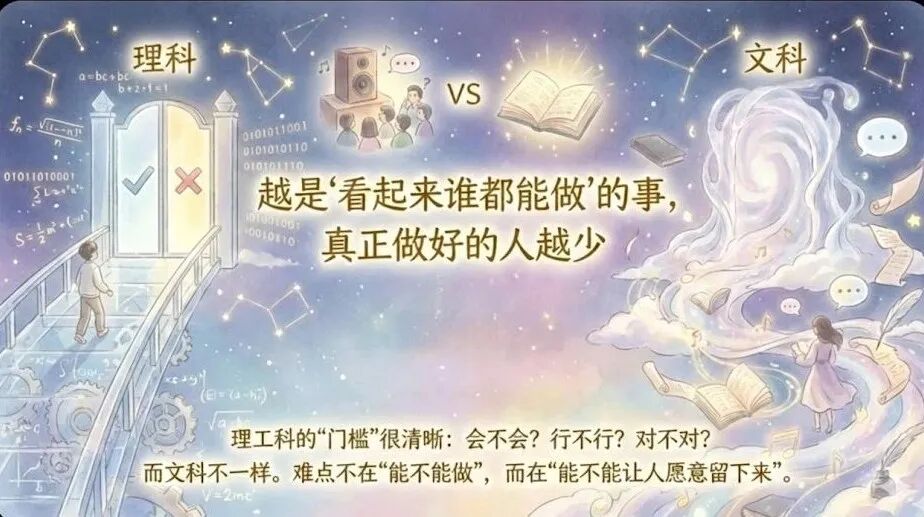
Of course you can speak. But why do some people make you want to listen as soon as they begin, while others lose your attention after three sentences? Of course you can write. But why do you want to reread some people’s words, while you close the page after just one sentence from someone else?
The difficulty is not whether you can do it, but whether you can make people want to stay.
And that is precisely the ability that is hardest to quantify and hardest to develop quickly.
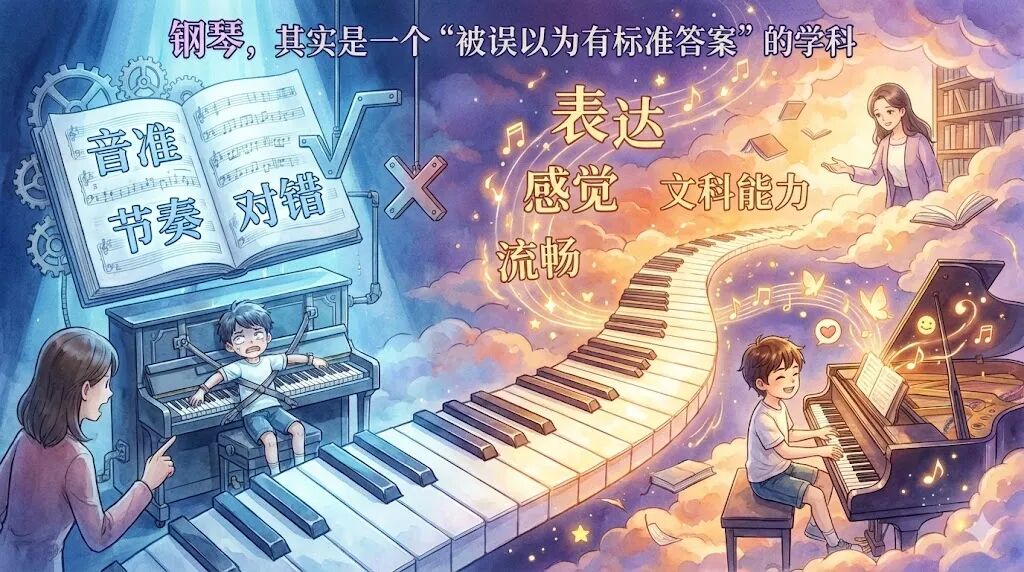
Piano Is Actually a Subject Mistakenly Thought to Have “Standard Answers”
When parents first start helping their children learn piano, many have a simple thought:
“Isn’t it just about playing the score correctly?” “If the notes and rhythm are right, isn’t that enough?”
But at a certain stage, you find that the questions become less clear-cut:
- All the notes are right, so why does it still sound as though there is “no feeling”?
- The rhythm is correct, so why does the teacher keep saying it “doesn’t flow”?
- The child practices every day, so why does more practice make them less willing to play?
Only then do you realize that the truly difficult part of piano has never been “right or wrong,” but expression.
And expression is itself a skill associated with the humanities.
The Fundamental Strengths of the Humanities Are Actually Three “Invisible Abilities”
If we had to sum them up, the fundamental strengths of the humanities could be described in roughly three points.
The first is perceptiveness.
Can you hear subtle changes? Can you notice shifts in emotion? Can you distinguish between “close enough” and “just right”?
Piano is the same.
With the same note, a small change in dynamics can convey a completely different emotion. With the same melody, different phrasing and breathing immediately change how it sounds.
There is no formula for these things; they depend on perception.
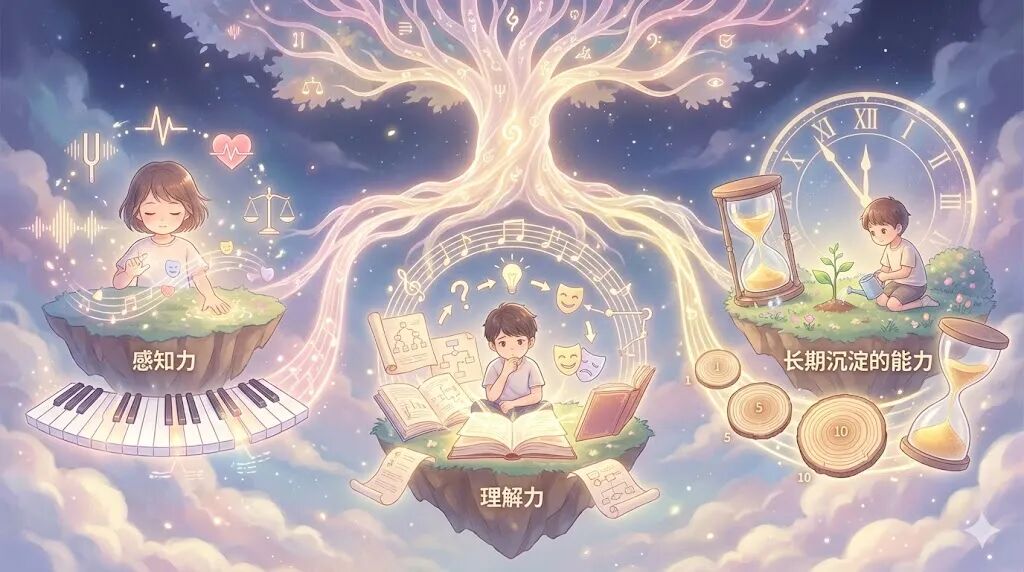
The second is understanding.
This is not about memorizing information, but understanding the logic and emotion behind it. Why was a piece written this way? Why should this phrase be a little slower? Why is this passage not about “playing harder”?
A child who practices mechanically can easily become bored. Once they understand “what the music is saying,” they begin to engage.
The third is the ability to build depth over time.
What makes the humanities particularly challenging to our desire for quick results is that they offer almost no instant rewards. Expression, aesthetic judgment, and musical feeling grow gradually.
This is also why many people underestimate both the humanities and piano.
Why Do Children Today Need a Humanities Approach to Music Education More Than Ever?
In an age that places great emphasis on efficiency and results, sensitivity and patience are precisely what children can most easily lose. If piano becomes nothing more than a “task,” it really can become a burden.
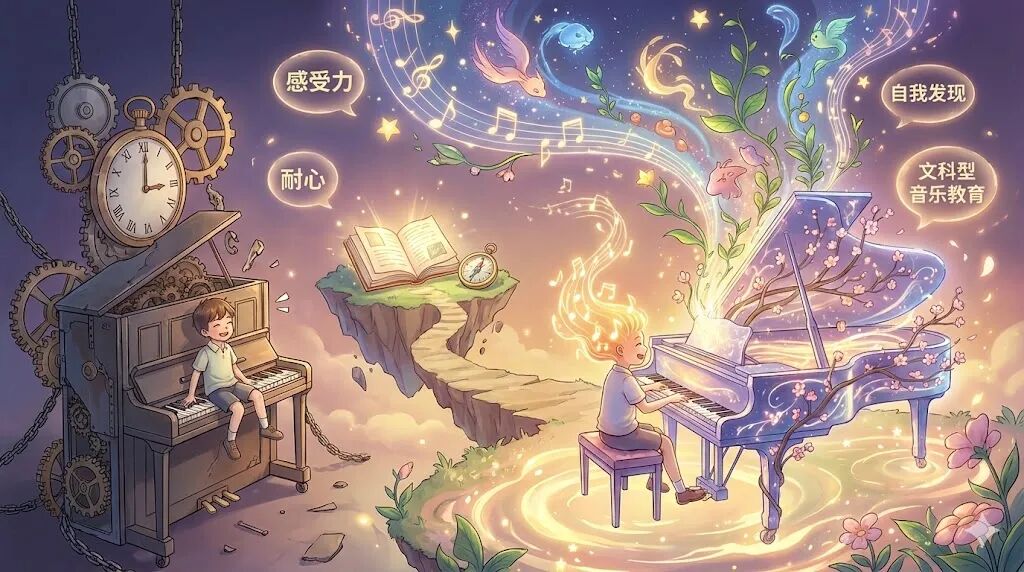
Good piano learning should mean that a child wants to open the piano, can feel their progress, and knows what they played well and where they could try again.
It should not mean being hurried, corrected, and compared with others every day.
That is why more and more parents are beginning to reflect: have we started treating music like “science and engineering” too early?
When Piano Practice Starts to Resemble the Humanities, Children Can Go Further
The original article describes a change some parents noticed later:
When they stopped focusing on “how many times the child played today” and paid attention instead to “what the child understood and felt,” practice became easier.

Some children would repeat a short passage on their own. Others would volunteer, “I want to play this part again.” Some began to respond emotionally to music and form their own judgments about it.
Only then do you realize that what piano truly develops is not just technique, but a person’s ability to express themselves.
Good Tools Should Help Children Cross the “Invisible Barrier”
The difficulty of the humanities is that there are no standard answers. The difficulty of piano, too, is that “the feeling is hard to put into words.”
At this point, a good supporting tool should make vague feedback gentle and clear; guide children to discover things for themselves rather than interrupt them; and make practice feel more like exploration than completing a task.
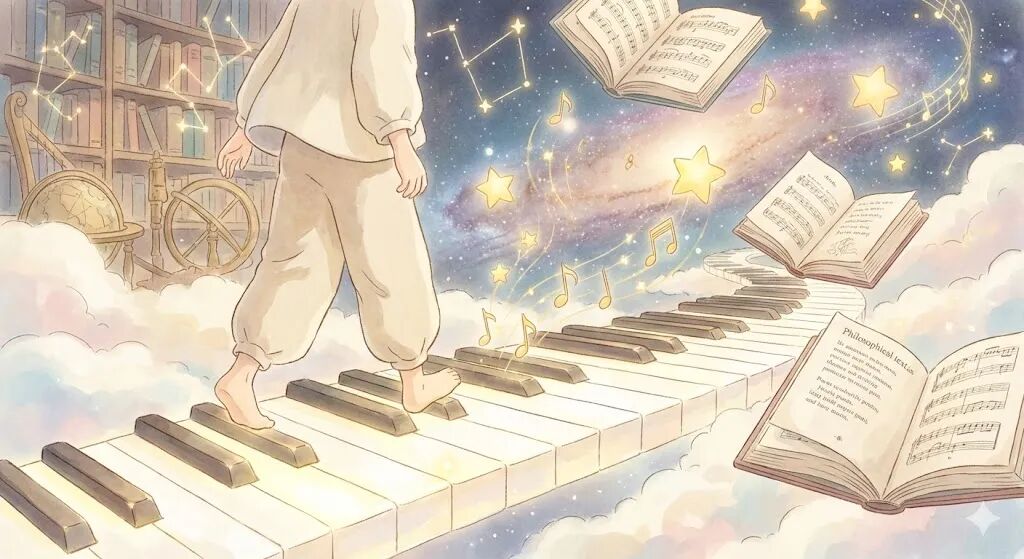
The original article presents AI-assisted, gamified practice tools such as Wonder Piano as a way to help children cross that “invisible barrier”: the aim is for children to build perceptiveness through repeated attempts, rather than feel repeatedly put down.
When a child becomes willing to listen, make adjustments, and try again, music truly begins to happen.

The humanities do have barriers to entry, and piano is not something everyone can simply do.
Their difficulty has never been that they are impossible to learn.
It is whether you are willing to take your time reaching that invisible yet deeply important place.
Q & A
Q: Why do children struggle to keep learning piano?
Many children struggle to continue not because they dislike music, but because their interest has been worn down over time by “right and wrong” and a sense of obligation. When practice becomes nothing more than meeting targets, few people can truly go far.
Q: What is the purpose of learning piano?
Learning piano has never been just about acquiring another talent. It is about helping children learn to listen, feel, and express themselves. The patience, concentration, and aesthetic awareness held within melodies can quietly find their way back into a child’s life much later.
Q: What are the long-term effects of music education on children?
What music education truly leaves behind is not just a few pieces a child can play, but sensitivity to emotion and an inner sense of rhythm. These qualities often reveal their value gradually as children grow up.


Wonder Piano
Magic Pianist | Currently testing a magic potion 🧪