
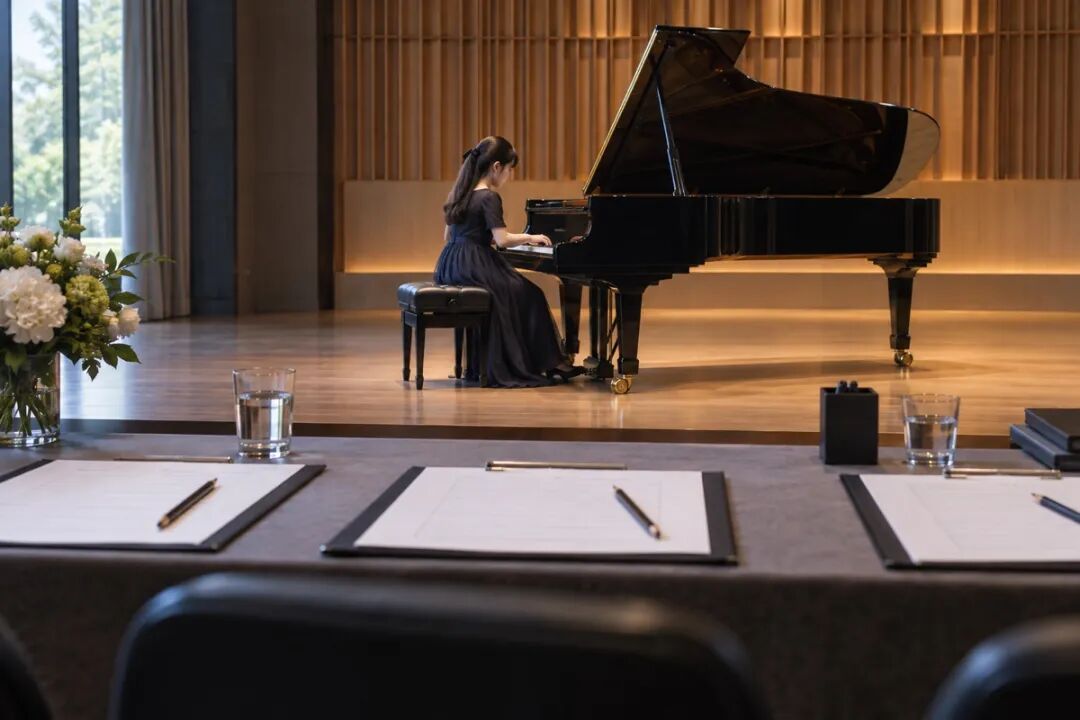
An étude at the level of Czerny Op. 740, a polyphonic work by Bach, an allegro movement from a Classical sonata, and a passage to sight-read as soon as the score is handed over.
The article describes these as the requirements for the piano entrance audition for the senior secondary division of the Affiliated Music School of Zhejiang Conservatory of Music in China in 2018. It also mentions a written music theory test and an oral sight-singing test. None of the listed audition requirements calls for a graded-exam certificate.
Verification note: The school’s official 2018 prospectus does not list piano sight-reading. It specifies an étude at the level of Czerny Op. 740 or Chopin’s études, a Bach polyphonic work, and either an allegro movement from a Classical sonata or a Chinese or other international piece. Its foundational musicianship assessment includes music knowledge, a written aural test, and sight-singing. These are historical requirements, not current admissions guidance. See the official 2018 prospectus.
The point is that examiners want to hear how a child actually plays in the room. The article also emphasizes whether the child can handle an unfamiliar score, although the prospectus does not specify that as a piano audition component. Holding a Grade 10 certificate offers little help in that audition room.
Turn the question around, and it concerns most families: if a child is not pursuing a professional path, should they still take Grade 10? Here, Grade 10 refers to the graded arts examination system in China.
What Graded Exams Were Meant to Do
The Regulations on the Administration of Social Arts Graded Examinations, originally issued by China’s Ministry of Culture and available on the Ministry of Culture and Tourism’s website, define these exams as activities in which authorized examining organizations assess the artistic proficiency of people studying the arts and provide guidance through examinations. In plain terms, they measure where a piano student is now and what still needs work. See the official regulations.
They do not say that an exam is the endpoint of learning piano, or that reaching Grade 10 means a student has finished learning.
Yet in many families, Grade 10 gradually becomes the finish line. A child progresses from Grade 1 to Grade 10, practicing three exam pieces each year from September until the following summer, until they know them inside out. On exam day, the piano lid closes—and for some children, it never opens again.
What Graded Exams Can Offer Children Who Are Not Pursuing a Professional Path
Graded exams are not inherently a bad thing. For children who are not pursuing a professional path, they can serve three useful purposes.
First, they give the year a deadline. Without one, many children let a single piece drag on for three months. Once they have registered and know they must perform in July, their practice for the year has a direction.
Second, they give children a chance to perform. A graded exam requires playing in front of an examiner. For a child who normally plays only at home, it is a rare occasion when they must play all the way through without stopping.
Third, they give the teacher an outside point of reference. A teacher who listens every day can also miss things. When someone else listens, their comments often reveal something neither the family nor the teacher had noticed.
When It Is Time to Pause
It is worth stopping to think if exams have come to mean this: the child plays only three exam pieces all year and touches no other music; they skip grades to accelerate progress and can get through the pieces, but read music very slowly; or when they talk about piano, their first words are “I’ve reached this grade,” rather than “Here’s what I can play.”
At that point, moving up another grade adds very little to what the child has learned.
Three Questions Parents Can Ask First
Before registering for the next exam, ask these three questions.
Besides the exam pieces, how many pieces that the child wanted to play have they learned this year?
After the exam, will they choose to sit down at the piano again?
If we do not take an exam, what will our family use as this year’s goal?
The third question is the hardest. Families who decide against exams often still want a goal; they simply do not know what to replace the exam with. Let the child choose: add a few pieces they want to play to their favorites in Wonder Piano, work through them one by one over the year, and make a mark on the calendar whenever they finish one.
A certificate can tell you how a child played on the day of the exam. Whether they are still playing ten years later depends on something else: whether they have a few pieces they love and can play whenever they sit down.
Wonder Piano provides AI-assisted piano practice for families at home. Here, we write about practice methods and the difficulties families encounter when putting those methods into daily life.