Translation note: Product descriptions retain the original article’s China-market context at the time of publication, rather than promising current Global functionality.
This is Wonder Piano. We develop AI-assisted piano practice tools for families, and we also take a harder question seriously: what should you do when a child does not want to practice, cannot settle into practicing, and you do not know what to say? Here, you will find practice methods, along with the difficulties families can encounter when they actually put those methods into use.
This article is about just one word: finished.
A certain disagreement keeps coming up in many families. A child says, “I can play this piece now.” A parent listens and thinks it really does sound good. Then, at the lesson, the teacher says, “Practice this one for another two weeks.”
On the way home, the parent wonders: it sounded fine, so why does it need another two weeks?
It is not that the teacher is strict or the parent’s standards are low. The two sides simply do not mean the same thing by “finished.”
At home, the test for whether a piece is finished is this: the child can play it from beginning to end without any obvious wrong notes.
That is a reasonable test, because it is something a family can listen for. Following the score, a parent can get a general sense of whether the notes are right.
It is a single threshold: cross it, and the piece is finished.
In a lesson, the teacher listens for several layers, with correct notes only the bottom one. Above that come other questions: is the tempo steady? Can the child play continuously without going back and starting passages again? Can you hear which hand carries the leading part? Do the phrases have shape?
These are not separate suggestions of equal priority. Each layer rests on the one below it. When the tempo is still wandering, trying to add expression to a phrase usually does not work.
So what a child calls “finished” at home is often only the bottom layer in the teacher’s eyes. Parents cannot hear the layers in between, and children do not even know they are there.
Why Those Middle Layers Are Hard to Hear at Home
Because the higher the layer, the more it takes a trained ear.
A steady tempo is not simply a matter of “getting the beats right.” It means keeping the pace even. Many children speed up in familiar passages and unconsciously slow down in difficult ones to give themselves more time, then speed up again once they are past them. The overall performance sounds fairly smooth because the notes are all correct.
To hear which hand carries the leading part, you have to focus on one hand while both are sounding, and judge whether the left hand is overpowering the melody in the right.
Neither of these is a matter of patience. Both require training. It is entirely normal for parents not to have that training, and they should not be expected to have it.
That is how the familiar scene arises: at home, the piece seems finished; at the lesson, it needs another two weeks. Each side finds the other’s reaction puzzling.
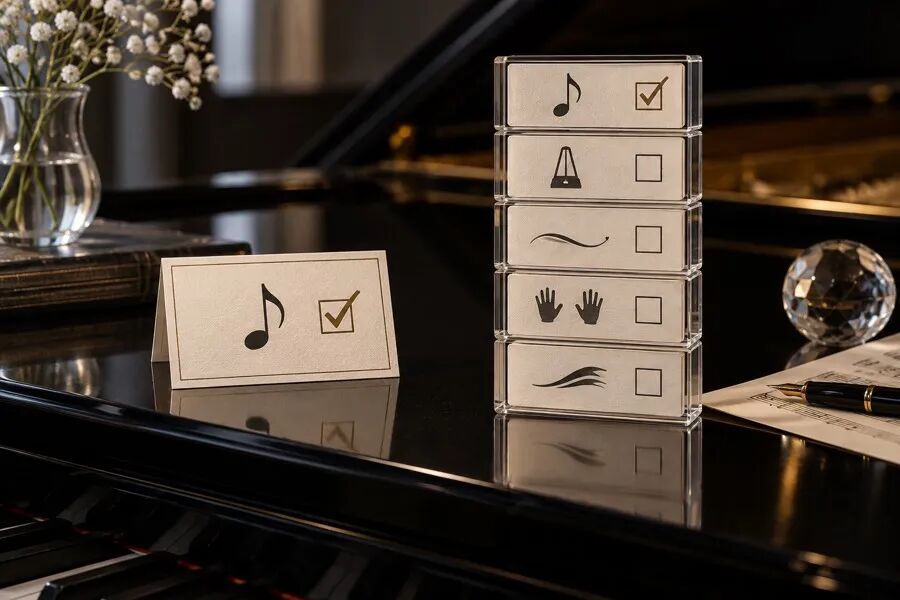
There is a more practical step: thoroughly check the things that can be heard at home.
The bottom two layers—correct notes and a steady tempo—can be hard for parents to distinguish, but they have concrete standards and can be checked at home. If these two layers are secure before the lesson, lesson time can go toward the later layers instead of more wrong-note correction.
Conversely, if those first two layers are still shaky before every lesson, the entire lesson can easily go toward correcting notes and counting beats. The later layers never get their turn.
That is often where “another two weeks” comes from. It is not that the child lacks ability. It is that every lesson still begins with problems at the bottom layer.
What Can You Listen for at Home?
Here are two checks that require no professional skills and can be tried tonight.
Ask your child to play the piece again at half the tempo. If playing slowly actually makes it messier and more prone to mistakes, that suggests the original run-through relied on the fingers’ automatic momentum, and the tempo layer is not yet secure. A child whose playing is truly secure will be even steadier at a slower tempo.
Then ask them to play it correctly twice in a row. One successful run could be luck; two count as a sign of stability.

If you want a more detailed check of that bottom layer—whether the problem is a wrong note, a missed note, or a rhythm that rushes ahead of the beat—you can have your child play those two measures in Wonder Piano and look at the note and rhythm feedback from that run. That turns “something sounds a little off” into a specific measure to work on.
Leave the higher layers to the teacher. Those are the parts more worth spending lesson time on.
The next time your child says, “I can play this piece now,” hold off on a verdict. Ask them to play it at half the tempo and see what happens.
Has your family ever thought a piece sounded good at home, only to be told at the lesson that it needed more practice? Feel free to share in the comments.
Source: Original Chinese article on WeChat.