
This is Wonder Piano. We make an AI practice companion for piano practice at home, and we also take a harder question seriously: what should families do when a child does not want to practice, cannot settle into practice, and their parents do not know what to say? Here, you will find practice methods, along with the difficulties families can encounter when putting those methods into everyday use.
Today, we want to discuss a question that many families face but rarely address on its own: When is it really decided that a child will eventually stop learning piano?
Most parents answer, “Things got too busy later on,” or “There was no time once middle school started.” Yet when we look back at families whose children kept going, they were just as busy. Our view is that the difference often begins much earlier than people expect—usually in the first two years of learning piano, when children are still at a very early stage.
What takes shape in those two years is not their playing level, but something else: whether they have experienced completing a practice session themselves.
There Are Two Ways a Practice Session Can End
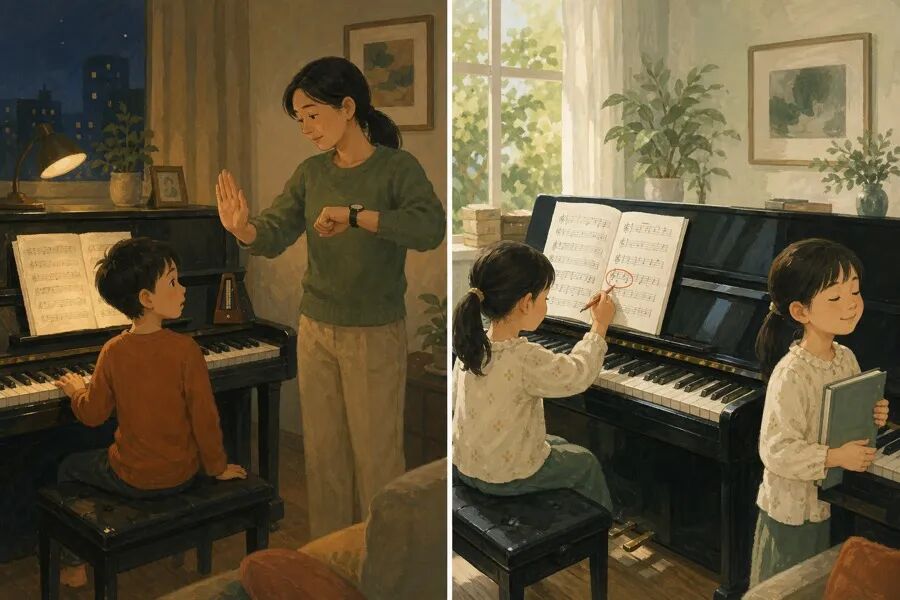
In the first, a child sits down to play while a parent waits nearby. At some point, the parent says, “That’s enough. Go take a bath.” Someone else calls an end to the practice session.
In the second, the child knows which passage to work on before sitting down. Once they can play that passage smoothly from start to finish, they close the score themselves and say, “Done.” The practice session ends because the task is complete.
On that particular day, the two may seem much the same. The first session may even last longer.
But what they leave in a child’s mind is entirely different.
When the first pattern happens repeatedly, the child learns that practice is a stretch of time to endure, and someone else decides how long it lasts. If someone else sets the duration, daily bargaining makes sense: “Can I just play for five more minutes?” “Can I practice a little less today?” Those conversations are probably familiar.
When the second pattern happens repeatedly, the child learns that practice is a task with an endpoint. The work itself defines that endpoint: once I have done it, I am finished.
When schoolwork gets heavier in third or fourth grade, the first child faces “another stretch of time to get through,” while the second faces “one small thing I haven’t finished yet.” The former is easy to drop from the day; the latter is harder to leave undone.
The Step That Most Easily Goes Wrong in the First Two Years
One of the most common things parents do in the first two years—and one of the easiest to get wrong—is to set the requirement as “play the whole piece once.”
The reason is easy to understand: a complete play-through is the only standard those parents know how to judge by listening. Once they have heard the whole piece, they feel that the day’s practice has been done properly.
But for a child who has been learning for only a year or two, playing the whole piece once is almost never entirely satisfactory. There is always a stumble somewhere, so they try again. On the next attempt, they stumble somewhere else. This kind of practice has no endpoint: it can only stop when time runs out, rather than when the task is complete.
A better approach is to make the day’s goal small enough for the child to actually finish: the right-hand part of four particular measures, a particular fingering change, or the left-hand rhythm in one phrase. Once they have done it, stop—even if it took only twelve minutes.
Parents may worry: isn’t that too little practice?
For a single day, it is indeed less. But the goal is not to squeeze in ten extra minutes today. It is to let the child accumulate hundreds of experiences of “I finished it” over those two years. In our view, those hundreds of experiences determine what piano practice means to them from third grade onward.
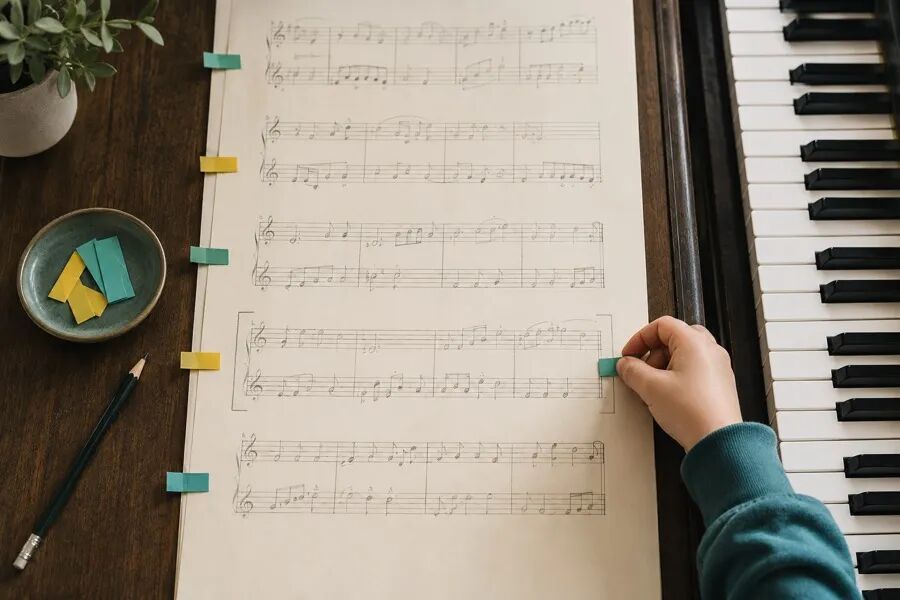
If you are unsure how small to make a passage, the original China-region article suggests using Wonder Piano’s sectional practice to turn a piece into a small task of just a few measures. The idea is that, after finishing, the child can immediately hear how the passage sounds different from before and wants to tap the next section. Practice then has an endpoint they can reach for themselves.
A Signal You Can Check Tonight
You do not need to wait years to find out whether you are heading in the right direction. You can check tonight:
Did your child end this practice session themselves, or did you tell them to stop?
If you have called time several days in a row, that does not mean something is wrong with your child. It usually just means that the day’s goal was too big—so big that it had no reachable endpoint. Make it a little smaller, and give your child a chance to say, “Done.”
The last time your child finished practicing, did they close the score themselves, or were they told to stop? You are welcome to share your family’s experience in the comments on the original article.