A child plays a wrong note in the exam room and freezes. As soon as they come out, they burst into tears: “I definitely failed.”
Many parents of young piano students have seen a scene like this. But does one wrong note really mean failing?
Many people think piano exam marking starts with a perfect score, with one mark deducted for every wrong note. The Associated Board of the Royal Schools of Music (ABRSM, often known in China as “Yinghuang”) publishes its marking criteria in its exam syllabus. Its approach is different from what many people imagine.
ABRSM Piano Practical Grades are marked out of 150: 100 for a Pass, 120 for a Merit, and 130 for a Distinction. Each of the three pieces is worth 30 marks, making 90 altogether—the largest share of the total.
The syllabus makes the approach clear: examiners start at the pass mark and adjust upward or downward, rather than deducting from a perfect score. Not every aspect has to be flawless; strengths in one area can balance weaknesses in another.
Examiners listen to each piece across five areas: pitch, time, tone, shape, and performance. For parents, three deserve particular attention. These are the criteria for Practical Grades, as set out in the ABRSM Piano Practical Grades syllabus for 2025 and 2026.
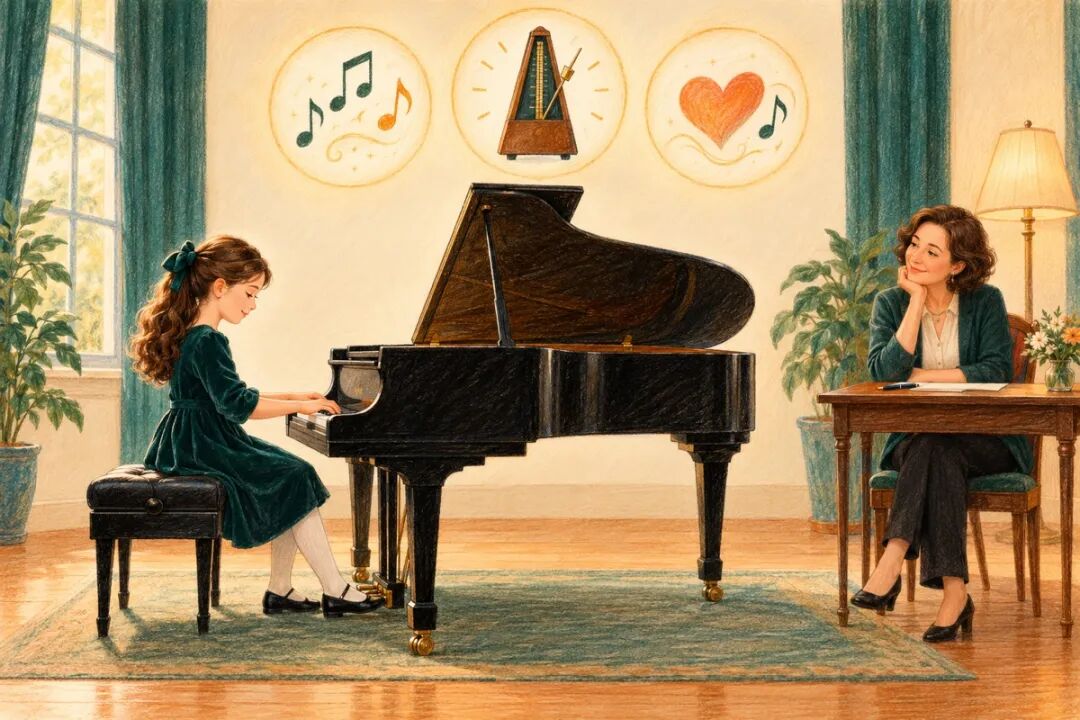
The detailed rules vary among exam boards in China, but the qualities examiners listen for are broadly similar.
Scoring Point 1: Are the Notes Correct?
A piano’s pitches are set by its tuner. For pianists, then, “pitch accuracy” is about whether the right notes are played clearly and reliably.
In ABRSM’s marking criteria, a Pass calls for notes to be generally correct; a Distinction calls for a high degree of accuracy.
Pay attention to “generally.” One or two wrong notes do not automatically mean a fail.
How to work on it: When preparing for an exam, do more than play through the whole piece. Circle the notes that go wrong repeatedly, practice them separately until they are consistently correct, and then put them back into the piece.
Scoring Point 2: Steady Rhythm Matters More Than Speed
For time, examiners listen for three things: an appropriate tempo, a steady pulse, and accurate rhythm.
The Pass criteria describe an appropriate speed and a pulse that is steady overall. The first point under Time in the Below Pass band concerns an inappropriate or uncontrolled tempo.
Many children start speeding up as soon as they enter the exam room. Their hands race ahead of their thoughts, leading straight into this problem.
How to work on it: During the week before the exam, practice a little more slowly than usual until every beat is steady. In the exam, it is better to be a little slower than to rush.
Scoring Point 3: Can You Carry On After a Mistake?
The expressive side of playing appears under two headings in the marking criteria: musical phrasing and shaping (Shape), and overall performance (Performance).
The Performance column is particularly useful for parents. At Pass level, it describes a generally dependable performance with quick recovery after mistakes; Below Pass, it describes uncertainty and difficulty recovering.
In other words, a wrong note need not be a disaster. Stopping and starting again from the beginning is where marks can be lost.
For a Distinction, examiners listen for full engagement and a vivid sense of the piece’s character and style. Correct notes and a steady beat are not enough: listeners also need to hear what the music is saying.
How to work on it: Practice carrying on after mistakes at home. Play the piece from beginning to end and keep going, whatever goes wrong. Do the same when playing for family members.
Before the Exam, Play Once for an “Examiner”
For those few minutes in the exam room, children face the examiner on their own. At home, however, they rarely get the chance to play a complete, uninterrupted performance as they would in an exam, then see which areas need work.
In China, Wonder Piano’s Challenge mode was presented on October 27, 2026 as a way to hold a “mock exam” at home. Children play through a piece on their real piano, then see feedback on note accuracy, rhythm, tempo, and completeness. The results page shows which notes were wrong and which passages were rushed, and the performance can be replayed.
In the author’s example, a child plays one Challenge run each day during the week before an exam: on day one, the results page flags several problems; by day five, only one remains. In the example, the child says, “This time, I made a mistake but didn’t stop.”
A graded exam is not a hunt for mistakes. The examiner is looking for what you can do.
Wonder Piano provides AI-assisted piano practice for the home. Here, we write about practice methods and the difficulties families encounter when putting them into use.