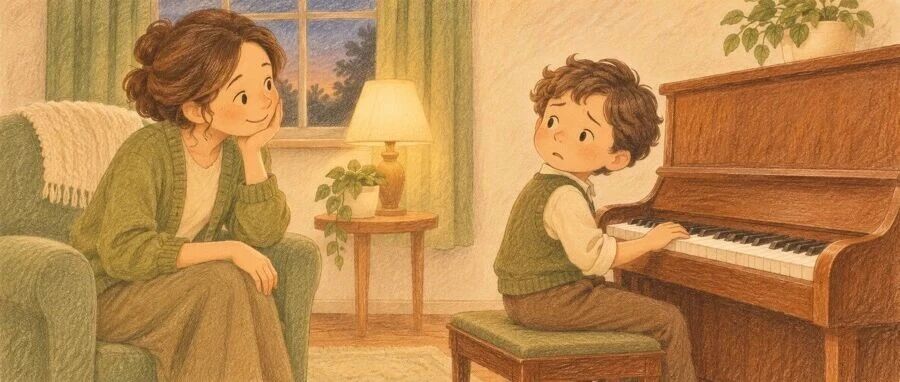
Pianists play wrong notes on stage, too. Yet when children play a wrong note at home, they often hear, “Wrong again?”
In recent years, videos of pianists making mistakes in live performances have circulated widely online. Many parents watch them and forward them to their children: “Look, even the masters make mistakes.”
But the next time their child makes a mistake, what the parent says at home often stays exactly the same.
01 Even the Masters Make Mistakes on Stage
Portuguese pianist Maria João Pires once joined an orchestra to play Mozart at an open rehearsal. Only when the orchestra began did she realize she had prepared a different concerto. The conductor quietly encouraged her while continuing to conduct. When it was time for the piano to enter, she drew on her memory and played the intended concerto through to the end.
When people later praised this as a miracle, she said:
“It’s a bit unrealistic when people think this is something extraordinary.”
Pires described the occasion as a public rehearsal in her interview with Classic FM.
Go back further, to May 9, 1965: Vladimir Horowitz returned to Carnegie Hall after twelve years away from public performance. In the very first piece, he played several wrong notes. The original record patched those mistakes with rehearsal recordings; in 2003, the record company released an unedited version, restoring the wrong notes as they had sounded. Sony Classical’s announcement confirms the return date and the release of the unedited recording.
The difference between a master and a child is not whether they make mistakes, but what they do next.
02 Children Watch the Adults’ Faces
So where do children learn what to do after making a mistake?
In 2016, Stanford psychologists Kyla Haimovitz and Carol Dweck published a series of studies in Psychological Science. They found that children were largely unaware of their parents’ beliefs about whether intelligence is fixed, but could accurately perceive how their parents viewed failure. The study links parents’ views of failure with their children’s beliefs about intelligence.
Parents who viewed failure as harmful were more likely to focus on performance and ability when their children made mistakes. Their children, in turn, were more likely to think, “If I get it wrong, it means I’m not capable.”
Beside the piano bench, the point is simple: what a child remembers is not an adult saying, “Don’t be afraid of mistakes,” but the look on that adult’s face at the moment they play a wrong note.
03 Thoughtful Parents Change What They Say
After watching a master’s video, thoughtful parents change their own words rather than trying to change their child.
Replace “Wrong again?” with “What happened just there?” Be curious, without passing judgment. Children can think back for themselves: did their fingers fail to keep up, or did they misread the score? A wrong note becomes a clue rather than an accusation.
Replace “The adult points it out immediately” with “Let the child find it.” Consider this home-practice example from the Chinese product context described in November 2026: a child opens Wonder Piano’s Adventure mode and plays on the family’s real piano while the app listens. If they play a wrong note, progress on the screen pauses there until they play it correctly. The adult does not need to say anything. When they get it right, a Magic Star lights up, and they turn around and say, “I found that note myself.”
Replace “The adult just watches” with “The adult lets the child see them make mistakes, too.” Ask your child to teach you a very simple piece. You are bound to make mistakes. Your child will get to see an adult play a wrong note, smile, and try again.
04 Talking About Mistakes at Different Ages
Here is an age-by-age guide to keep handy and revisit as your child grows.
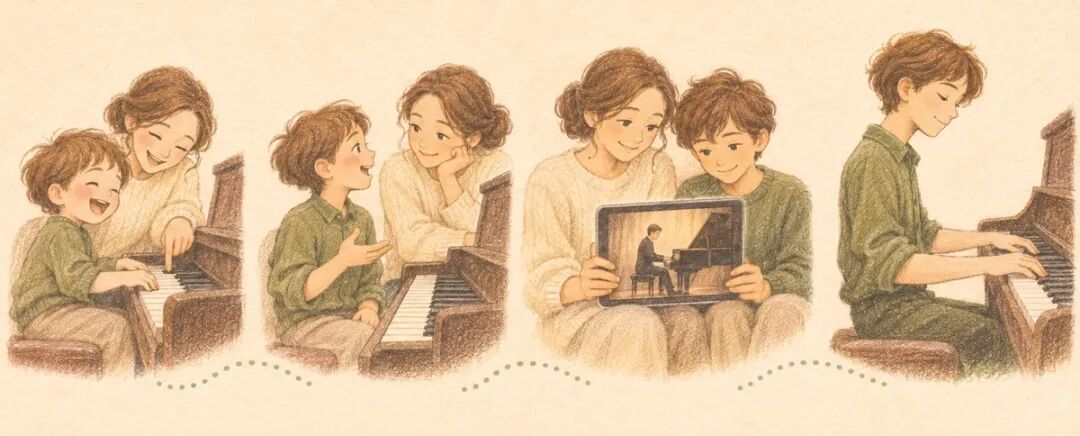
Ages 4–6: Make wrong notes into a game. Deliberately play a wrong note and let your child “catch” it. Once they do, switch roles: they play a wrong note for you to catch. Make mistakes fun before focusing on correcting them.
Ages 7–9: Ask why it happened, rather than whether it was right or wrong. When your child plays a wrong note, ask, “What happened just there?” Let them explain the reason themselves.
Ages 10–12: Watch the masters make mistakes together. Watch live performance videos with your child and discuss how the pianists continued after making mistakes. This lesson is especially useful before a child’s first performance on stage.
Middle-school years: Let the child make the judgment. Let them decide where to stop and correct a mistake, and where to keep playing through to the end. Listen and help when they need you.
Let children make mistakes. Let home be a place where mistakes are nothing to fear.
We will explore each age group in more detail.
#Piano #BeginningPiano #ChildrenLearningPiano #PianoPracticeSupport #PianoFamilies
Wonder Piano provides AI support for piano practice at home. We write about practice methods, as well as the difficulties families encounter when putting those methods into everyday life.