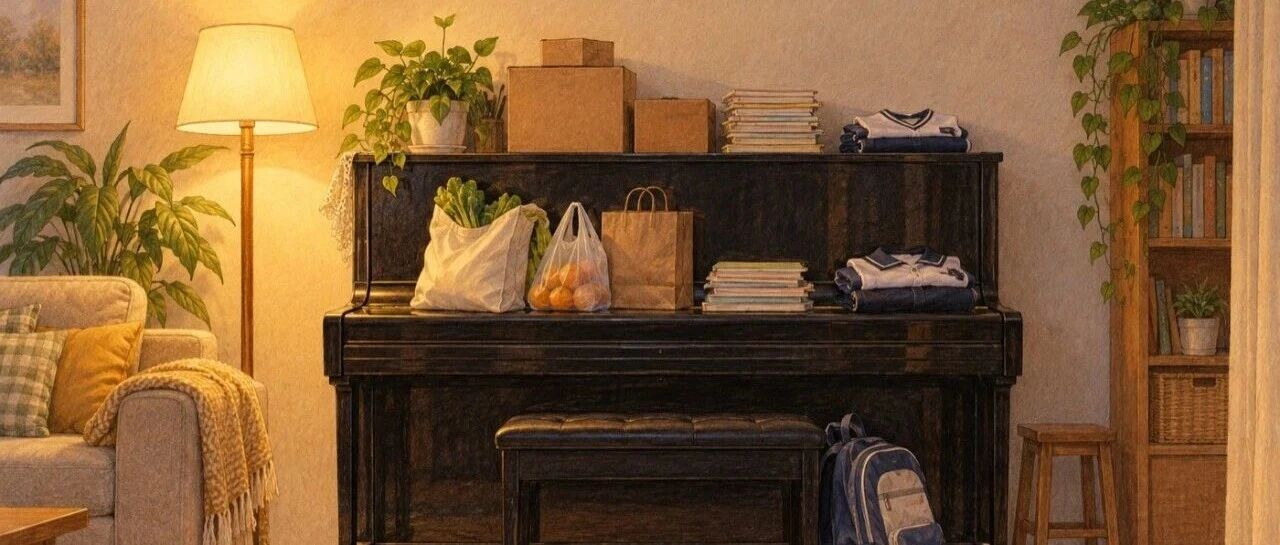
A Yamaha piano bought for more than 40,000 yuan, and a secondhand dealer willing to offer only a little over 10,000 yuan for it.
In July 2026, the Yangtze Evening News reported on Mr. Tang, a resident of Fujian, China. He had bought the piano for his child in 2021. The report described it as “90% new,” or nearly new. “I bought it for my child to practice on. After learning for a few years, he lost interest, and the piano has sat unused ever since,” he said.
In plenty of other homes, the piano has not been sold. Its lid has simply been closed, and parcels, exercise books, and freshly brought-in school uniforms have gradually piled up on top. It has become the most expensive storage rack in the house.
Many parents who sit with their children during piano practice have reached this point. Night after night beside the piano bench, you have argued, coaxed, and softened. Two years later, your child still stumbles through pieces. Looking at that pile of things on the piano lid, you find yourself wondering: Has all this piano learning been for nothing?
Do not rush to a conclusion. One piano teacher also endured a stretch when it seemed that nothing was growing.
Zhou Guangren Spent Half a Year Just Touching the Piano Keys
Zhou Guangren, former head of the Piano Department at China’s Central Conservatory of Music, taught piano for nearly 70 years.
In 1982, she broke her fingers in an accident. Her fingers were saved, but she had to start playing the piano all over again.
Later, recalling that period on CCTV’s interview program Dajia, she said, “When I began practicing again, I wore rubber gloves.” At the time, “just being able to touch the piano a little was already something.”
A pianist who had played for decades could do little more each day than touch the keys.
“After half a year of touching the keys, I had essentially managed to work on one piece: Chopin’s Berceuse.” A year after the accident, she returned to the stage.
During those six months, an observer might have seen no progress. Yet her fingers were gradually getting to know the keys again.
She and her students played the piano in her home for decades. “This piano is my precious treasure. It has been with me all my life,” she said.
The same instrument can become a storage rack in one home and a lifelong companion in another. The difference often lies in the days when progress is hardest to see.
So what is growing during those seemingly invisible days when a child is learning piano?
Ten Years in the Lives of 157 Children
Music education researcher Gary McPherson and his colleagues followed 157 children, aged seven to nine, who were about to begin learning an instrument. Before lessons began, the researchers asked a simple question: How long do you think you will keep learning?
They then recorded the children’s practice time over the first three years and continued following them beyond the ten-year mark.
McPherson and his colleagues found that children who had thought, even before starting lessons, “I will keep learning,” played better and continued for longer. Those who intended to learn only “for a while” did not go as far, even with the same amount of practice.
Another finding directly concerned parents: when adults at home played instruments themselves and regularly played music for the family to hear, children were more likely to see music as something important.
The lesson the author draws is that how far a child goes depends on an inner sense of identity: “I am someone who plays the piano.” That identity does not show up in the number of correct notes played each evening. A parent sitting beside the piano bench cannot see it either.
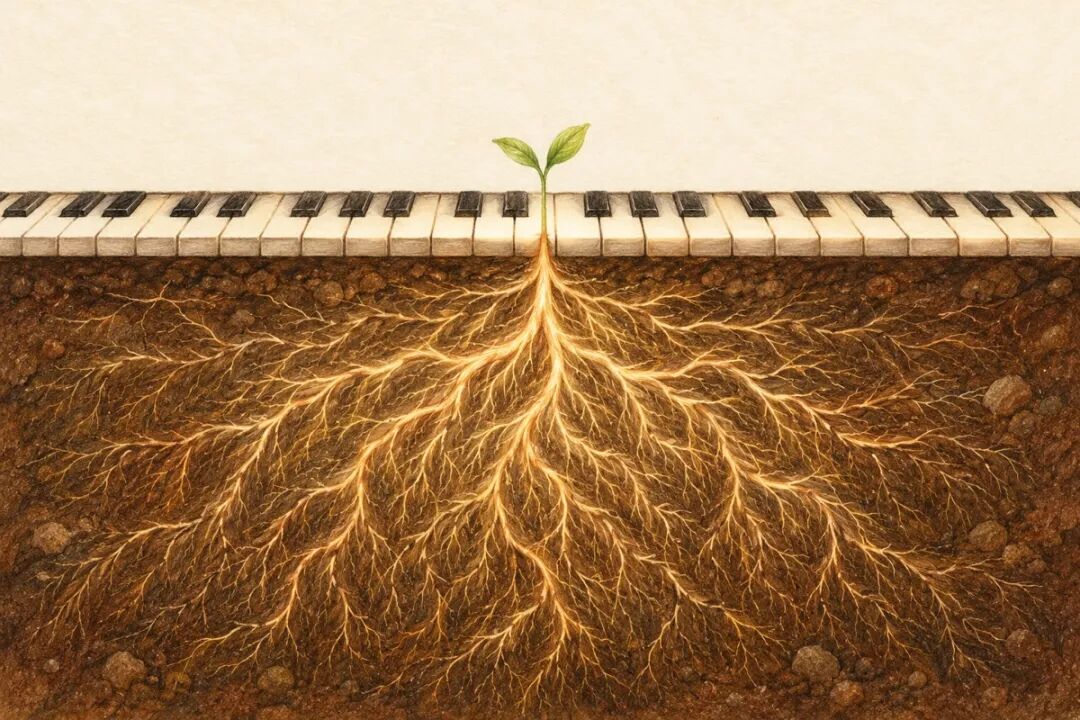
Put Zhou Guangren’s six months alongside this research, and you arrive at the thought in the title: Do not rush. What is truly taking root is often invisible.
Learning Piano Is an Education in Taking Things Slowly
This slow process tests parents most of all.
A child is putting down roots, but neither the parent nor the child can see them. After two years of practice, the child cannot explain how they are better than last year. They remember only being reminded to practice and having mistakes corrected every evening. On nights like these, the thought “I am someone who plays the piano” gradually grows quieter.
Parents can do two things that seem contradictory: ask “How well are you actually playing?” a little less often, while keeping the piano part of everyday family life.
Do not sell the piano just yet. Do not close its lid just yet. Your child’s sense of “I am someone who plays the piano” is still growing.
The roots may be invisible, but you can help your child see a small shoot first.
This is what Wonder Piano aims to do in its home-practice setting for families in China: a piece is divided into short sections, with each section forming a level. Children play on a real piano at home while the app listens to the sound. When they play correctly, Magic Stars light up on the screen. Children can see their own progress without waiting for a parent to point it out.
Imagine tonight: first, move the pile of parcels off the piano lid and prop the iPad on the music stand. The first level is only a few measures long. After two or three attempts, your child clears it, then turns to ask, “Can I try the next level tomorrow?”
In that moment, you will know those two years spent beside your child were not wasted. The roots were there all along. Today, a small shoot has appeared.
Wonder Piano is an AI practice companion for piano practice at home. Here, we write about practice methods and the difficulties families encounter when putting them into everyday use.