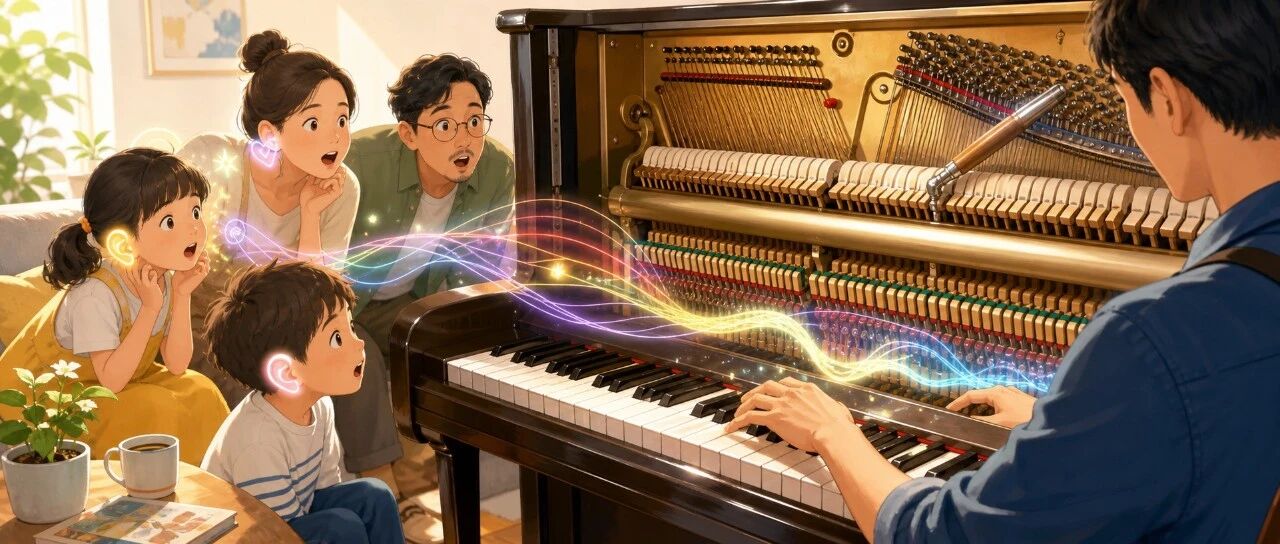
Sometimes we come across a scene like this:
Someone is tuning a piano.
The people nearby may neither know whether he can play nor see anything particularly special about him.
But when he sits down at the piano and casually plays a few phrases, everyone suddenly falls quiet.
It is not necessarily because the piece is difficult.
Nor is it necessarily because his fingers move so fast.
Yet it makes people feel: this sound is different from what they heard just a moment ago.
Many parents, seeing this, cannot help wondering:
What exactly does it mean to “play differently”?
My child is still learning the basics. Is this a long way off?
Actually, it is not.
What we call “different” is often not some mysterious gift. It comes from small abilities that can gradually develop from the very first day of learning piano.
It Is Not About More Notes, but About Ears That Stay Alert
Even when the same piano key is pressed, the sound can differ.
Some notes sound rushed, as though they have been slammed down.
Some sound thin and seem to dissipate as soon as they emerge.
Others may not be particularly loud, yet they sound clear and solid.
Someone who truly knows how to play keeps listening while his hands move.
He listens for:
Whether this note is too forceful.
Whether two notes are being crowded together.
Whether this phrase needs another half-beat of space.
Whether one hand is rushing ahead of the other.
So what people hear is not simply that “he pressed lots of the right keys.”
They hear that he knows how each sound should land.
This is also something especially worth protecting as children learn piano.
Do not let practice become only a question of “right or wrong.”
Leave a little time to ask:
“Which part do you think sounded clearer this time?”
The Real Difference Often Lies in Very Simple Details
We easily associate “playing well” with major pieces, fast tempos, and stage lights.
But often, the simpler the passage, the harder it is to hide the quality of the foundations.
After playing a note, can you wait for it to finish ringing naturally?
Can a short melodic phrase include changes between softer and stronger sounds?
After playing a wrong note, can you find your way back to the beat?
None of this is flashy.
Yet these details determine whether someone has a voice of their own at the piano.
Of course, a child who is just beginning does not need to play with great subtlety all at once.
But they can start with very small goals:
This time, listen to just one note.
This time, play just two measures more evenly.
This time, simply try not to rush into the next note.
Practice like this may seem slow, but the ear gradually becomes more perceptive.
During Practice, Parents Can Ask “Did You Play It Right?” a Little Less Often
And ask a little more often:
“What sounds different between this attempt and the last one?”
At first, a child may not be able to put it into words.
That is all right.
They might simply say, “This time it was not as messy.”
Or, “The left hand seems too loud.”
What matters is not how expert the answer sounds.
What matters is that they begin to understand that playing piano means more than carrying out movements with their hands. It also means hearing the sounds they make.
As a child gradually learns to listen, they no longer have to keep waiting for someone else to tell them what is wrong.
They develop their own judgment.
A Final Thought
Why can some people casually play a few phrases and immediately sound “different”?
It is not because they have never practiced simple things.
It is precisely because they have never dismissed simple things as unimportant.
The quality of a single note.
The breathing of a musical phrase.
Regaining steadiness after a mistake.
Little by little, these things accumulate into something others can sense as soon as they hear it.
The same is true for children learning piano.
There is no need to rush them toward “looking impressive.”
First, help their ears become a little more alert, their sound a little clearer, and their connection with music a little closer.
Then the things that truly make their playing “different” will have room to grow.