Your Expensive Piano Turned Into a Storage Shelf? Try These 3 Ideas to Bring It Back to Life
That piano sitting in the most prominent spot in your living room — the black, glossy, beautifully polished one — how’s it doing?
Can you drag your finger across the lid and write your name in the dust? Is it buried under unopened packages, a stack of your kid’s schoolwork, and your partner’s car keys?
The piano bench? It’s been claimed as the cat’s exclusive napping throne. Every time you walk past it, you feel that little pang of guilt. Followed by a sigh.
“Oh my God, I practically sold a kidney and split it into three interest-free payments to bring that thing home.” Several thousand dollars. Several. Thousand. Dollars!!
Add in twice-a-week lessons at around $55 each, and the total investment could have bought a used car. And now? Your kid won’t even glance at it.
In 90% of households, a piano’s life cycle apparently follows the same trajectory:
Year 1: Pure excitement. Your child rushes to it the moment they get home from school, plinking away happily for half an hour. You stand nearby, phone out recording a little video, secretly thinking: Hey, the next Lang Lang.
Year 2: The plateau. It becomes “Mom, can I just practice for 15 minutes today?” They play on weekends. When they feel like it. When you nag them into it.
Year 3: Exams become the only motivation. Apart from those two months before the grading exam, when they drill scales and exercises eight times a day, the lid stays closed.
Year 4: Full retirement. Schoolwork piles up, they’ve moved on to other activities. You don’t even know how to reply to the piano teacher’s messages anymore.
Year 5… Year 5 is where it is now. A silent, expensive, guilt-inducing storage shelf.
Are you really just going to write off that massive sunk cost? All that money. All those afternoons you spent supervising practice until you were hoarse. Those moments your child finished a piece in tears and you hugged each other. Forgotten?
The problem probably isn’t that your child has a short attention span. And it’s not that you “didn’t stick with it.” The problem is that from the very beginning, we thought of the piano path too narrowly.
The Piano Isn’t an “Exam Machine” — It’s a “Joy Amplifier”
Is a piano’s value really just about performing in a concert or earning a grade certificate? No. Absolutely not. You’ve forgotten that first and foremost, it’s a “family bonding machine.”
I have a friend who is completely tone-deaf and can’t read a single note. But every year on his daughter’s birthday, he insists on performing one number: “Happy Birthday.”
He plays it with two index fingers, one note at a time. Do-Do-Re-Do, Sol-Mi… Every year it’s clumsy, the rhythm’s all wrong, and he hits at least three wrong notes. His wife and daughter double over laughing every single time.
His daughter says: “My dad starts secretly practicing a whole month in advance for this. Honestly, he takes it more seriously than I ever did with my piano lessons.”
See? Does this require any special technique? Does it? Not at all. It’s a clumsy but deeply loving expression. In that moment, the piano stops being a test of skill and becomes a big toy that creates connection and carries emotion between family members.
On a Deeper Level, It’s Also a “Private Emotional Sanctuary.” And this one isn’t even about your child. It’s for you
Have you ever had one of those days? You got into it with your boss, or a client drove you absolutely crazy, and you come home bursting with frustration. Don’t bottle it up. Walk over, lift the lid, and slam your palm down on a cluster of bass notes.
That deep, rumbling resonance seems to carry the tension right out of your chest. Or late at night — the kids are asleep, your partner is asleep. You pour yourself a glass of wine, sit down at the bench, and from memory, pick out the opening bars of a song you used to love.
It’s choppy and halting — so what? That moment of stillness, that private conversation between you and music, is a kind of soul spa that money can’t buy. The piano was always meant to be the warmest object in your home. So don’t sentence it to death just yet.
It’s waiting for your family to wake it up in a whole new way.
Launch the Revival Plan
Let’s start with the simplest warm-up. A pact.
”Starting today, every day, someone — anyone — must walk over, lift the lid, and play for just 1 minute.” Play what? Anything. Even a random sweep from left to right across the keys
Who plays? You, your partner, your child, even a visiting friend. The only goal: make it produce sound.
This tiny ritual acts like a switch, silently telling everyone: This big thing isn’t a shrine — it’s a musical toy our family can play with anytime. Once that mindset takes hold, we can launch the really fun revival activities.
Revival Idea 1: “Name That Tune” Challenge
Pick a song everyone knows by heart. Something like “Twinkle Twinkle Little Star,” the chorus of a popular kids’ song, or a movie theme. One person plays just the first 5 notes using a single finger. “C D E C, C D E C…”
Everyone else races to guess! Whoever gets it right earns the right to pick the next song. Or wins a piece of chocolate. Want to raise the difficulty? Play only the rhythm on a single note — “da, da-da, da-da…” — and have everyone guess.
Revival Idea 2: Storybook Live Soundtrack
Pull out your child’s favorite picture book. Your child (or you) reads the story aloud. The other person sits at the piano as the “chief soundtrack composer.” When the story gets to “the kid doing something naughty,” the composer drags their fingers wildly up and down the keys to create chaotic “scribble” sounds.
When it says “Mom yells angrily,” slam out a couple of dissonant chords in the bass. When it says “Mom hugs the baby,” gently play a few soft, bright high notes.
Revival Idea 3: “Family Edition” Holiday Song
Max out the family tradition vibes. Pick an upcoming holiday. For Christmas, commit to “Jingle Bells.” For Thanksgiving, try “We Gather Together.” For a birthday, it has to be “Happy Birthday.” Divide up the roles. Your child plays best, so they handle the melody.
Dad has good rhythm but can’t play? No problem — he keeps a steady beat by tapping on the side of the piano. You can be the lead vocalist.
Grandparents? They’re the VIP audience and hype crew, responsible for erupting into thunderous applause at the end. Finally, record a 30-second video and share it with the family group chat. It’s more heartfelt and alive than any text message ever could be.
Wait — I know what you’re thinking. These ideas sound great, but where do I find the sheet music for “Jingle Bells”? Is there a simplified version of these songs that my kid can actually play?
Even if I manage to print something out, my child sits down to practice, hits two wrong notes, and I can’t even tell — so we’re right back to square one: me stressing out while they fumble through it! This roadblock is honestly the number one reason most families’ “revival plans” fail. What starts as fun gets derailed by the technical hassles of finding sheet music, reading it, and catching mistakes.
These are all solvable problems — just use the Wonder Piano app, and this practical issue goes away.
It’s a massive portable sheet music library. Want to do a “Family Edition Holiday Song”? Whether it’s “Jingle Bells” or a popular pop song, there are multiple versions available — there’s always one your family can handle.
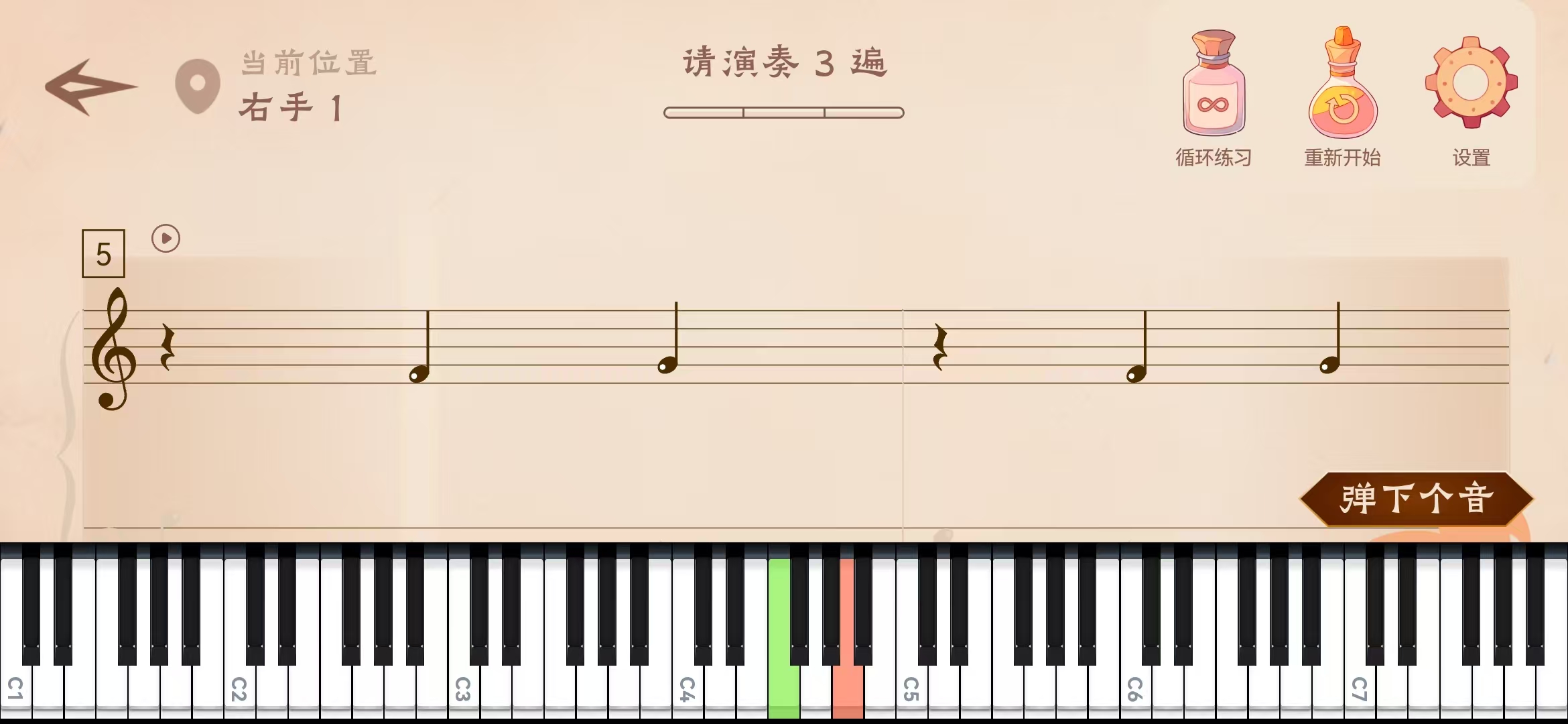
Set up your iPad on the music stand and open the sheet music. Your child follows along with the notes on screen, and if they hit a wrong note, they get a voice prompt plus a visual keyboard showing exactly which note was wrong and which one is right. It’s like a patient, tireless digital practice partner available 24/7 — precise and never loses its temper.
Tools exist to clear obstacles. Their ultimate purpose is to help you and your family enjoy the purest joy music has to offer — more easily, more simply. Don’t let your big investment gather dust in silence.
We don’t need to become Lang Lang. We don’t need to become any kind of famous “virtuoso” to deserve the joy of playing piano.
Music isn’t a masterpiece locked away in a museum.
Music is the warmth of a busy kitchen, the laughter filling a living room, and the best reason for a family to spend a little more time together.