Two Kids, One Piano: How to Balance Practice Resources in a Two-Child Family
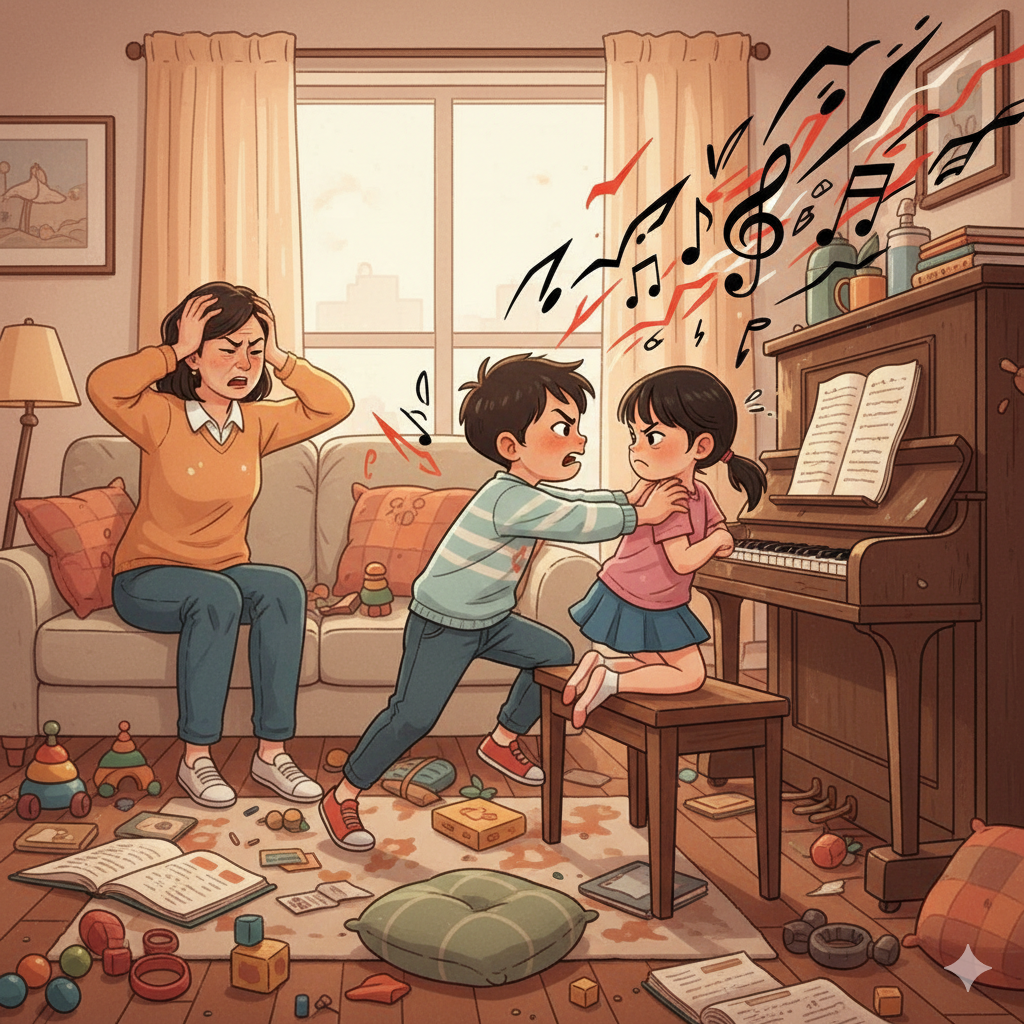
The piano wars in a two-child family: why does trying harder to be “perfectly fair” only make everything more chaotic?
The biggest trap in a two-child family isn’t buying two backpacks, two sets of toys, or even moving to a bigger house. It’s when parents — especially moms — become obsessed with splitting everything perfectly down the middle.
What you think of as “fairness” is actually the fuse that lights the war between your two children. Especially when it comes to piano practice.
At Wonder Piano, we hear from parents every day who are on the brink of a breakdown: “Why did I sign both kids up with the same teacher and buy the same books, and they still fight constantly?”
Today, we need to look past the surface of “fairness” and talk about the real solution for piano practice in two-child families.
What Children Are Really Fighting Over Isn’t the Piano — It’s Your Exclusive Attention
Many parents assume their children argue because “resources are limited” — there’s only one piano. That’s wrong. Children instinctively aren’t competing for material things; they’re competing for your high-quality, undivided attention.
There’s a specific term in psychology for this: Parental Differential Treatment (PDT). Research shows that PDT is “one of the strongest predictors of sibling rivalry and conflict.”
Most importantly, this sense of “unfairness” doesn’t even need to be real. Just the perception of favoritism — like a parent being “more patient” or using a “warmer tone” with one child — is enough to trigger jealousy and anxiety.
Children are incredibly sensitive to signals of attention. They’re not keeping track of “who got five extra minutes of practice time.” They’re keeping track of:
“Is Mom more patient when she sits with my brother during practice?”
“Why does she laugh when my sister plays a wrong note, but scold me when I do?”
When a child feels they are “less favored,” they tend to show more symptoms of depression, lower self-esteem, and more tension in their sibling relationship. The more you try to fix things with material equality, the more emotionally unbalanced your children become.
What Overwhelms Parents of Two Is the “1+1 > 2” Parenting Pressure
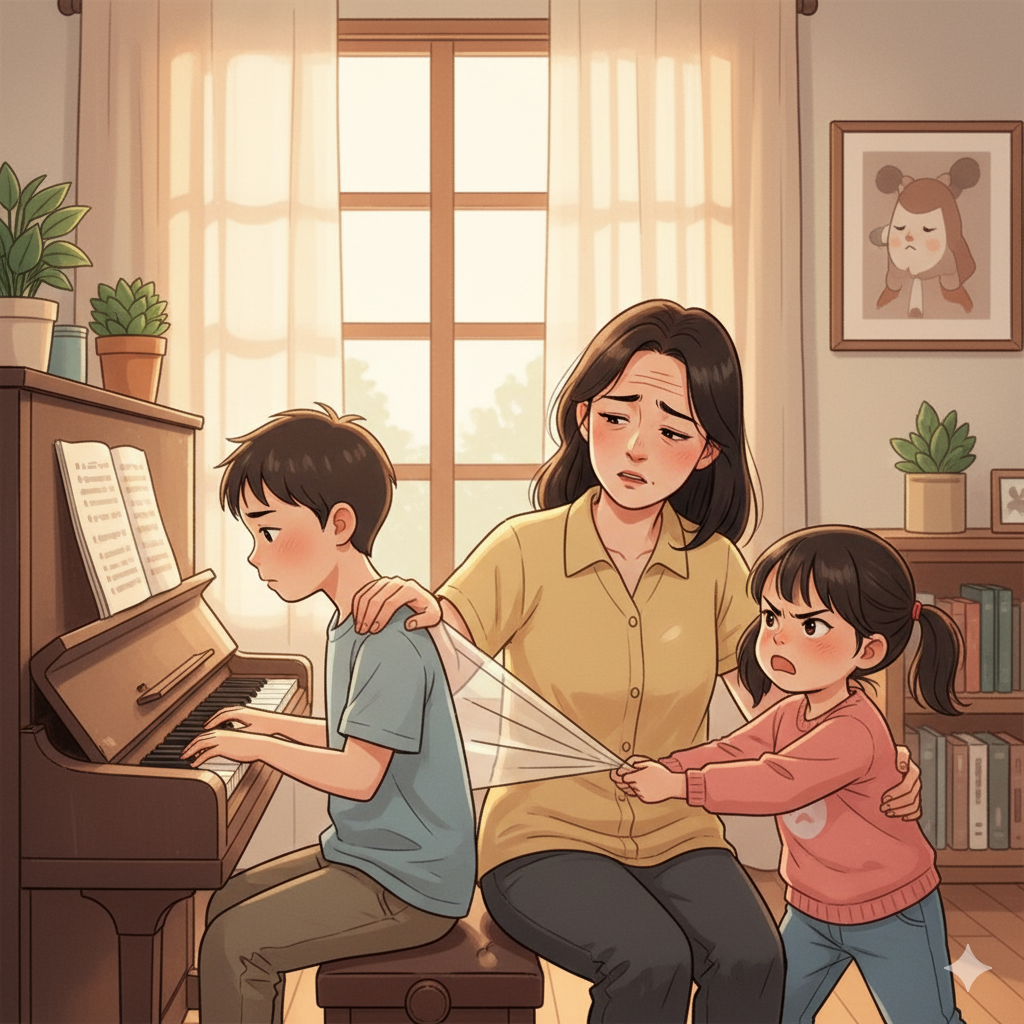
Many parents of two children say: “I’m clearly more exhausted, so why is the house even more chaotic?” This isn’t your imagination.
A study published in the journal Frontiers in Psychology, specifically examining families in China, compared 621 two-child families with 319 one-child families. The results were clear: “Mothers of two children reported significantly higher parenting stress than mothers of one child.”
This pressure is a “1+1 > 2” effect. Parents face more complex family dynamics, which causes them to “experience greater stress.”
Now, carry that exhaustion into practice time.
You’ve finished work and chores for the day. You’re running on 10% battery. You sit down on the piano bench and tell yourself to stay calm.
Your older child plays two wrong notes. (Hold it in — 8% battery.) Your younger child runs over to ask what’s for dinner. (Hold it in — 5% battery.) Your older child plays the same wrong passage again and starts zoning out. (1% battery.)
Boom. You explode
You yell at the older one, snap at the younger one. You think you’re being “disciplined,” but in your children’s eyes: Mom (or Dad) has become a scary person because of piano practice.
In a two-child family, parents’ emotional energy is the scarcest and most critical resource that needs to be balanced.
The Solution: Drop “Equal Division” and Practice “Differentiated Care”
Since splitting everything equally is a trap, what should you do instead? The answer: replace “equal distribution” with “needs-based allocation.”
This doesn’t mean playing favorites — it means giving each child what they need, when they need it. Research also shows that if parents can explain to their children why one child needs more attention at a given moment (because they’re sick, or have an exam coming up), it effectively reduces the other child’s suspicion of favoritism.
For piano practice, we have two suggestions:
1. Establish “Exclusive Practice Time.” Don’t say “you each get half an hour.” Instead, clearly announce: “From 7:00 to 7:30 PM is your brother’s Exclusive Practice Time. No one — including Mom — may interrupt unless it’s urgent.” Then 7:30 to 8:00 is your sister’s “exclusive time.” The word “exclusive” powerfully satisfies a child’s psychological need to feel they have your undivided attention.
2. Shift your role from “supervisor” to “chief appreciation officer.” Remember — your energy is a scarce resource. If you spend all of it “watching the keys” — “That note was wrong!” “Your rhythm is off!” “Fix your hand position!” — you’re not just exhausted, you’re actively creating conflict.
But what if you don’t supervise and practice quality suffers? What if you don’t have a music background and can’t hear wrong notes? What if your child simply refuses to practice and throws a tantrum every time?
This is exactly the core problem Wonder Piano was built to solve for two-child families. Our mission is to “help children practice willingly, and let parents enjoy the journey.”
We believe the greatest value of technology and AI is freeing parents from the role of “supervisor,” so you can invest your precious energy in encouragement and hugs.
Here’s what Wonder Piano can do in a two-child practice scenario:
First, it replaces the “task-based” approach with gamification, solving the motivation problem.
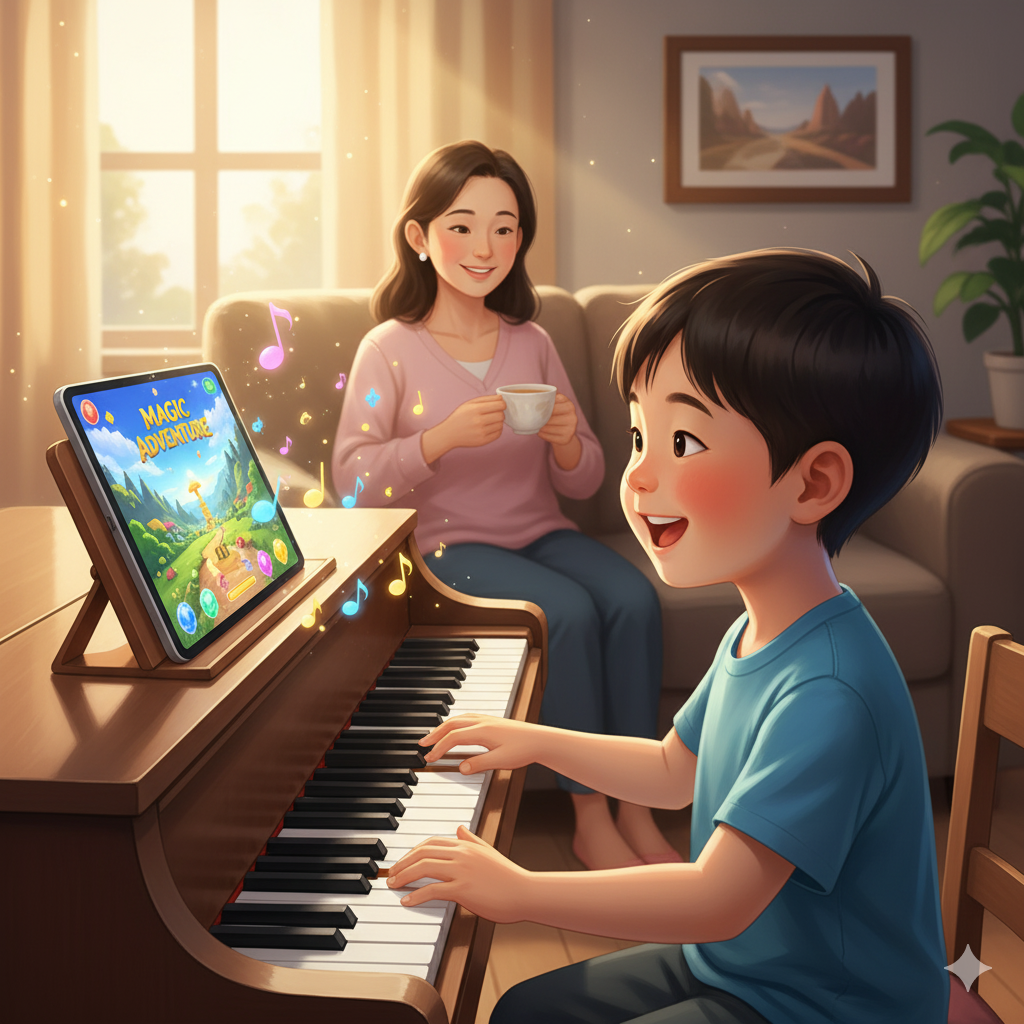
Our key differentiator is replacing the traditional task-based model with game mechanics. We’ve designed a story-driven adventure system where every practice session feels like embarking on a magical quest. Children play to collect “magic stones” and “magic power.” This taps into intrinsic motivation (our educational philosophy: intrinsic motivation first), and many children tell us “it feels like playing a video game while practicing piano.”
Second, it replaces one-on-one human supervision with AI, solving the monitoring pressure
Wonder Piano’s built-in real-time AI recognition system requires no external hardware — just a tablet or phone microphone — to accurately detect pitch and rhythm errors.
Most importantly, it uses gentle feedback: rather than immediately interrupting and discouraging children, it encourages them to self-correct, significantly reducing the frustration of practice.
Finally, it frees up parents’ emotional resources. Once the work of error correction and supervision is handled by AI, parents’ roles change completely.
You don’t need a music background to understand your child’s practice reports. You no longer need to raise your voice. All you need to do — whether it’s for your older or younger child — is give them a hug when they complete a level and say: “Great job, sweetheart!”
You’ve transformed from a “supervisor” into an “appreciator” and “encourager.”
We believe that in a two-child family, nothing is more valuable than a parent who is emotionally stable and knows how to appreciate their children.
Wonder Piano isn’t just a practice app. We want it to serve as an “emotional buffer” for two-child families — taking over the most tedious, conflict-prone part of practice (supervision), reducing parents’ emotional cost, and giving you back that positive, loving cycle between parent and child.
After all, the reason we started our children on piano wasn’t to create two more “competitors” at home — it was to nurture two souls who can appreciate each other.