Top 5 Parent Habits That Drive Piano Teachers Crazy — Are You Guilty?
We recently sat down with several experienced piano teachers to chat about teaching tips. What was supposed to be a professional exchange quickly turned into a full-blown venting session.
The teachers were unanimous: “Honestly, the kids are easy to teach. The real challenge? The parents.”
Many parents feel wrongly accused: “I’m paying for lessons, sitting through every class, and practicing with my child at home — how could I possibly be the problem?”
Today, we’re bravely counting down the Top 5 “nightmare parents” as seen by piano teachers. This isn’t about blame — it’s about using research-backed insights to show you that some well-meaning efforts can actually do more harm than good.
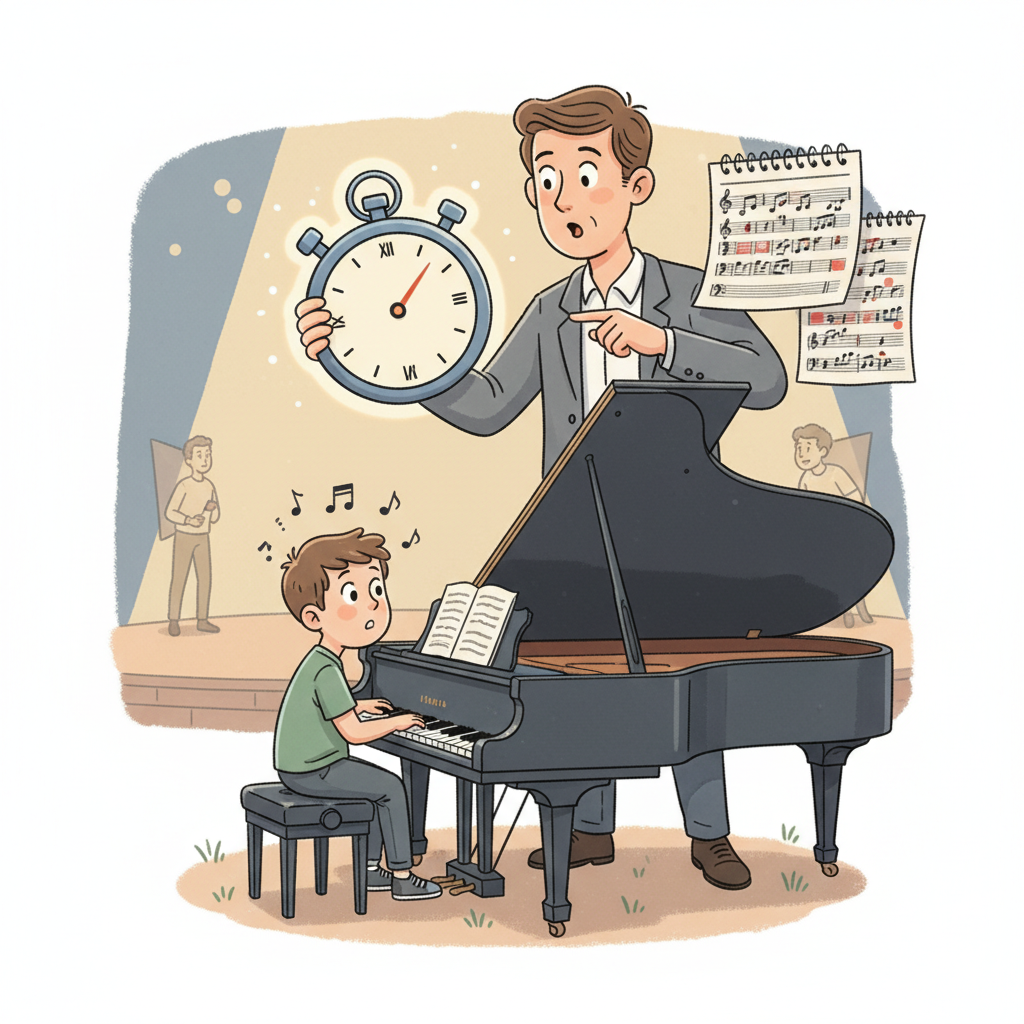
Top 5: The “Speed Racer” Parent
What the teacher is thinking: “They just learned Do-Re-Mi and the parent is already asking when the child can playErta’s Croatian Rhapsody. That’s not learning piano — that’s skipping straight to the final exam!”
Many parents measure progress by exam grades and the difficulty of pieces.
Research published in the Journal of Educational Psychology on skill acquisition shows that the core of deliberate practice lies in automating foundational movements. When you skip over basics like fingering, hand position, and sight-reading to force harder pieces, a child’s cognitive load becomes overwhelming.
Data shows that students with weak foundations have a dropout rate as high as 68% once they reach intermediate-to-advanced levels.
The bottom line: If the foundation isn’t solid, the higher you build, the faster it all comes crashing down. Slow and steady truly wins the race.
Top 4: The “Human Metronome” Parent
What the teacher is thinking: “I’m trying to teach the lesson, but the parent is sitting there giving live commentary like a sports announcer…”
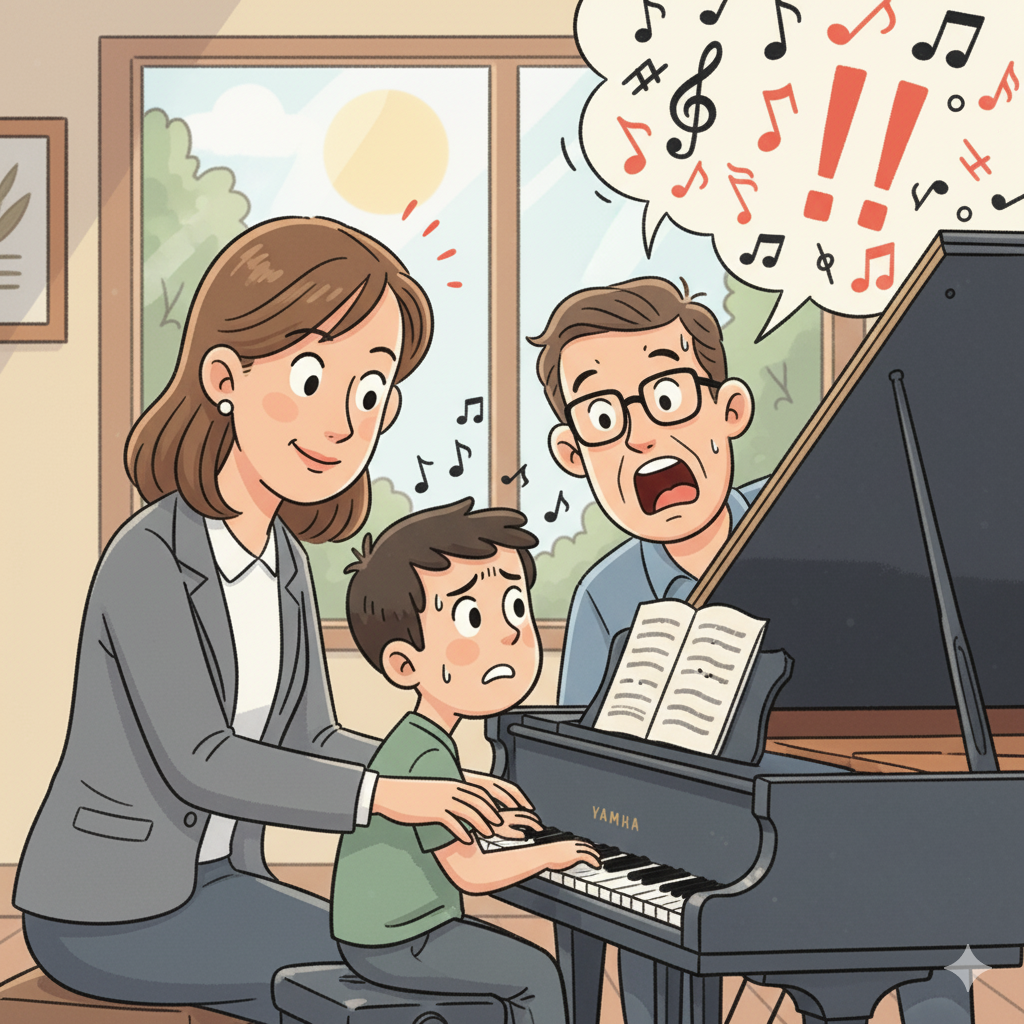
These parents love to “sit in” on lessons. The moment the teacher points out a wrong note, the parent jumps in: “Did you hear that?! The teacher said watch the F#! How did you forget again?! Sit up straight!” By the end of the lesson, the teacher has delivered half the instruction — and the parent has delivered the other half.
Psychologists Deci and Ryan at the University of Rochester developed Self-Determination Theory, which shows that when a child’s sense of autonomy is taken away, intrinsic motivation drops sharply. Studies indicate that under “high-control” parenting, a child’s aversion to their instrument increases by 40% — and this resentment typically explodes in full force during adolescence.
The bottom line: The classroom is the teacher’s domain. Please put down the “remote control.” The more you interrupt, the more your child feels like a puppet on strings.
Top 3: The “Hands-Off” Parent
What the teacher is thinking: “I see the child once a week. What happens at home is anyone’s guess, and every review lesson is a roll of the dice.”
“Teacher, I don’t know anything about music, so it’s all up to you.”
“We didn’t practice the assignment this week because of school exams / a family trip / a bad mood…”
This is where we need to bring up the famous Ebbinghaus Forgetting Curve. The human brain forgets new skills at an alarming rate. Without review, only 33% of what was learned is retained after 24 hours, and after six days without practice, retention drops to nearly 0%. Relying solely on one 45-minute lesson per week without any home practice makes learning piano a statistical near-impossibility — what researchers call “low-efficiency input.”
The bottom line: Piano isn’t something you can be “taught” in class alone — it has to be practiced. The teacher shows the way, but walking the path is up to the child (with the parent’s encouragement).
Top 2: The “Error Obsession” Parent
What the teacher is thinking: “The child hits one wrong note, and before they even have a chance to self-correct, the parent has already shouted them down.” Many parents can’t tolerate a single mistake during home practice.
“Stop! Wrong again!”
“Start over! Play this measure ten times!” The result? The child can barely finish a phrase before being interrupted five or six times, ending in tears and slamming the piano lid shut.
Neuroscientist Daniel Levitin explains in his book This Is Your Brain on Music that learning music requires building complete neural pathways. Frequent interruptions destroy a child’s flow state, causing the brain to flood with cortisol (the stress hormone). In this state, the hippocampus — responsible for memory — becomes suppressed. In other words: the more you yell, the faster they forget, and the more mistakes they make.
The bottom line: Give it a moment to breathe. Children need room to make mistakes. Your “perfectionism” may actually be the root of your child’s “learned helplessness.”
Top 1: The “Ineffective Recording” Parent
What the teacher is thinking: “They record the entire lesson on their phone, but never actually watch the video at home — or just play it as background noise.” This has become almost standard for modern parents. They feel that recording equals learning, or they hand the phone to their child afterward: “Just watch what the teacher said.”
Cognitive Load Theory tells us that passively watching video is far less effective than active participation.
More importantly, parents without musical training often can’t accurately judge whether their child’s current practice matches what was demonstrated in the video. According to music education research, approximately 75% of young piano students practice incorrect patterns at home — drilling wrong fingering and rhythm until it becomes second nature. Teachers then have to spend triple the time undoing these ingrained mistakes.
The bottom line: Recording is a great tool, but without an effective feedback mechanism, it’s just a “placebo.”
So What Should You Actually Do? Turn “Drill Sergeant” into “Supportive Partner”
By this point, many parents might feel stuck: If you don’t supervise, the child won’t practice (Top 3). If you do, you risk becoming a “control freak” (Top 2 / Top 4). You don’t know music well enough to catch errors (Top 1). You want faster progress but don’t want to push too hard (Top 5).
It Feels Impossible.
The key to resolving all these conflicts is solving one technical challenge: How do you provide timely, accurate, and objective practice feedback — without damaging the parent-child relationship?
This is exactly why Wonder Piano was created. As the team behind Wonder Piano, we deeply understand the pain points families face when learning piano. That’s why we’ve combined AI-powered audio recognition technology with proven piano teaching methods to give you a practice partner that’s “available 24/7, never loses its temper, and is highly professional.”
1. Say Goodbye to “Yell-and-Correct” — Protect Your Relationship
No need to play “human metronome” or “error police.” Wonder Piano’s high-precision AI error detection identifies wrong notes and rhythm issues in milliseconds.
It pinpoints exactly where things went wrong: It won’t get frustrated — it simply highlights the errors on screen and guides your child to self-correct.
Solving the pain point: You’ll never have to argue with your child over whether you heard a mistake. Leave the technical feedback to AI, and focus on giving your child love and encouragement.
2. No More “Wasted Practice” — Let the Data Speak
For the “hands-off” and “ineffective recording” concerns, we have a solution.
Smart Practice Reports: After every session, the system automatically generates a detailed analysis covering pitch accuracy, rhythm, and other key metrics.
Solving the pain point: Even if you can’t read sheet music, one glance at the report tells you how your child practiced today and where they need improvement. This is also exactly the kind of “homework feedback” teachers love to see at the next lesson.
3. Learning Through Play — Let Progress Happen Naturally
For “progress anxiety,” Wonder Piano uses gamified interactive practice.
We’ve transformed tedious scales and technical exercises into fun, level-based challenges.
Solving the pain point: Your child’s competitive spirit replaces parental nagging. When practice feels like a game, motivation kicks in, progress speeds up naturally — and it’s built on a solid foundation.
Learning piano is a marathon, not a sprint. Don’t become the “nightmare parent” in the teacher’s eyes, or the “villain” in your child’s.
Leave the error-catching and tedious drills to Wonder Piano. Save the love and appreciation for your child.