
10 Piano Pieces That Sound Impressive but Are Surprisingly Easy to Learn
When kids want to quit piano, we often assume they “can’t sit still” or “lack talent.” But here’s the honest truth: most children give up not because piano is too hard, but because it feels boring and unrewarding.
Why does a sense of achievement matter more than playing every note perfectly? Research shows that practicing traditional, repetitive scales and exercises is one of the main reasons students lose interest.
Even more concerning, a longitudinal study on music education found that roughly 50% of students stop taking music lessons before age 17, with a critical dropout peak between ages 11 and 15.
Why? Because at that stage, they crave autonomy and a sense of accomplishment.
A study on motivation in music learning identifies three core psychological needs that sustain long-term motivation: competence, relatedness, and autonomy.
In everyday terms:
Competence: “I can do this! That sounded really good!”
Relatedness: “My friends and family love what I play.”
Autonomy: “I chose this piece myself — nobody forced me.”
Yet the typical “drill sergeant” approach to practice destroys all three. We focus too much on “don’t play that wrong” and forget that children need those “wow, I’m amazing!” moments.
That’s exactly why “instantly impressive” pieces exist
They’re like cheat codes in a video game — delivering a massive competence boost in the shortest possible time. These pieces sound far more difficult than they actually are, letting kids show off in front of classmates and relatives. That kind of positive feedback is more powerful than any lecture or pep talk.
Today, we’re rounding up 10 piano pieces that sound instantly impressive, so your child can experience that “I’m amazing!” moment with ease.
The List: 10 Instantly Impressive Piano Pieces
Classic Starter Pack (Sounds grand, but follows clear patterns)
Minuet in G Major (Bach)
Why it impresses: It’s Bach — instant classical credibility. This piece is a gentle introduction to polyphonic music with an elegant, cheerful melody. A safe and sophisticated choice for any school performance.
How to master it: It sounds like two hands are having a conversation, but each hand actually stays within a small range. Once your child gets the coordination down, the results are stunning.
Fur Elise — Opening Section (Beethoven)
Why it impresses: The most iconic piano piece in the world. The moment that opening motif begins, everyone recognizes it — it’s practically hardwired into our DNA.
How to master it: Many students only learn the A section (the famous part). The fingering is fixed, and the left-hand accompaniment is straightforward. Once your child can play the opening smoothly, they’re guaranteed 100% admiration.
Turkish March — Opening Section (Mozart)
Why it impresses: Speed and excitement! The lively, bouncing melody is full of sparkling energy. One word: dazzling.
How to master it: Again, we focus on just the showiest passage. It sounds fast, but many of the note patterns repeat, making it excellent for building finger agility and power.
Film & Animation Favorites (Built-in soundtracks that transport you instantly)
Castle in the Sky — Easy Version (Joe Hisaishi)
Why it impresses: The magical combination of Miyazaki and Joe Hisaishi is beloved by parents worldwide. The moment the melody begins, it’s both wistful and healing, full of storytelling magic.
How to master it: The simplified version uses easy chords with a clear melodic line. When your child plays this piece, they’re not just practicing — they’re telling a fairy tale they already love.
He’s a Pirate (Pirates of the Caribbean)
Why it impresses: An epic soundtrack! Incredibly rhythmic and powerful. A favorite among boys — after playing it, they’ll feel like Captain Jack Sparrow himself.
How to master it: The key here is rhythm. It uses lots of syncopation, which looks complex but follows a clear strong-weak pattern. Once they’ve got that down, the result is absolutely electrifying.
Super Mario Bros. Theme
Why it impresses: “Da-da da-da-da-da!” Whose childhood didn’t include Mario? This piece is a showcase of technical flair — pure fun and flashy.
How to master it: It’s fast with lots of jumping notes, but the melody hits kids right in their excitement zone. They’ll have incredible motivation to conquer those rapid sixteenth notes.
Popular & Singalong Picks (Easy to learn, fun for the whole family)
Canon — Easy Version (Pachelbel)
Why it impresses: The gold standard of chord progressions and the ancestor of countless pop songs. The melody is warm and healing, with an effortlessly refined feel.
How to master it: It’s built on the timeless I-V-vi-iii-IV-I-IV-V chord progression. As long as the left hand holds those chords steady, any variation in the right-hand melody will sound harmonious and full.
Mariage d’Amour (Dream Wedding) — Excerpt (Richard Clayderman)
Why it impresses: The quintessential romantic piece — gorgeous, flowing, and full of emotional depth.
How to master it: The arpeggios sound intimidating, but an arpeggio is simply playing chord notes one at a time. Once your child learns to relax and move the wrist smoothly, they can easily produce that “flowing water” effect.
Heart and Soul (Four-Hand Duet)
Why it impresses: The ultimate feel-good piece! This song was practically made for playing together.
How to master it: We highly recommend a parent-child duet! One person plays the simple bass chords (incredibly easy), while the other plays the melody. This perfectly addresses the “relatedness” need we mentioned earlier — practice becomes a family bonding experience.
Chopsticks
Why it impresses: Simplicity taken to the extreme — yet surprisingly flashy. You can play this piece using just your index fingers (like chopsticks!), but the speed can get impressively fast.
How to master it: It’s pure play. It shows children that piano doesn’t always have to be serious — it can be genuinely fun. It’s a great way to transform a child’s intimidation around the piano into a feeling of mastery and control.
By now, some parents might be thinking: “This all sounds great, but my child will still make mistakes on these pieces. I’ll still have to hover and correct them, and they’ll still get frustrated.”
That brings us back to the original question: What role should parents actually play during practice?
Multiple studies show that parental involvement and support are crucial for a child’s music education. But that involvement should be about encouragement and celebration, not supervision and correction. Research has found that families where parents increased their own engagement with music after their child started lessons produced the highest-achieving students.
In short: be an appreciator, not a supervisor.
The problem is, most of us parents aren’t musicians ourselves. We can’t hear subtle differences in rhythm or pitch, so we feel helpless.
That’s where an AI practice assistant comes in.
Many parents choose Wonder Piano because it perfectly fills the roles of both “encourager” and “gentle corrector,” freeing parents from the supervisor role while actually boosting children’s motivation to practice.

How does Wonder Piano do it?
First, it replaces “task mode” with gamification.
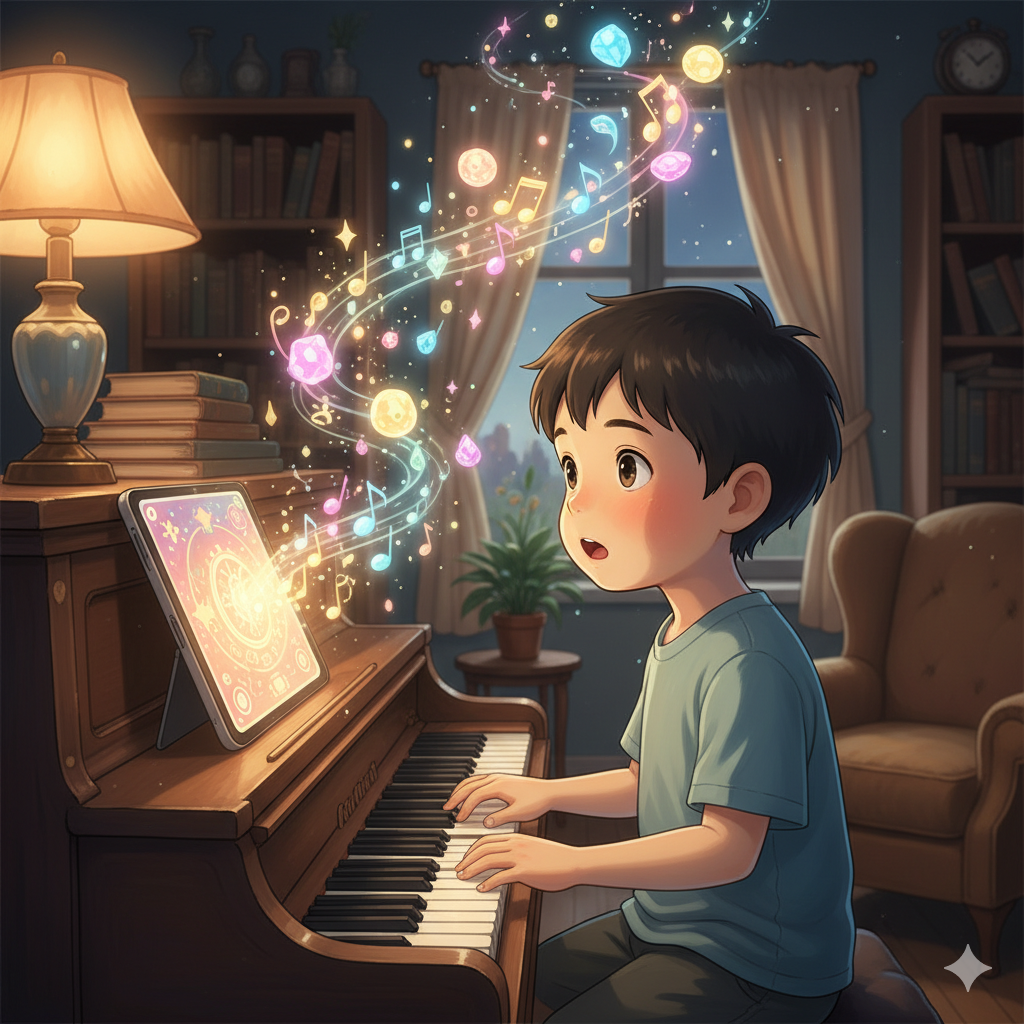
We know that boredom is the number one enemy of practice. That’s why Wonder Piano is built around gamification. Instead of tedious “play this 10 times” assignments, there are magical adventure storylines. Every section your child plays correctly unlocks new story chapters, earning “magic stones” and “magic power.”
Research confirms that this kind of gamified instant feedback — progress bars, badges, and rewards — triggers a sense of satisfaction that makes practice feel like playing a game. When children say “it feels like playing a video game,” that’s exactly the intrinsic motivation we’re aiming for.
Second, it provides gentle feedback that protects your child’s sense of competence.
When a child makes a mistake, the worst thing is a harsh “Wrong!” that breaks their concentration. Wonder Piano’s real-time AI recognition system uses gentle feedback.
It detects pitch and rhythm in real time but doesn’t abruptly interrupt. Instead, it encourages self-correction through structured practice stages (hands separate, then hands together), giving clear results that help children find and fix problems on their own. This dramatically reduces frustration.
Finally, it turns parents into appreciators.
Wonder Piano comes with a massive built-in music library, from classical starters to pop arrangements (including many of the showstopper pieces listed above), and children can choose what they want to play.
Letting children practice by choice and parents accompany with ease — that’s what piano practice should feel like. Rather than burning through enthusiasm with tedious drills, start with one “instantly impressive” piece that ignites your child’s sense of achievement.
Wonder Piano is available on all major app stores. Head over to our extensive music library and find your child’s first showstopper piece!