10 Essential Piano Fundamentals to Practice Every Day: Practical Tips and Techniques
Whether you’re a young student just starting out or an adult looking to level up, every piano learner wants to make the most of their practice time. Many people fall into the habit of playing through pieces over and over while neglecting the seemingly tedious — but absolutely essential — fundamentals. The truth is, a solid foundation is what supports every beautiful piece you’ll ever play.
“Practicing” doesn’t mean “playing songs.” Efficient practice means focusing your time where it matters most. Here are 10 carefully curated core fundamentals covering technique, method, and musicality. Stick with them, and you’ll see remarkable progress.
1. Finger Independence
This is the starting point for all finger technique, designed to train each finger’s ability to move independently and build initial strength.
Why it matters: It solves the problem of fingers feeling “stuck together” or weak, making every note clear and full. The naturally weaker 4th and 5th fingers especially need this extra attention.
How to Practice
Place your hand on the keys in a rounded, ball-holding shape, keeping your hand position stable.
While the other four fingers stay pressed on the keys, lift just one finger (such as the thumb), then drop it quickly and firmly.
The key is this: when you lift one finger, the others must stay completely still. Practice each finger in turn, repeating the exercise.
2. Scales
Scales are the most comprehensive and fundamental exercise in piano technique — the backbone of fluid playing.
Why it matters: They help you learn the keyboard, train finger speed and evenness, and develop smooth thumb-under and crossover transitions.
How to Practice
Start with C major, hands separately, at a slow tempo. Pay attention to the thumb-under motion — it should happen early and smoothly, with the wrist staying level and relaxed.
Always use a metronome! Start at a very slow tempo (such as 60 BPM). Make sure every note is even in timing and dynamics, perfectly consistent, before increasing speed.
Gradually add all major scales, minor scales (harmonic and melodic), and chromatic scales to your routine.
3. Arpeggios
Arpeggios are broken chords that greatly improve finger reach and wrist flexibility.
Why it matters: Many pieces (like Beethoven’s “Moonlight” Sonata) are full of arpeggios. Mastering them gives your playing a sense of flow and power.
How to Practice
Start with the C major triad (C-E-G), hands separately.
Feel how the wrist guides the motion. Playing arpeggios isn’t purely a finger exercise — it’s the wrist leading the fingers horizontally across the keyboard. The movement should feel like “drawing a rainbow,” smooth and connected.
4. Hanon Exercises
Hanon is a classic technical training book where each exercise targets a specific challenge — think of it as a gym workout for your fingers.
Why it matters: It systematically builds finger strength, speed, independence, and endurance.
How to Practice
Commit to 1–2 exercises per day. Quality matters far more than quantity.
Follow the printed fingerings strictly, and try practicing with different articulations like staccato and legato. The metronome is essential here too.
5. Slow Practice
Slow practice isn’t a type of content — it’s the master key to solving every technical challenge.
Why it matters: At slow speeds, your brain has enough time to direct your fingers to make the correct movements, building solid muscle memory. Every mistake in fast playing can be traced back to insufficient slow practice.
How to Practice
Practice difficult passages at a speed so slow that mistakes become impossible.
During slow practice, focus your attention on listening to tone quality, feeling the key touch, and checking whether your wrist and arm are relaxed.
6. Chords
Music is built from melody and harmony. Practicing chords develops your understanding of music’s harmonic structure.
Why it matters: It strengthens your harmonic ear, lays the groundwork for improvised accompaniment and musical analysis, and trains your palm support and coordinated finger power.
How to Practice
Practice basic triads and their inversions, making sure all notes sound together cleanly.
Practice common chord progressions (such as I-IV-V-I) and transpose them into different keys, noticing the color changes as chords connect.
7. Dynamic Control
Music without variation in dynamics and tone color feels lifeless. This is the core ability that breathes life into your playing.
Why it matters: It determines your musical expressiveness. Controlling the full range from ppp (very soft) to fff (very loud), and using different touch techniques (legato, staccato, portato), is the key to conveying emotion.
How to Practice
Play a scale passage — the first time as softly as possible, the second time as loudly as possible.
Practice smooth crescendo and decrescendo.
Play the same melody using full legato and then short, bouncy staccato. Notice the dramatic difference in tone color.
8. Sight-Reading
Spending 5–10 minutes on sight-reading every day will benefit you for life.
Why it matters: Strong sight-reading skills mean you can pick up new music quickly, vastly expanding your musical horizons.
How to Practice
Choose music well below your playing level.
Before playing, quickly scan the score (key signature, time signature, rhythmic patterns).
Start at a steady, slow tempo. The golden rule: even if you hit a wrong note, never go back and never stop. Your eyes should always be looking ahead at the next notes, keeping the rhythm intact.
9. Efficient Memorization
Memorizing music isn’t about rote repetition — it’s about multi-dimensional memory and understanding.
Why it matters: It frees your eyes, allowing you to focus more on musical expression and connecting with your audience.
How to Practice
Analytical memory: This is the most reliable method. Understand the structure of the piece (A-B-A), the harmonic progressions, and melodic sequences. Use your “brain” to memorize, not just your “muscles.”
Aural memory: Become familiar with the melodic direction so you can “sing” the score.
Visual memory: Form a mental “photograph” of the sheet music.
Muscle memory: Developed through repeated practice, but this is the least reliable method and should be combined with the others.
10. Listening and Self-Correction
What you actually play and what you think you play are often worlds apart.
Why it matters: It develops objective listening skills, helping you catch rhythmic instability, wrong notes, and uneven dynamics that you might not notice in real time. It turns you into your own first teacher.
How to Practice
Regularly record your practice sessions on your phone.
Listen to the recording as if you were an audience member — without bias — and write down every flaw you notice.
Take the problems you’ve discovered back to slow practice, and address them one by one.
Weaving these 10 fundamentals into your daily practice routine may feel tedious at first, but stick with it and your technique and musical expression will make a quantum leap. Consistency and the right method are always the fastest path to success.
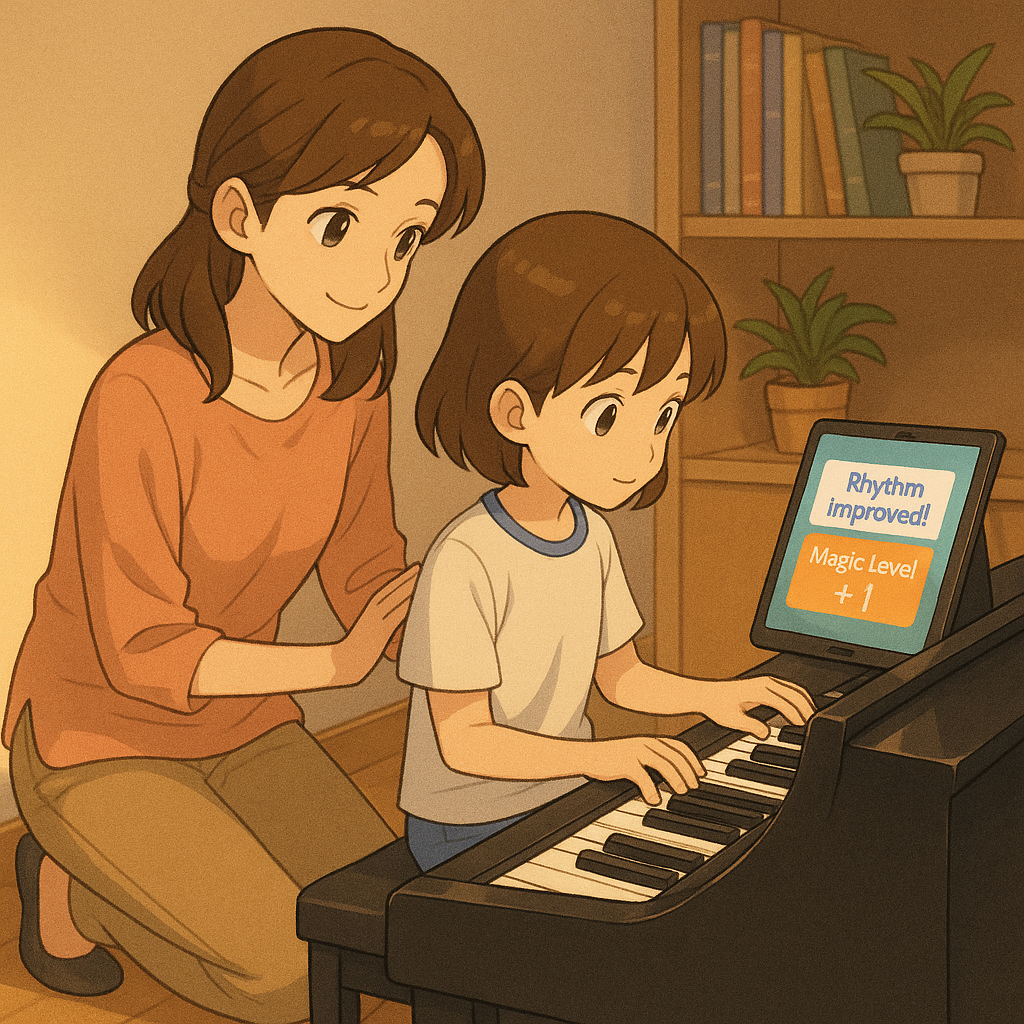
For younger students, though, repeating these foundational exercises day after day can feel boring and may lead to resistance. So how do you help your child build solid fundamentals while keeping their love of piano alive? Consider using a practice tool like the Wonder Piano app, which cleverly turns practice into a “magical adventure.”
Instead of mechanically completing tasks, children progress through levels and collect rewards in a game-like environment. The AI system recognizes pitch and rhythm in real time and gently encourages self-correction, which does wonders for protecting their confidence.
This gamified approach transforms “I have to practice” into “I want to practice,” and turns parents from anxious supervisors into relaxed admirers — making practice time a joyful bonding experience for the whole family.
May your music grow more beautiful with each day of thoughtful, consistent practice — and may every young pianist’s musical journey be filled with fun and a sense of accomplishment.