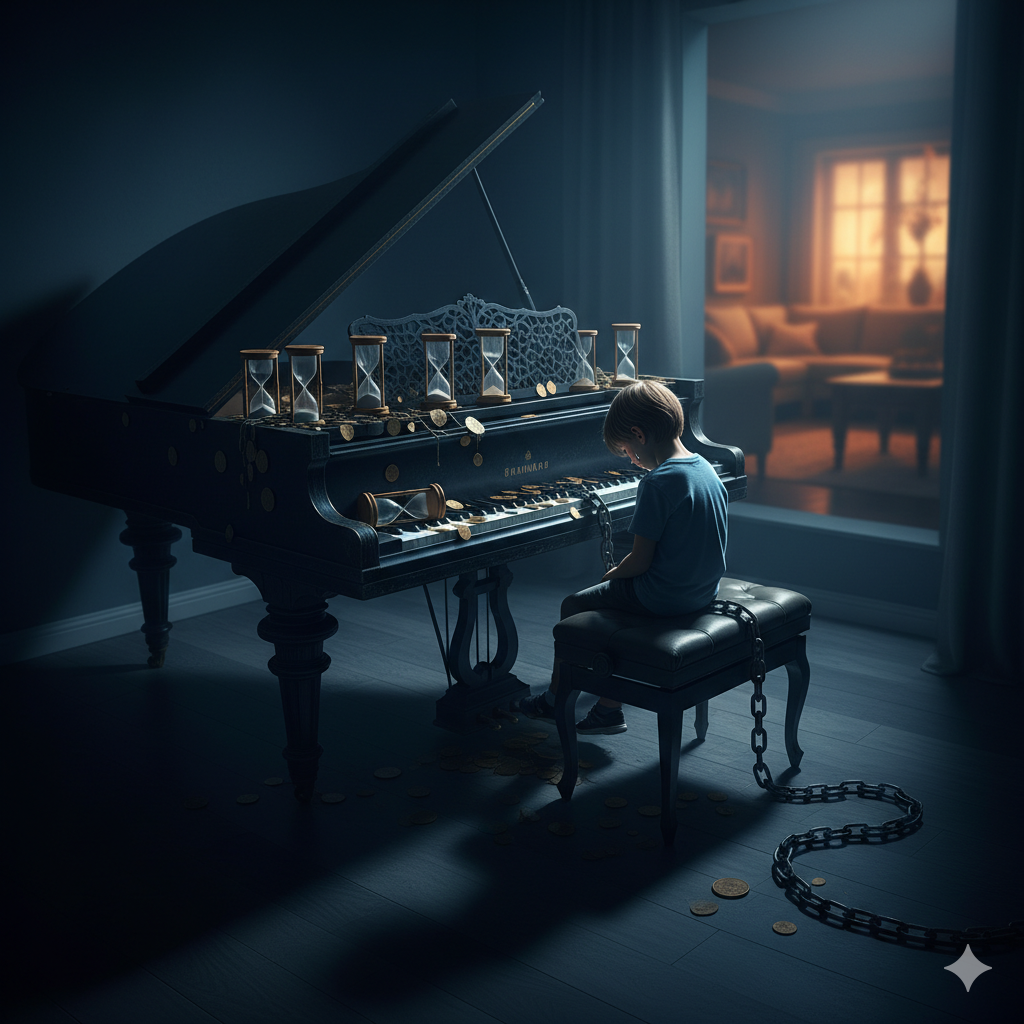
How Many Piano Families Are Trapped by the Sunk Cost Fallacy?
Many parents think the pain of wanting to quit comes from “failing their child’s future.” But chances are, you’re really just heartbroken over that expensive piano gathering dust.
What You Call “Perseverance” Is Really Just Loss Aversion
“We’ve spent thousands on lessons — quitting now means all that money is wasted.” If this sounds familiar, you and your child may both be held hostage by the sunk cost fallacy.
In psychology, this powerful mental trap is quietly destroying your relationship with your child.
So what exactly is a “sunk cost”? Simply put, it’s money, time, and energy you’ve already spent and can never get back.
Imagine you buy a movie ticket for $15, and twenty minutes in, you realize the film is terrible. Do you “tough it out since you’re already here,” or do you leave and spend your time on something better?
A rational person would leave immediately. That $15 (the sunk cost) is already gone — whether you stay or go, you’re not getting it back. Staying just wastes your next two hours, which are far more valuable.
But most people choose to sit through it. Why? Because our brains are wired to hate losses.
Nobel Prize-winning economist Richard Thaler identified the “sunk cost effect” back in 1980. He offered a classic example: you’ve bought a $40 ticket, but a blizzard hits that evening. You know driving is dangerous, but you’ll probably brave the storm anyway — because you “don’t want to waste that $40.”
Another Nobel laureate, Daniel Kahneman, along with his colleague Amos Tversky, explained this through “Prospect Theory”: the pain of a loss is roughly twice as intense as the pleasure of an equivalent gain.
Translated into a parent’s inner monologue: the pain of “admitting the piano was a waste of money” far outweighs the uncertain future benefit of “forcing my child to keep playing (maybe they’ll pass a grading exam).”
To avoid the pain of “I made a bad decision,” parents pour in even more “future costs” — a child’s tears, a parent’s anger, and a household thick with tension — all trying to “rescue” what is already a sunken “past cost.”
This is the triple hostage that sunk costs take on piano families.
Three Ways Sunk Costs Hold Piano Families Hostage — How Many Apply to You?
When it comes to piano lessons, the sunk cost fallacy creeps into almost every decision.
The First Hostage: Money — “That Piano”
This is the most obvious one. A piano costs anywhere from a few hundred to several thousand dollars. Lessons run $50 to $100 or more each, adding up to thousands per year. When your child says “I don’t want to practice anymore,” what you hear isn’t a cry for help — it’s all those dollars screaming, “You made a terrible investment!”
The goal of practicing shifts. It’s no longer about “musical enrichment” — it’s about “making this investment feel worth it.” You start calculating the piano’s cost-per-hour, and every day your child skips practice, your perceived “loss” grows.
The Second Hostage: Time — “We’ve Already Put In Two Years”
“We’ve made it through beginner methods — quitting now means the last two years were for nothing!” This is a classic logical trap.
The truth is: whether you quit or not, those two years are already gone. They’ve sunk. They’re not coming back.
What you need to decide now isn’t how to recoup the past, but how to make the future more valuable. Should your child keep grinding through misery, or is there a new approach that could make the time ahead actually meaningful?
The Third Hostage: Emotions — “After Everything I’ve Sacrificed for You”
This is the most hidden — and the most damaging.
How many evenings have you spent supervising practice? How many social events have you skipped to drive your child to lessons? How many times have you lost your temper trying to help?
When parents invest massive “emotional labor,” a child’s resistance starts to feel like betrayal.
This trap stems from what psychologists call “cognitive dissonance” — the conflict between “I’m a loving, smart parent” and “I made an expensive decision that’s making my whole family miserable.”
To ease that conflict, parents instinctively double down, trying to prove “my original decision was right.” And the child becomes the biggest casualty of that need to be proven right.

Calculate the Real “Opportunity Cost”: What Are You Actually Losing?
Many parents think quitting means losing “thousands of dollars.” That’s wrong.
As Richard Thaler reminds us, the only thing that should matter in our decisions is “future costs and benefits.”
Let’s do a “future accounting.” If you stay hostage to sunk costs and keep trudging down this high-pressure, painful road, what will you actually lose going forward?
1. Your “Parent-Child Relationship Account” Practice time has become the number-one killer of family happiness. For the sake of that piano, you’re draining the already limited trust and closeness between you and your child every single day. Once this “account” is overdrawn, no amount of money can buy it back.
2. Your “Musical Interest Account” Does your child actually hate music? No — they hate the process of “practicing piano.” Forcing them through checklists and assignments is like killing the goose that lays the golden eggs. You might “win” a grading certificate, but you could shut the door on music for the rest of their life.
3. Your “Family Atmosphere Account” In any home with a piano-learning child, the whole family’s mood can be held hostage. Mom is anxious, dad is critical, the child is bottled up. This low-pressure atmosphere is an “invisible cost” far more devastating than any financial loss.
How to Break Free: Stop the Drain, Change the Method
By now, you might be asking: should I just accept the loss and let my child quit?
There is an answer.
Our team at Wonder Piano — a group of mothers who understand music, understand children, and understand AI — believes: the best way to break free from sunk costs isn’t to “give up,” but to “take a different path.”
Your biggest “sunk cost” — that piano — is still sitting right there. Your original love for music is still there too.
The Root of the Problem Isn’t the Piano or the Money — It’s the Way Practice Is Done
Traditional piano practice works against human nature: it’s boring, high-pressure, loaded with frustration, and heavily dependent on parental supervision. That’s the real culprit behind parent-child battles and what turns your investment into a “sunk cost.”
What if there were a way to make practice something other than a battle?
That’s exactly why we created Wonder Piano. We’re not here to “supervise” your child — we’re here to help you turn that expensive “sunk cost” back into a living asset.
We discovered that when children stop resisting, parents naturally stop stressing. Here’s how we make that happen.
First, we replace the “traditional task system” with “gamified learning” to dissolve resistance.
Children don’t inherently dislike playing piano — they dislike being forced to practice. Wonder Piano turns every practice session into a “magical adventure.” Instead of “completing assignments,” kids are “conquering levels.” When they tell you “it feels like playing a game while playing piano,” resistance drops to a minimum.
Second, we replace “harsh correction” with “gentle feedback” to reduce frustration.
What’s the most dreaded part of traditional practice supervision? Wrong notes. Parents tense up the moment they hear one. Our real-time AI recognition system uses a “gentle feedback” approach — it catches wrong notes reliably, but instead of interrupting the child mid-performance, it encourages self-correction. This dramatically protects a child’s sense of achievement while reducing frustration.
Finally, we want parents to “step back” — from “supervisor” to “appreciator.”
Our system is designed so that even parents with zero musical background can understand practice reports. You no longer need to play “inspector” — instead, you can share in the joy of “magic stones” and “power points” with your child. When the parent-child relationship enters a positive cycle, practice truly becomes self-motivated.
You’ve already paid a steep “sunk cost” for your child’s musical journey. Please don’t keep spending even more precious currencies — your parent-child relationship and your family’s peace of mind.
Breaking free is simpler than you think: acknowledge that past spending can’t be recovered, but the future experience can change. Maybe what your child needs isn’t more willpower — just a little spark to reignite their interest.
Wonder Piano uses a “low-commitment subscription” model because we don’t want you making another big “sunk investment.” We want to invite you and your child to try it with the lowest possible barrier to entry (less than $7 per month).
If you’ve read this far, here’s a hidden bonus: the first 10 new users can redeem a free month of membership. Redemption code: bcb4
How to redeem: Download the Wonder Piano app, go to the home page, tap More, then Settings, then Redemption Center.
When practice is no longer a “war” but a “game” — when you’re no longer an “inspector” but a “teammate” — that expensive piano can finally transform from a “sunk cost” back into your family’s most beautiful “future asset.”