Why Starting with Jay Chou Songs Beats Starting with Beyer for Modern Piano Learners
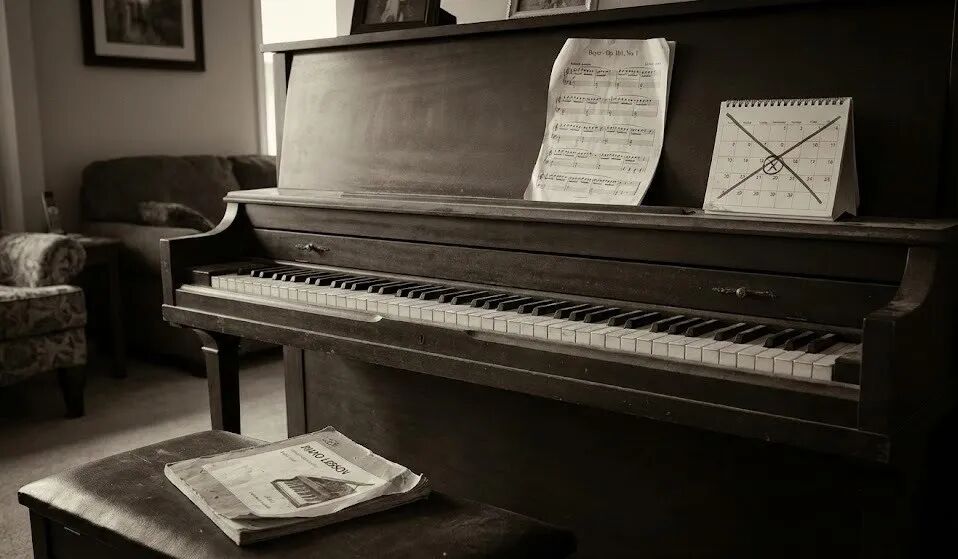
The day you bought your piano, you were full of determination. Then your teacher sent over Beyer Exercise No. 1, and you stared at the dense sea of notes, forcing yourself through two painful weeks. Practicing those melody-less exercises every day felt like serving a sentence. On day 15, you closed the lid — and never opened it again.
Beyer’s 599 Exercises: The First Wall That Stops Most Learners
Beyer has 599 exercises in total. Sounds hopeless, right?
At the traditional pace of one exercise a day, it would take nearly two years to get through them all. In reality? Most people give up within three months. Data shows that only 23% of adult learners who follow the traditional path are still practicing after three months. That means 7 out of 10 adults who start learning piano quit because of Beyer.

Where does it go wrong?
You started learning piano because you dreamed of playing a Jay Chou hit at a party, or imagined yourself sitting at the piano looking effortlessly cool. Instead, you spend every day grinding through do-re-mi-fa-sol exercises so dull they could make you cry.
That gap between expectation and reality is harder to bear than hitting a wrong note.
Learning piano as an adult is nothing like learning as a child. Kids have endless time and parents pushing them along — they can afford to build foundations slowly. Adults? Squeezing out 30 minutes a day is already a win. And you’re supposed to spend those precious 30 minutes on exercises that sound like noise?
Motivation drains away, day by day.
Jay Chou: A Better Starting Point
Imagine two scenarios:
Scenario A: You tell a friend, “I’ve been learning piano — I’m on Beyer Exercise No. 20.” Your friend stares blankly, not sure what to say.
Scenario B: You sit down at the piano and play the opening notes of Jay Chou’s “Sunny Day.” Your friend’s eyes light up: “Wow, you can play Jay Chou!”
Which one gives you a bigger sense of accomplishment? The answer is obvious.
This isn’t about vanity — it’s human nature. People need visible goals and immediate positive feedback. Psychologist Edwin Locke’s Goal-Setting Theory proved long ago that specific, concrete goals are far more motivating than vague, abstract ones.
“I want to play Jay Chou’s ‘Simple Love’” vs. “I want to build a solid piano foundation” — the first is a reachable goal; the second is a slogan floating in the air.
Jay Chou isn’t just a singer — he’s a role model. Bandura’s Social Learning Theory shows that observational learning and modeling are among the most effective ways humans learn. Jay Chou’s image as a piano virtuoso gives learners a concrete model of success: “I want to be someone who can play like that.”
That kind of motivation is more powerful than any lecture.

The difference becomes even clearer after three months. Traditional-path learners are still grinding through Beyer Exercise No. 30, progressing so slowly they question their life choices. Meanwhile, those who started with Jay Chou can already play “Sunny Day” from start to finish, share it on social media to a flood of likes, and even perform at gatherings.
A sense of accomplishment and social value — both achieved. Motivation to keep learning? It sustains itself naturally. Data shows that the three-month retention rate for learners who start with pop songs reaches 78% — more than three times the traditional path.
Not Skipping Fundamentals — Learning Them Through Real Songs
Some might wonder: won’t jumping straight to difficult songs without practicing basics lead to bad habits?
That concern is understandable. The traditional logic is: fundamentals first, then technique, then application. Step by step, steady and sure.
But this logic has a fatal flaw: the delayed gratification cycle is far too long. For adults, motivation runs out long before any results appear.
The modern approach flips the order: application first, then fundamentals and technique. The key difference isn’t skipping the basics — it’s learning the basics through real practice.

While learning to play “Simple Love,” you’re working on hand position, rhythm, and dynamics the entire time. The right-hand melody trains finger agility, the left-hand chords build reach and strength, and playing hands together develops coordination. These foundational skills aren’t drilled through monotonous exercises — they’re absorbed naturally through beautiful melodies.
Adult learners need to see practical value above all else. Beyer’s value is abstract and long-term; Jay Chou’s value is concrete and immediate. Adults have limited time, strong autonomy, and zero patience for learning just for the sake of learning. That’s not laziness — it’s rationality.
AI Technology Makes This Path More Scientific
There’s another traditional concern: without a teacher watching, you won’t even know when you play something wrong, and mistakes will become ingrained.
That used to be a real problem. Teachers have limited bandwidth and can’t watch you practice every day. So many self-learners developed sloppy habits — distorted hand position, chaotic rhythm — and correcting those later was even more painful.

But now, AI has solved this problem.
Wonder Piano’s AI achieves 95% note recognition accuracy, judging every note in real time. Play it right, and you get instant positive feedback. Play it wrong, and you’re corrected immediately — before the mistake gets repeated eight or ten times and locked into muscle memory.
More importantly, AI can break down a complete Jay Chou song into a progressive learning path: from a simplified arrangement to the full version, from right hand alone to both hands together, from slow tempo to original speed. Each stage has clear mini-goals — conquer one level to unlock the next.
Throughout this process, foundational skills are learned organically. If your rhythm is unstable, it shows in your score. If you hit a wrong note, the AI catches it.
This isn’t learning without guidance — it’s a scientifically supported path backed by technology.
A Real Story: From “Simple Love” to “Fur Elise”
A friend of mine bought a piano on impulse last year, took Beyer lessons with a teacher for a month, couldn’t take it anymore, and quit.
This May, he heard that Wonder Piano lets you practice pop songs directly, so he downloaded the app to give it a try. His first song was the intro to “Simple Love.” It took two weeks to go from stumbling through it to playing it smoothly.
The day he shared a video on social media, the comments exploded. His sense of accomplishment went through the roof. Colleagues said, “I had no idea you were this talented.” Old classmates said, “You have to perform at our next reunion.”
Once the motivation kicked in, the rest followed. “Sunny Day,” “Rice Field,” “Qi Li Xiang” (Fragrant Jasmine, one of Jay Chou’s most beloved ballads) — he unlocked one song after another. Six months later, he was already playing “Fur Elise,” a classic beginner piece.
He said: “If I’d kept going with Beyer, my piano would be collecting dust by now. Starting with Jay Chou is what kept me going. The fundamentals? I picked them up along the way without even realizing it.”
Redefining Where Piano Learning Begins
There’s no single right path — only the path that’s right for you. Whatever keeps you going is the best starting point. Dreams and role models are the most powerful fuel for learning. Those iconic song intros don’t just spark interest in piano — they ignite a belief that “I can do this too.”
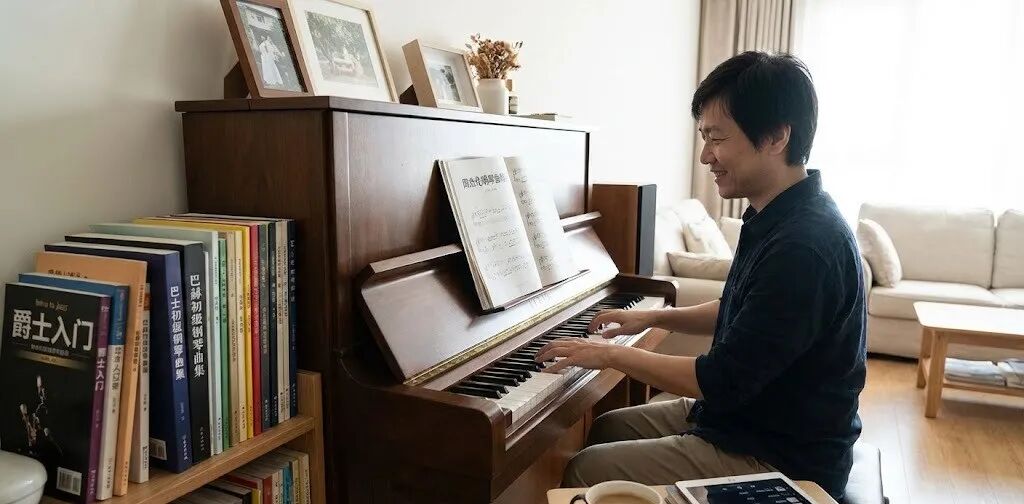
Music is fundamentally about expression and enjoyment, not exam certificates. Starting with Jay Chou doesn’t mean you’ll only ever play pop songs. Once your skills and interest have built up enough, branching into classical or jazz is a perfectly viable path.
At the end of the day, choosing Jay Chou over Beyer isn’t a question of right or wrong — it’s a question of strategy. For modern learners, especially adults with limited time who need immediate motivation, Jay Chou is simply the smarter choice.
Don’t let dry, joyless exercises kill your love of music.
Q&A
Q1: Won’t my hand position develop badly if I skip Beyer and go straight to pop songs?
No — as long as you have a real-time correction system. The traditional worry exists because without guidance, mistakes get locked in. But today’s AI practice tools can identify hand position, pitch accuracy, and rhythm issues in real time with 95% accuracy. Wonder Piano weaves foundational skill training into pop song practice, so hand position, dynamics, and rhythm are all developed progressively through real songs. The key is choosing a learning tool with solid technology behind it, rather than fumbling through on your own.
Q2: If I start with pop songs as an adult, can I still learn classical music later?
Absolutely. Starting with pop songs doesn’t mean giving up classical — it means adjusting the learning sequence. Data shows that learners who begin with pop songs actually progress faster when they later take on classical pieces, because they have real playing experience and understand the practical application of each technique. Jay Chou himself is a perfect example — his music blends classical elements, proving that pop and classical aren’t opposites. Many learners have successfully made the journey from “Simple Love” to “Fur Elise.”
Q3: Why is Jay Chou a better starting point than Beyer for modern piano learners?
It comes down to how motivation works. Beyer relies on delayed gratification — you need months of practice before you can play a complete melody, which drains adult motivation far too quickly. Data shows only 23% of traditional-path learners are still practicing after three months. Jay Chou provides instant motivation: a clear role model, achievable goals, social value, and a sense of accomplishment — things Beyer simply can’t offer. Psychology research confirms that specific, short-term goals are far more effective at sustaining motivation than abstract, long-term ones. Add AI technology that breaks difficult songs into progressive learning paths where fundamentals are absorbed naturally through practice, and “play songs first, build technique along the way” becomes a scientifically sound new approach. For adults who value their time and need to see practical results, Jay Chou is the smarter starting point.
Sources
The data and theoretical foundations in this article come from Wonder Piano’s product knowledge base, including user retention data, AI recognition technology specifications, and established educational psychology theories (Goal-Setting Theory, Social Learning Theory, and Adult Learning Theory).