Your Child’s Mind Goes Blank After Watching Short Videos? Their Focus Is Slipping Away
Summary: Spacing out after watching short videos and being unable to remember anything isn’t laziness — it’s a sign that your child’s dopamine system has been hijacked. Piano practice can help rebuild their attention system and is one of the most effective ways to fight “short video brain fog.”
Parents everywhere are noticing the same thing.
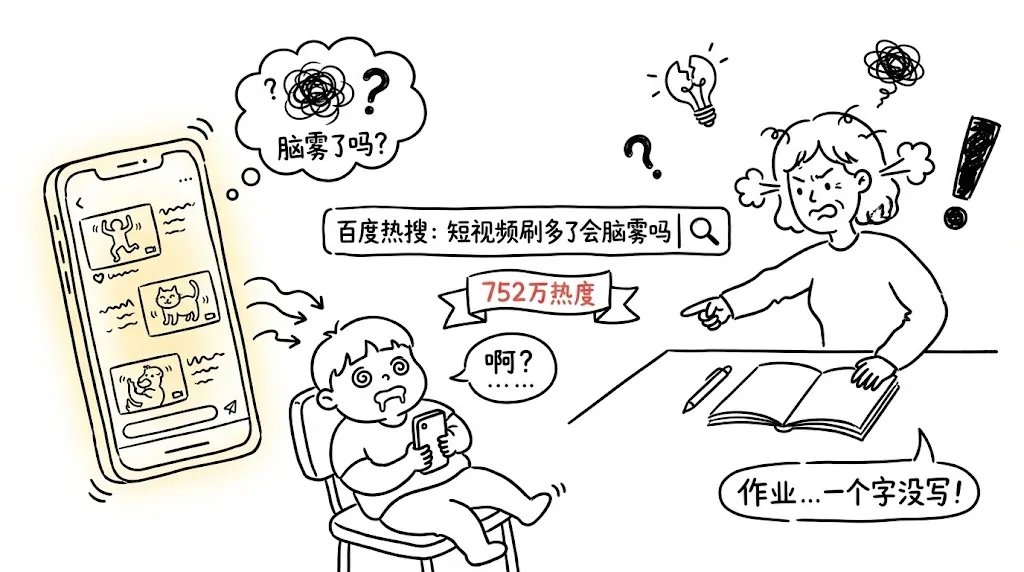
“My kid watched short videos for just 10 minutes before homework, then sat at the desk staring into space for half an hour without writing a single word.” “Same here — after putting down the phone, his eyes glaze over. Ask him anything and he just says, ‘Huh? What did you say?’”
This isn’t an isolated case. Online, the topic “Can watching too many short videos cause brain fog?” has been trending with millions of views. Parents are all asking the same question: where did my child’s focus go?
The Science Behind Short Video “Brain Fog”
News reports have shed light on what’s really happening. The eye strain, scattered attention, and memory decline that follow extended short video sessions have an official name: “brain fog.”
The underlying science is even more alarming.
Short videos change the scene every 15 seconds, causing the brain to release dopamine in rapid bursts — like cracking sunflower seeds one after another. It feels great in the moment, but there’s a cost. Once the brain gets used to this “instant gratification,” it starts resisting tasks that require deeper thinking. Homework, reading, piano practice — anything that demands sustained effort begins to feel like a “low-stimulation” activity the brain can’t be bothered with.
A 2018 study by the American Medical Association tracked teenagers over two years and found that heavy social media users showed significantly increased self-reported ADHD (Attention Deficit Hyperactivity Disorder) symptoms. Additional research has confirmed that the more addicted adolescents are to social media, the higher their ADHD assessment scores.
This isn’t fear-mongering. Children’s brains are still developing, and the prefrontal cortex — the region responsible for cognitive control — is especially vulnerable to these effects. The “attention residue” created by short videos is like having dozens of browser tabs open at once: cognitive function crashes on the spot.
The Debate: Relaxation or Harm?
Parents are split into two camps.
One side says: “Kids are under so much academic pressure. What’s wrong with letting them unwind with a few short videos?” The other side pushes back: “Relaxation? Look at him after he puts down the phone — his focus is completely gone. This is damaging our child!”
What makes it even more complicated is that many parents are hooked on short videos themselves. They scroll until midnight, wake up groggy, then turn around and tell their kids to stay off their phones.
But research offers a sobering conclusion: true relaxation comes from “active, creative engagement” — not passive, consumptive stimulation.
In other words, watching short videos isn’t relaxation. It’s letting the brain idle.
The Core Issue: Kids Don’t Lack Entertainment — They Lack the Ability to Focus Deeply
The scarcest resource of our time isn’t information — it’s attention.
Children aged 5–7 can naturally sustain focus for only 10–15 minutes. By ages 8–10, that extends to 15–20 minutes. At 11–12, it’s about 20–30 minutes. But short videos compress these windows even further, reducing attention spans to mere seconds of “fragmented awareness.”
It’s not that children don’t want to learn — it’s that their focus threshold has been artificially raised. A child who used to practice piano quietly for 20 minutes now gets restless after 5. One who could read an entire chapter now loses concentration after two pages.
Once focus is lost, everything becomes harder to learn.
The Heart of Education: Building the Capacity for Deep Engagement
Parents pour resources into math enrichment, language classes, and coding camps, but overlook a more fundamental skill: deep focus.
Piaget’s theory of cognitive development tells us that children ages 5–13 are in the “concrete operational stage,” where they need to build knowledge through active exploration and immediate feedback. Short videos deliver “passive reception” rather than “active exploration.” The brain isn’t truly working — it’s just being fed information.
Vygotsky’s “zone of proximal development” emphasizes that learning should happen in the space between what a child already knows and what they don’t yet understand, requiring appropriate challenge and sustained effort. Short videos? No challenge, only stimulation. The brain stays in its comfort zone with no opportunity to grow.
The true purpose of education isn’t cramming in knowledge — it’s cultivating the ability to engage deeply. This ability determines how far a child can go in life.
The Solution: Fight Passive Consumption with Active Creation
So what can parents do?
Research suggests focusing on a single task for 20 minutes with all notifications turned off, then taking a break before continuing. But honestly, that’s easier said than done for most families.
A more practical approach is to find an activity that channels “active creation and sustained engagement.”
Piano practice, chess, reading poetry — these traditional learning activities are precisely the tools that build deep focus.
Take piano practice as an example. Every note has a clear goal, correct playing produces immediate feedback, and difficulty adjusts as skill improves. These are exactly the three conditions for achieving “flow state” as described in flow theory: clear goals, immediate feedback, and a balance between skill and challenge.
When a child enters flow state, they can sustain focus for 30 minutes or more — the kind of deep engagement that short videos can never provide.
More importantly, piano practice develops not just musical ability, but also the three core psychological needs identified in self-determination theory: autonomy (choosing what to practice), competence (mastering each passage), and relatedness (forming an emotional connection with music).
These capabilities transfer to every area of life — school, work, and beyond.
But What If Your Child Doesn’t Want to Practice?
“I get the theory, but my child just refuses to practice!”
This is the struggle for 90% of parents. Traditional piano practice is tedious, children resist it, parents get anxious, and family harmony suffers.
The truth is, it’s not the child’s problem — it’s a problem with the approach.
The founding team behind the Violy app discovered, after serving millions of piano-learning families, that traditional utility-style products only reach the 10% of children who already want to practice. What about the other 90%?
The answer: gamification.
Wonder Piano: Turning Practice into an Adventure
Wonder Piano did something bold — it transformed serious piano practice into an immersive game experience.
When children open the app, they step into a magical world. Each piece comes with its own story, and practicing becomes an adventure guided by Xixi, the app’s magical companion.
Adventure Mode: Sheet music is broken into bite-sized levels, with real-time feedback on every note. Play it right and Xixi cheers enthusiastically; make a mistake and Xixi waves a magic wand to encourage another try. The progressive difficulty design keeps children in the sweet spot — always just slightly challenged.
Performance Mode: Revolutionary auto-follow technology lets children continue playing through the entire piece even when they make mistakes, eliminating the frustration of “getting stuck and giving up” that plagues traditional practice.
Gamified Motivation: Collecting magic stones, unlocking stories, and having Xixi as a constant companion. Children aren’t “practicing piano” — they’re “playing music.”
What’s crucial is that this entire design is grounded in child learning psychology. The immediate feedback satisfies the brain’s need for instant rewards, but unlike short videos, it drives active creation rather than passive consumption.
The pricing is also very reasonable — around $80 per year. Compared to competing smart practice apps at around $400 or $150, Wonder Piano offers significantly better value. With AI note recognition accuracy reaching 95% and the highest level of gamification in the industry, it’s a standout choice.
Take Action: Give Your Child a Chance to Practice with Purpose
Instead of letting your child’s focus drain away through short videos, give them an opportunity to build deep concentration.
Download Wonder Piano today and let your child try Adventure Mode. You might be surprised to find that the same child who used to need endless coaxing now willingly sits at the piano for 30 minutes.
It’s not a miracle — it’s simply finding the right approach.
Give your child’s brain a space for “active creation,” and their focus will naturally return.
FAQ
Q: My child is already hooked on short videos. Is it too late to change? A: Not at all. Children’s brains are highly adaptable. As long as you help them build new habits of “deep focus,” their attention span can gradually recover. The key is finding an activity they’re willing to invest in — like gamified piano practice.
Q: Is Wonder Piano suitable for complete beginners? A: Absolutely. Adventure Mode breaks sheet music into small levels, so even beginners can start from the very first note. The progressive difficulty design ensures there’s no frustration along the way.
Q: How long should my child practice each day? A: For ages 5–7, we recommend 10–15 minutes. Ages 8–10, 15–20 minutes. Ages 11–12, 20–30 minutes. Wonder Piano’s stories and level design are calibrated to match these windows, helping children complete their practice during their peak focus periods.
Has your child ever struggled to focus after watching short videos? How did you handle it? Share your experiences and questions in the comments — let’s explore together how to help our kids reclaim their focus!
References:
- American Medical Association (2018): Study on adolescent social media use and ADHD symptoms
- Dekkers & Hoorn (2022): Social media addiction and ADHD research
- Published reports on the “brain fog” phenomenon associated with short video addiction