Why Does the “Free-Range” Second Child Always Learn Piano Faster Than the Carefully Coached First?
In families with two children, there’s a well-known parenting paradox: the first child is raised “by the book” — meticulously guided at every step — yet piano practice turns into a daily battle. The second child is left mostly to their own devices — and somehow picks it up like a natural.
Many parents are baffled: they gave the first child more resources, more supervision, and more effort — so why does the second child seem to have more natural feel and learn faster?
In the past, we might have chalked it up to the second child simply being “more talented.” But recent research in developmental psychology tells a different story. This isn’t just about talent — it’s a revealing experiment in parenting mindset.
The truth might sting a little: the second child learns faster precisely because you’re managing them less.
The Frontrunner Effect: The Second Child Has a Built-In Guide
First, we have to acknowledge the difference in environment. Alfred Adler, the renowned 20th-century psychologist and founder of Individual Psychology, proposed his famous “birth order theory.” He pointed out that when the second child is born, they already have a “frontrunner” in their life.
For the second child, learning piano isn’t some abstract task — it’s “that fun thing my older sibling is doing.” Social learning theory confirms this: children acquire skills through observation far more quickly than through being told what to do.
When the older sibling practices piano, the younger one plays with blocks nearby — but they’re actually absorbing the lesson subconsciously.
When the older sibling gets scolded, the younger one watches from the sidelines and learns what pitfalls to avoid.
This kind of “observational learning” means the second child already has a mental map of music before they ever sit down at the piano. Meanwhile, the first child is often navigating in the dark, carrying the full weight of their parents’ anxiety.
The Cost of Over-Intervention: The Closely Watched First Child Loses Their Sense of Control
This is the point most worth reflecting on. With the first child, we tend to become “helicopter parents”: correcting their posture, interrupting every wrong note, sighing at unsteady rhythm. This kind of intense attention can actually be psychologically harmful.
A study published in the Journal of Child and Family Studies on “over-parenting” found that excessive psychological control by parents — attempting to control a child’s behavior, emotions, and thoughts — directly erodes a child’s sense of autonomy and significantly increases their anxiety levels.
Another study published in a leading academic journal found that when parents display excessive control while sitting nearby, the child’s brain switches from “learning mode” to “defense mode.”
In other words, when the first child practices piano, 80% of their energy goes toward reading their parents’ mood.
“Mom is frowning — I just need to not make mistakes. Whether it sounds good doesn’t matter.”
“Dad just sighed — I’d better finish this piece and end the suffering.”
And the second child? Because the parents are still busy with the older one, they often don’t have time to hover. Their attitude toward the second child is usually: “Just play around and have fun.”
It’s precisely this relaxed, hands-off approach that unexpectedly gives the second child the most valuable educational resource: autonomy. Research shows that “autonomy-supportive” parenting maximizes a child’s intrinsic motivation, leading to greater engagement in skill development — including fine motor skills and artistic perception.
The second child is “playing” the piano. The first child is “checking off a task.” Who progresses faster is obvious.
How Can Every Child Have the Second Child’s Joyful Learning Speed?
At this point, many parents might ask: “So should I just stop paying attention to my child’s practice altogether? Complete hands-off?” Of course not. “Hands-off” doesn’t mean indifference — it means “high-quality letting go.” Provide the environment, but don’t interrupt the process. Provide the tools, but don’t project your anxiety.
We need not only to reflect, but to act. Is there a way to give children the same freedom to explore that second children enjoy, while still ensuring practice quality — without parents having to serve as constant human monitors?
That’s exactly why Wonder Piano was created. Our goal is to use technology to transform parents from “stern supervisors” into “appreciative audience members,” and to turn piano practice from “a tedious chore” into “an engaging game.”
AI “Gentle Feedback” — No More Hovering and Scolding. The biggest problem with parents sitting in on practice is the constant interrupting. Wonder Piano’s real-time AI recognition system uses a tablet or phone microphone to capture sound and accurately identify pitch, rhythm, and dynamics.
But unlike a parent, our AI uses a “gentle feedback” approach. When a child plays a wrong note, the AI doesn’t stop them in frustration — instead, it provides on-screen cues that encourage self-correction. This non-intrusive companionship preserves the child’s flow state, letting them grow in a low-pressure environment, just like a second child would.
Gamification That Drives Intrinsic Motivation
The reason second children learn faster is that it feels fun. Wonder Piano turns repetitive practice into a story-driven adventure system.
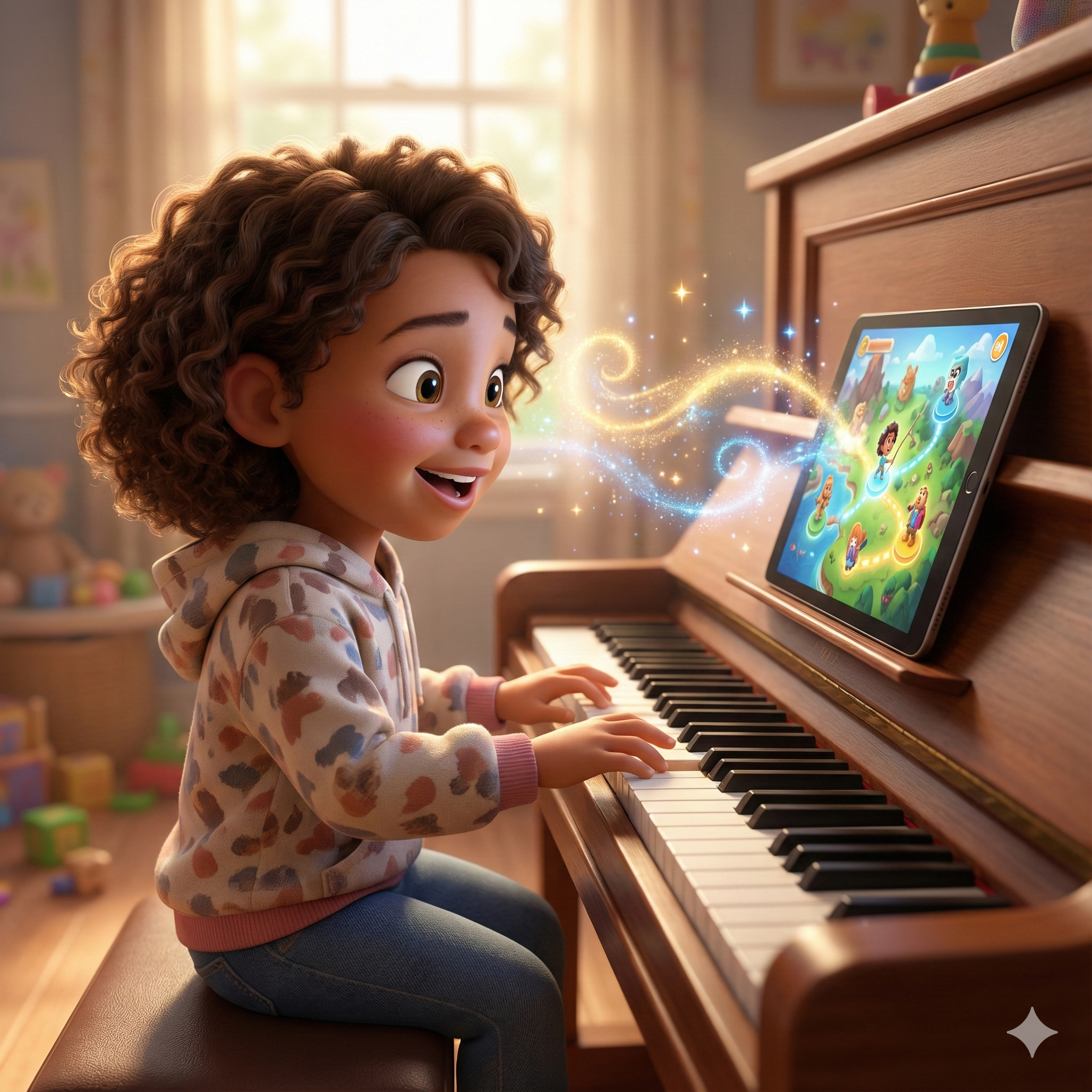
Every practice session is a “magical adventure.” Children unlock story chapters by playing pieces, earning magic stones and power points as rewards. This replaces the traditional task-based approach, transforming “I have to practice” into “I want to practice” — truly putting intrinsic motivation first.
Free Parents to Be the Cheerleaders Again. With Wonder Piano, parents no longer need to understand music theory, and they don’t have to be the “annoying supervisor.” Clear digital practice records let you see your child’s progress at a glance. No more hovering over every practice session.
Education isn’t about filling a bucket — it’s about lighting a fire. Whether it’s the first child or the second, every child deserves that pressure-free time to explore. Try letting go of the anxiety, leave the expert feedback to Wonder Piano, and give your child love and companionship instead.
You might find that when you stop trying so hard, your child actually runs faster.