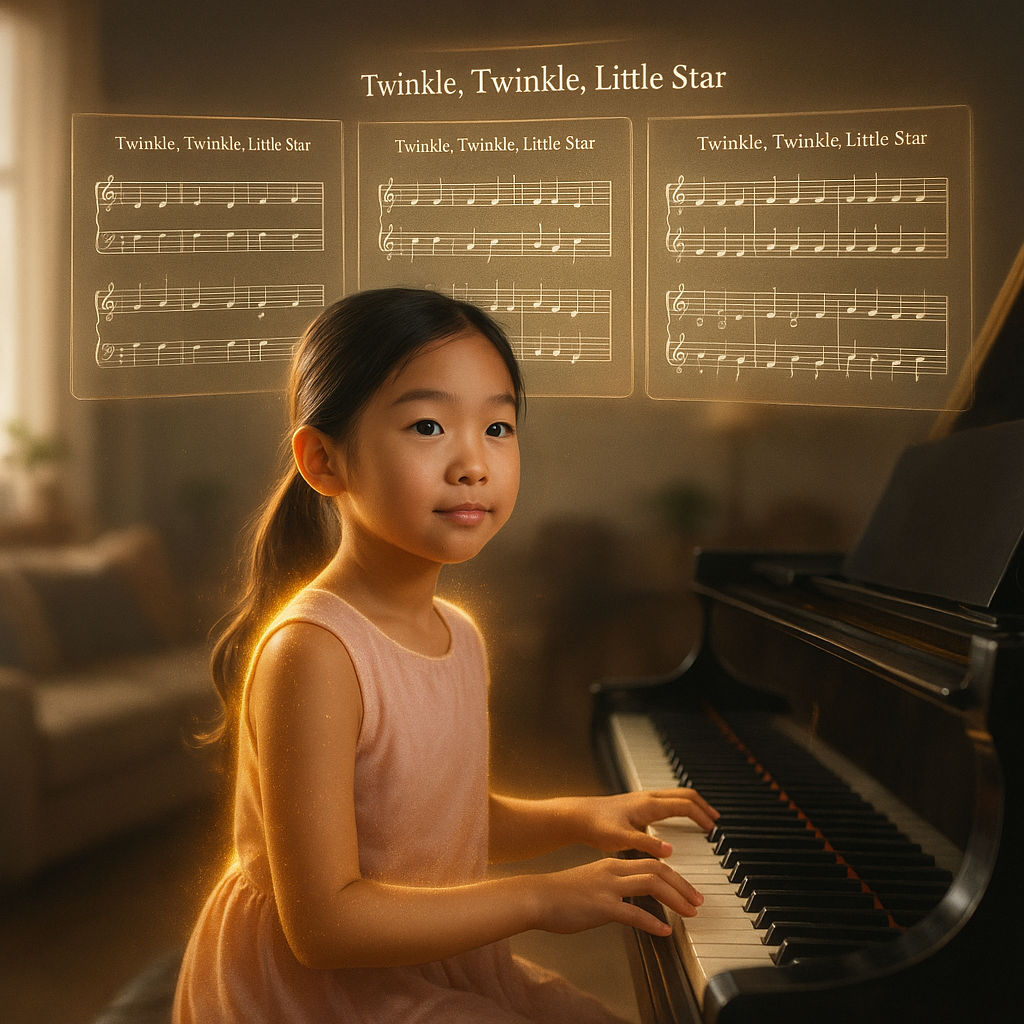
Why Does the Same Piece Have Different Versions? Did You Pick the Wrong One?
“Mom, why does my classmate’s ‘Twinkle Twinkle Little Star Variations’ sound better than mine?” “Why is the ‘Fur Elise’ on YouTube so long when mine is so short?” “The ‘Canon’ in my textbook is really easy — did the teacher give me the wrong version?”
These are questions nearly every piano family runs into sooner or later. And behind them lurks a deeper worry: “If we picked the wrong version, has all this practice been for nothing?”
In the world of music education, this question deserves a serious answer. But first, the bottom line: no practice is wasted — though how well the version matches your child’s level determines both efficiency and experience.
Practice always has value. Any version builds sight-reading, rhythm, fingering, and ear training.
But picking the wrong version can kill your child’s learning efficiency and motivation
Too hard: Repeated frustration drains enthusiasm, and technique starts to break down.
Too easy: Fingers never warm up, progress stalls, and advancement slows.
Misaligned difficulty: The piece may get “finished,” but the core foundational skills never actually get trained.
So the real issue isn’t that there are many versions — it’s whether the version matches your child’s current stage. In education terms, this is called “progressive skill building.”
The difficulty should always be just “one small step above” what your child can already do.
Why does the same piece come in so many versions?
Understanding the versions is the first step to letting go of the anxiety.
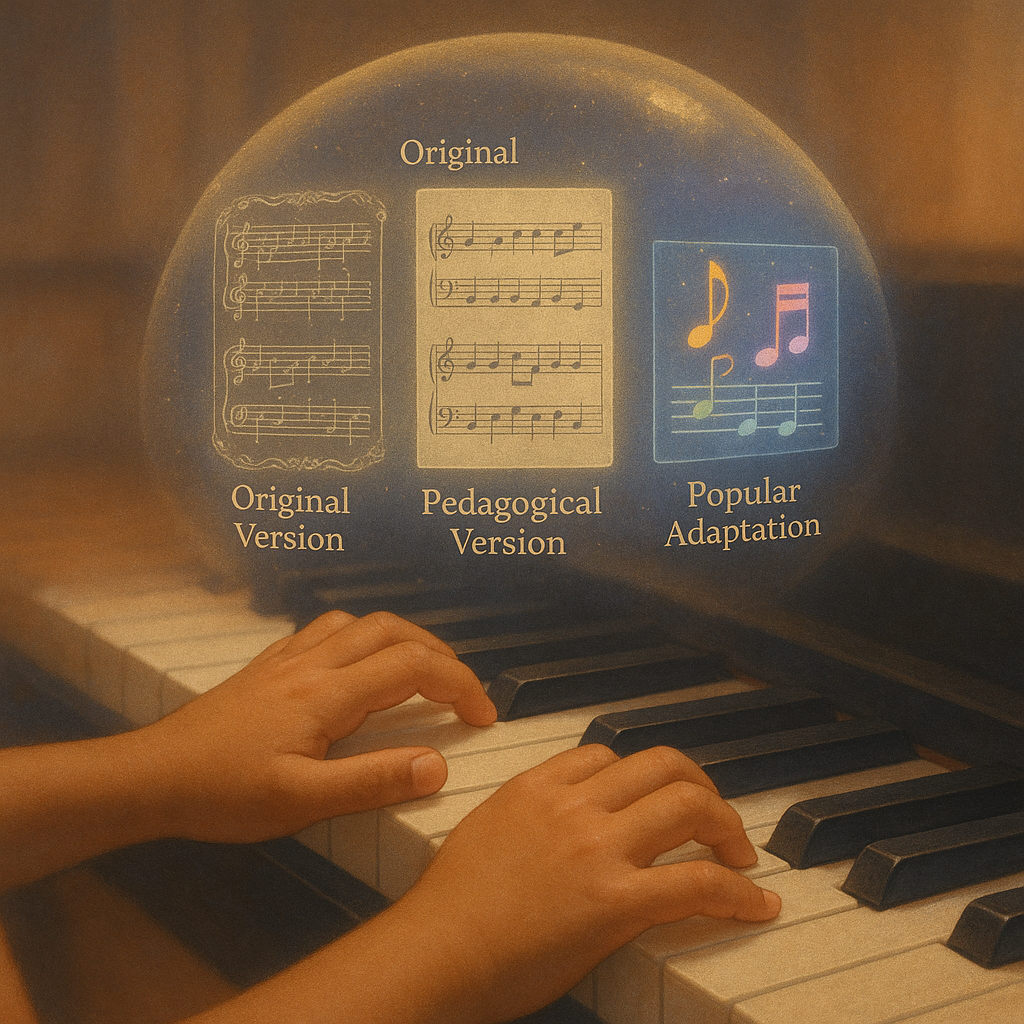
The Original Version — Purpose: Complete fidelity to the composer. When composers wrote their pieces, they weren’t thinking about beginner children. For example, the full version of “Fur Elise” was meant for accomplished players and includes complex ornaments and highly demanding passages. Key trait: Musically complete, but the difficulty scares off beginners.
The Textbook Arrangement — Purpose: Built as a learning staircase. Arranged by professional music educators, often called the “simplified” or “teaching” version.
Simplifies complex harmonies and rhythms.
Adjusts fingering to suit small hands.
Preserves the essential main melody.
Emphasizes specific skills for the current stage (such as left-hand accompaniment, staccato, etc.).
This isn’t “watering down the music” — it’s building a staircase so your child can climb the tower one step at a time.
The Fun Adaptation — Purpose: Spark interest and keep the love alive. Think piano versions of pop songs or movie soundtracks your child enjoys. These aren’t meant to replace structured training — they’re the “dessert” that keeps your child going through the harder work.
Three versions, three purposes: artistry, education, and enjoyment. All three matter.
Replace “Right vs. Wrong” Anxiety with a “Fit” Mindset
Psychologist Lev Vygotsky had a famous theory called the “Zone of Proximal Development”: Learning material should sit right in the zone where the child is “stretching on tiptoe, just barely reaching.”
Can’t reach it (too hard) — the child feels defeated.
No effort needed (too easy) — the child gets bored.
Children aren’t afraid of difficulty — they’re afraid of the hopelessness of “never being able to reach.” A learning science study from MIT found that when music learning is appropriately matched in difficulty, children’s persistence increases by 68% and confidence rises by 52%.
The goal of practice isn’t “conquer a Mozart sonata in one week.” It’s “building the confidence that ‘I can do this’ so your child wants to keep growing.”
The Golden Three Dimensions for Judging Whether a Version “Fits”
Professional teachers and good educational products evaluate from three angles:
1. Technical match: Can they “reach” it? Does the child have the necessary fundamentals?
Is their hand position relaxed?
Can they control legato and staccato?
Is their basic quarter-note and eighth-note rhythm steady?
Can they play simple broken chords?
2. Musical match: Can they “hear” it? Are they just mechanically pressing keys, or can they actually express phrasing, dynamics, and musical breathing?
3. Psychological readiness: Can they “handle” it? Does practice create a positive feedback loop? (The right cycle: Child conquers a challenge → feels a sense of accomplishment → wants to keep going)
An important signal: If a piece causes your child to show extreme frustration, resistance, or visible tension (like raised shoulders or stiff arms) for multiple days in a row (say, more than a week), it doesn’t mean they need to “toughen up” — it means the version genuinely doesn’t fit.
Focus on Building Habits, Not Conquering Difficulty Levels
Music is a marathon, not a sprint. What truly determines how far your child goes isn’t what grade they reach by age 10 — it’s intrinsic motivation + steady pace + positive feedback loop.
Remember what music educators widely agree on: Children don’t quit because they “can’t play well” — they quit because they “believe they can’t.”
Choosing the right version is fundamentally about protecting your child’s patience, confidence, and that original spark of curiosity.
The logic makes sense, but execution is hard. Many parents don’t have a music background and struggle to judge “technical match” or “psychological readiness.” In recent years, good AI practice tools have been tackling this “matching” challenge. They’re not just “error-correction assistants” — they’re “learning planners” and “practice companions.”
Take Wonder Piano as an example. It has built a dual support system for both technique and mindset:
Massive library, scientifically tiered: Covering children’s songs, classical introductions, and pop arrangements. Every piece of sheet music is carefully leveled by difficulty and training goals, making sure your child gets music that’s “just a stretch away.”
AI-powered precision: AI recognizes pitch, rhythm, and even dynamics in real time. It knows exactly where your child is getting stuck.
Gentle feedback model: It won’t constantly interrupt or harshly correct — instead, it encourages self-correction, protecting your child’s sense of accomplishment.
Interest-driven design: Through story-based adventures and magic gem rewards, it turns tedious practice into a game-like experience that keeps motivation going.
Transparent for parents: No music background needed — you can still understand the learning reports and stay involved in your child’s journey.
At its core, this system brings back the heart of education: step by step, making practice doable and sustainable.
The variety of music versions isn’t a “trap” in education — it’s a sign of a mature educational approach. It doesn’t give children shortcuts; it gives them a scientific, gradual, psychologically attuned path for growth.
No Version of Sheet Music Is “Better” or “Worse” — The Right Fit Is the Best Choice
May every child experience a genuine “I can do this” moment at the keyboard. And may every practice session turn music into a lifelong love — not a short-lived chore.