The Biggest Piano Myths That Mislead Parents
Summary: “Longer fingers are better” and “if you don’t start by age 3, it’s too late” — these widely shared beliefs about learning piano are pure pseudoscience. This article uses deliberate practice theory to debunk the most common myths, helping parents move from guesswork to science-based practice and avoid mistakes that could hold back their child’s musical development.
What Outrageous Myths Have You Heard?
In online discussions, alongside health and wellness myths, you’ll find plenty of myths about children’s education. One popular comment reads: “My mom always believed that you need long fingers to play piano. Because my hands were small, she never let me learn. Looking back, I missed out on a great chance to develop my musical abilities.”
Among thousands of replies, parents shared their own stories of being misled:
“The teacher said you have to practice exactly two hours every day, not a minute less. The result? My child just sat there zoning out and played worse than anyone.”
“I saw a post on social media saying ‘if your child doesn’t start piano by age 3, it’s too late.’ I panicked and signed him up right away. Now he’s six, and the teacher says he can’t sit still at all. We wasted two years of tuition for nothing.”
These well-meaning pieces of advice are actually pseudoscience. They spread like viruses through parent groups, derailing countless children’s musical potential every year.
How to Approach Piano Learning the Right Way
Parents tend to fall into two camps:
The Traditional Camp believes: Learning piano means suffering. Talent determines everything. If your child’s fingers aren’t right, don’t bother. You must practice a fixed number of hours every day. One wrong note means start over. The faster you pass grading exams, the better your child is doing…
The Science-Based Camp argues: Interest is the best teacher. Practice method matters more than duration. Anyone can improve through scientific training. Moderate, focused practice beats exhausting marathon sessions. Understanding music matters more than mechanical repetition…
At its core, the debate comes down to this: Should we teach children based on tradition and gut feelings, or should we nurture them with science-backed methods?
This isn’t just a clash of educational philosophies — it directly affects the learning experience and future development of countless young musicians.
Why Do These Myths Persist?
Many long-standing “truths” about piano simply don’t hold up under scrutiny. They either exaggerate the role of talent, place blind faith in logging hours, or use parental anxiety as leverage.
What truly determines whether a child can learn piano well is: scientific practice methods + reasonable goal-setting + sustained interest.
The root cause is this: Music education is still stuck in the “gut-feeling” era, lacking the support of scientific research.
Traditional piano teaching often treats a teacher’s personal experience as gospel. However the teacher was taught, that’s how they teach. Whether this approach works for every child or whether there are more effective methods is rarely questioned.
What’s worse, parental anxiety is being commercially exploited. Phrases like “if you don’t start by age 3, it’s too late” and “without grading exams, there’s no future” hit parents right where it hurts, making them afraid to question or slow down.
But educational psychology proved long ago that learning outcomes do not equal hours spent, and expertise is not solely determined by talent.
The key isn’t “how long you practice,” but “how you practice.” Mechanically repeating for 10,000 hours is far less effective than 1,000 hours of deliberate practice.
What Is “Deliberate Practice”?
Professor Ericsson identified four core elements:
1. Clear Goals Not “practice well today,” but “learn measures 1 through 8 today” or “get this staccato passage up to 120 beats per minute.”
2. Focused Engagement Adults can sustain a maximum of 4–5 hours per day (in multiple sessions); children can manage 1–2 hours per day (in multiple sessions). Beyond that, practice efficiency drops sharply.
3. Immediate Feedback Know right away when you play a wrong note and adjust immediately. Delayed feedback causes mistakes to become ingrained habits.
4. Stepping Outside the Comfort Zone The optimal practice zone is 70–90% accuracy. Too easy (above 95%) means no growth; too hard (below 60%) leads to giving up.
Here’s an example:
Ordinary Practice: Mindlessly playing scales 10 times ≈ no real practice Deliberate Practice: Setting a speed goal, using a metronome, recording and listening back, focusing on weak spots > 10 rounds of ordinary practice
This is why some children practice two hours a day and make no progress, while others practice just 30 minutes and improve rapidly.
The gap isn’t in duration — it’s in method.
The true purpose of piano education is to help children develop:
- Focus: The ability to concentrate and complete a task
- Goal Awareness: Knowing what you’re practicing and why
- Resilience: Not giving up when facing difficulty, and being willing to try again
- Self-Motivation: Moving from “I’m told to practice” to “I want to practice”
Building these abilities requires scientific methods, not simply piling on hours.
How Can Parents Help Their Children Escape These Myths?
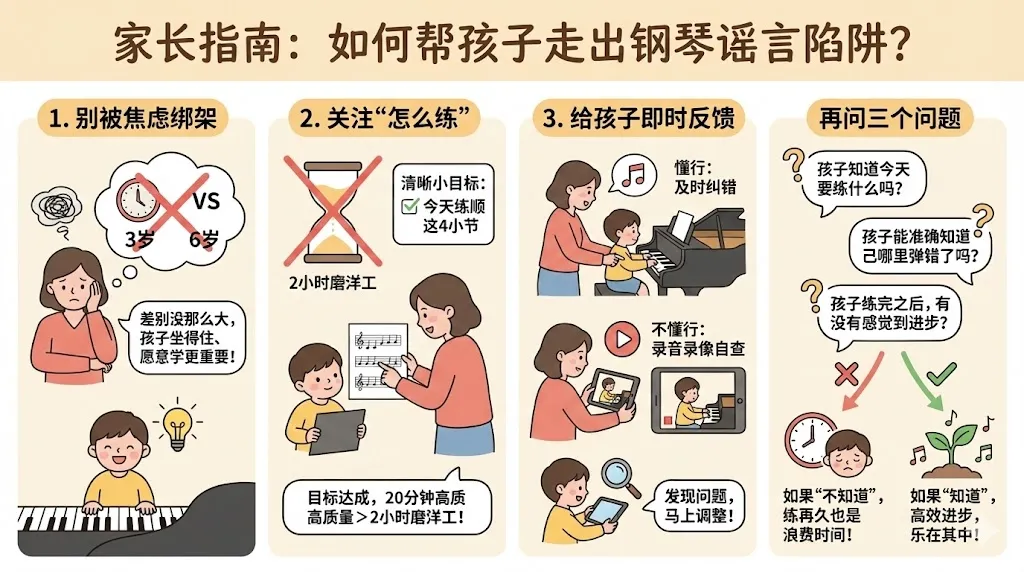
First, don’t let anxiety drive your decisions. Starting at age 3 versus age 6 doesn’t make as big a difference as you might think. Whether your child can sit still and is willing to learn matters far more than starting a year earlier or later.
Second, focus on “how to practice,” not “how long to practice.” Instead of watching the clock to make sure your child sits for two hours, help them set clear, small goals: “Today, let’s get these four measures smooth.” If they achieve the goal in just 20 minutes, that’s worth more than two hours of unfocused practicing.
Third, give your child immediate feedback. If you know piano, sit nearby and correct mistakes in real time. If you don’t, use recordings — audio or video — so your child can listen and watch for themselves, spotting their own errors.
Ask yourself three questions:
“Does my child know what they’re supposed to practice today?” “Can my child tell exactly where they played a wrong note?” “Does my child feel a sense of progress after practicing?”
If the answer to all three is “I don’t know,” then no amount of practice time will prevent it from being wasted.
5 Practical Tips for Parents
1. Break Goals into Small Steps Don’t have your child tackle the entire piece at once. Split the score into small sections and master one section at a time. Once one section is solid, move on to the next. As small victories add up, your child’s confidence will grow.
2. Set the Right Difficulty — Aim for 70–90% Accuracy Pieces that are too easy won’t hold your child’s interest. Pieces that are too hard will frustrate them. Choose a difficulty level that’s a slight stretch — that’s where motivation thrives.
3. Use a Metronome and Recordings for Instant Feedback A metronome helps your child master rhythm. Recordings help them catch their own mistakes. These two tools are more effective than a hundred reminders from a parent.
4. Practice in Short Sessions — Avoid Marathon Practice Children have limited attention spans. Each practice session should last about 15–20 minutes before taking a break. Three 20-minute sessions in a day is far better than forcing a child to sit for two hours straight.
5. Celebrate Progress Instead of Punishing Mistakes When your child plays a passage better today than yesterday — even just one measure — acknowledge it right away. Helping your child feel “I’m getting better” is far more effective than fixating on errors.
Remember: Scientific methods + moderate practice > traditional rules + exhausting marathon sessions.
It’s Time to Say Goodbye to These Harmful Piano Myths
You don’t need to wait for your child to grow “piano hands.” You don’t need to force two hours of practice every day. You don’t need to turn your child into a grading-exam machine.
All you need to do is:
Start today — replace anxiety with science.
Help your child set one small goal, join them for one high-quality practice session, and celebrate every bit of progress.
Small changes lead to big differences.
When a child feels that “practicing piano makes me stronger” rather than “practicing piano is punishment,” their musical potential can truly blossom.
Don’t let a myth destroy a child’s dream of music.
FAQ
Q: My child has short fingers. Are they suited for piano? A: Finger length has nothing to do with piano ability — many professional pianists have small hands. What matters is scientific training methods and consistent practice.
Q: What’s the best age for a child to start learning piano? A: Ages 5 to 7 is generally an ideal range, but what matters more is whether your child can sit still and is willing to learn, rather than hitting a specific age.
Q: Does my child have to practice for 2 hours every day? A: Practice quality matters more than duration. For children, 1–2 hours of high-quality practice per day (split into multiple sessions) is far more effective than long, unfocused sessions.
What’s the worst piano advice you’ve heard during your child’s learning journey? Share your experience — you might be surprised how many other parents have fallen for the same myths!