The Hidden Benefits of Piano: Why Kids Who Play Piano Tend to Excel at Math and Reading
Do you ever worry that spending hundreds of dollars a month and countless hours on piano lessons is “stealing” time from your child’s math and language studies?
Have you ever done the math: “The neighbor’s kid is at a math tutor, while ours is practicing piano.” “If we spent that same time doing extra worksheets, wouldn’t their grades be better?”
If that’s how you think, let me be blunt: 90% of parents have misunderstood the true value of piano lessons from the very start.
Every minute we invest in piano isn’t “wasting” time on academics — it’s actually reinforcing core subjects in the most efficient, foundational way possible, especially math and reading.
How Does Piano Practice Activate Spatial Reasoning?
Piano Practice “Forces” the Brain to Perform Spatial-Temporal Reasoning
Parents might assume math is logic and piano is art. But the brain doesn’t see it that way. When a child sits down at the piano, what do they need to do?
Reading sheet music: Dense musical notation is essentially a coordinate system. Which note sits on which line or space? (Spatial positioning)
Counting rhythm: Whole notes, half notes, quarter notes… aren’t these the same as fractions and multiples in math? (Logical computation)
Playing hands together: The left hand plays one rhythm while the right hand plays a melody, both coordinating with millisecond precision. (Multitasking + fine-grained timing)
This entire process is what neuroscience calls “spatial-temporal reasoning.” And this ability is precisely the core foundation for excelling in math — especially geometry, algebra, and logic.
This isn’t guesswork. Let’s look at the data — the landmark Rauscher & Shaw study: Dr. Frances Rauscher of the University of Wisconsin and Dr. Gordon Shaw of the University of California conducted a famous experiment. They provided a group of preschool children with six months of piano keyboard lessons.
The result: Compared to the control group (children who didn’t learn piano), the piano students scored an average of 34% higher on spatial-temporal reasoning tests.
A 34% improvement! What does that mean?
It means that while other children are still memorizing multiplication tables by rote, your child’s brain — thanks to regular piano practice — may have already activated the neural networks responsible for spatial awareness and logical thinking. They can more easily grasp abstract concepts like fractions, ratios, patterns, and geometric shapes.
Another finding from a large-scale study in the Journal of Educational Psychology: The study found that high school students who systematically studied a musical instrument scored an average of 19% higher on Algebra 2 (advanced math) exams compared to non-music students.
In other words: You might think your child is just “playing a song,” but they’re actually “solving a math problem.” This kind of subtle mathematical thinking training is something no after-school math program can provide.
How Does Music Reshape Reading Ability?
If the connection between piano and math feels fairly “logical,” the link between piano practice and reading comprehension is even more surprising. Have you noticed that children who play piano seem to have a better “feel” for memorizing texts and understanding poetry?
The key point: music is essentially “the language of sound.” The areas of the brain that process music and language overlap significantly. When children practice piano, they aren’t mechanically pressing keys — they’re learning to express:
Is this musical phrase a “question” or an “exclamation”? (Like punctuation marks)
Do the crescendos and decrescendos here express “excitement” or “sadness”? (Like emotional tone and rhetoric)
Where is the right place to pause (breathe)? (Like sentence phrasing)
Isn’t this exactly the same as analyzing an author’s “main idea” and “emotional tone” in reading comprehension?
Let’s look at more data — the Moreno study: Dr. Sylvain Moreno of York University in Canada found that after just 20 days of music-based cognitive training, 90% of children showed significant improvement in “verbal intelligence.”
What is “verbal intelligence”? It’s what we commonly call “reading ability” and “expressive ability.”
The Journal of Educational Psychology study mentioned above also drew conclusions about reading: Students who consistently practiced an instrument scored an average of 13% higher on English Literature exams (the equivalent of language arts).
In other words: A child who can play a piece “with emotion” has already learned how to empathize and decode non-verbal information.
When they go back to read a text, they don’t just see words on a page — they can sense the “melody” the author has woven into the writing: whether it’s passionate, gentle, or somber.
This is the highest level of reading comprehension.
The Logic Is Sound, but 99% of People Get Stuck at “Can’t Keep Practicing”
If you’ve read this far, many parents are probably feeling that piano lessons are a “bargain”: it turns out you didn’t just sign up for an “extracurricular” — you actually gave math and language arts a powerful one-two punch!
But here comes the real challenge: all these “hidden benefits” — math, reading, focus, resilience — are built on one absolute prerequisite: the child must practice consistently.
And in reality, what often happens is:
You pay for lessons, but your child practices sporadically.
When you come home from work, you’re not practicing alongside them — you’re “supervising” and “battling.”
Eventually, dust piles up on the piano, and whatever interest the child had in music gets “yelled” away completely.
This is the real cost: We invest money and time, and not only do we miss out on the “hidden benefits,” we actually damage the parent-child relationship.
Our Answer: Getting Kids to Practice on Their Own
At Wonder Piano, we deeply understand this pain point. From the very beginning, our core mission hasn’t been to “teach” piano playing (that’s the teacher’s job) — it’s to “get kids to practice willingly and make it easy for parents to be supportive.”
So how do we turn “I have to practice” into “I want to practice”?
First, we replace “task mode” with “game mode.” We’ve found that children don’t resist repetition — they resist boring repetition.
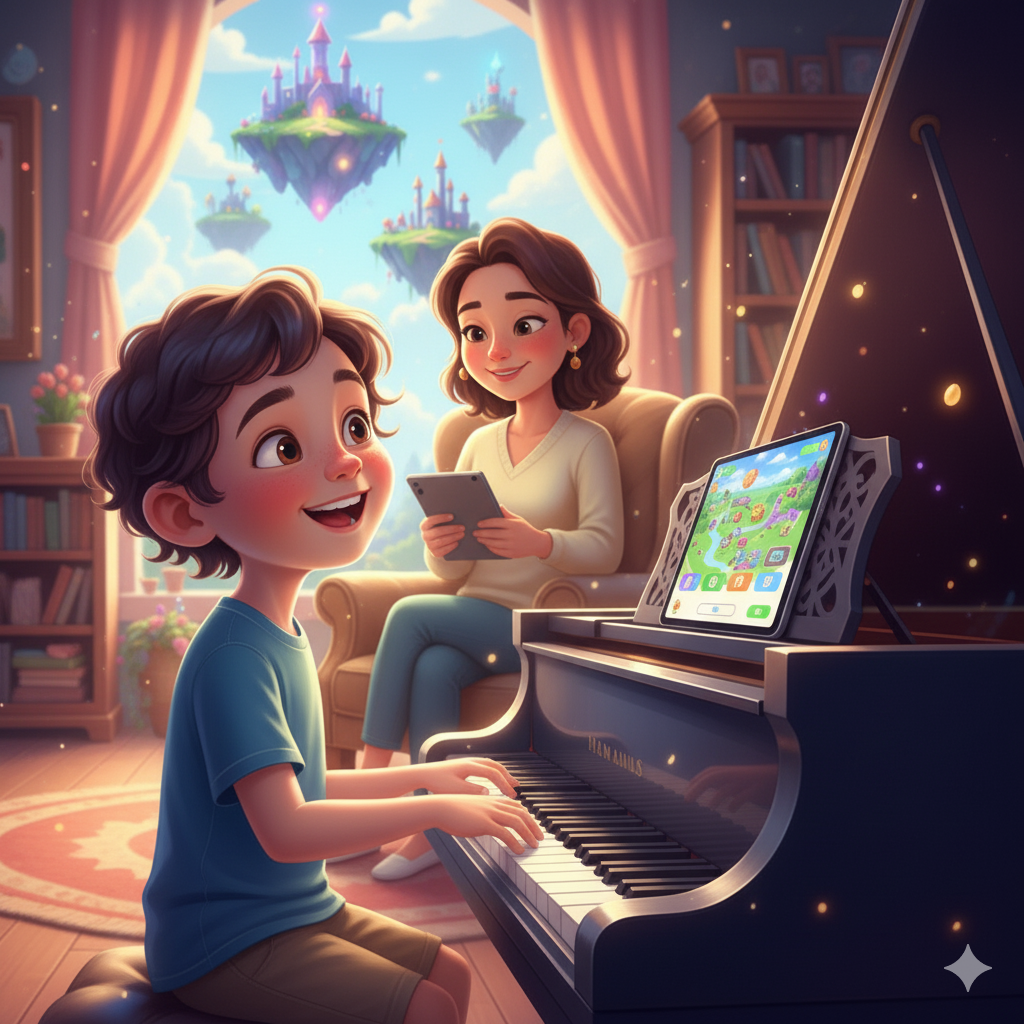
With Wonder Piano, practice isn’t a chore — it’s a magical adventure. Every time a child plays, they’re unlocking storylines and collecting “magic stones” and “magic points.” We use powerful positive reinforcement to firmly connect practice with fun and a sense of achievement.
Many parents have been delighted to report that “our child is more willing to open the app and practice on their own,” and some say it’s “like playing a game while playing the piano.”
Second, we use “gentle feedback” to protect children’s intrinsic motivation. The biggest source of frustration in traditional practice is hitting wrong notes. We’ve developed an industry-leading AI real-time recognition system that requires no external hardware — it can accurately identify pitch, rhythm, and even dynamics.
But the key is this: when a child plays a wrong note, we don’t immediately interrupt or sound a harsh “error” alert. We use gentle feedback that encourages the child to self-correct. This dramatically reduces the frustration of practice and protects the child’s precious curiosity and sense of accomplishment.
We want parents to be able to “relax and enjoy the journey.” With Wonder Piano, parents don’t need any musical background to understand practice reports. You’re no longer the “taskmaster” standing over them with a stick — you become the “cheerleader” who genuinely applauds when your child completes a challenge.
We believe that a child who wants to practice and a parent who knows how to encourage — this kind of positive parent-child cycle is the real driving force behind sustained progress.
Learning piano was never about “becoming the next Lang Lang.” It’s about building the deep foundations of spatial thinking and verbal intelligence through those repetitive practice sessions.
Don’t let the difficulty of practice stand between your child and those hidden benefits.
At Wonder Piano, we don’t create “prodigies.” We simply use technology and love to ignite a child’s intrinsic motivation, so they can naturally discover those wonderful surprises in math and reading through a joyful, magical adventure.