When Champions Fall and Young Pianists Break Down: What Musicians and Athletes Have in Common
Summary: A 0.1-second mistake on the Olympic ice and a wrong note meltdown in the practice room share the same root cause. This article draws parallels between musicians and athletes — exploring their shared demands for precise physical control and mental resilience under pressure, the brain science behind repetitive practice, and how Wonder Piano turns the harsh “arena” into a joyful adventure.
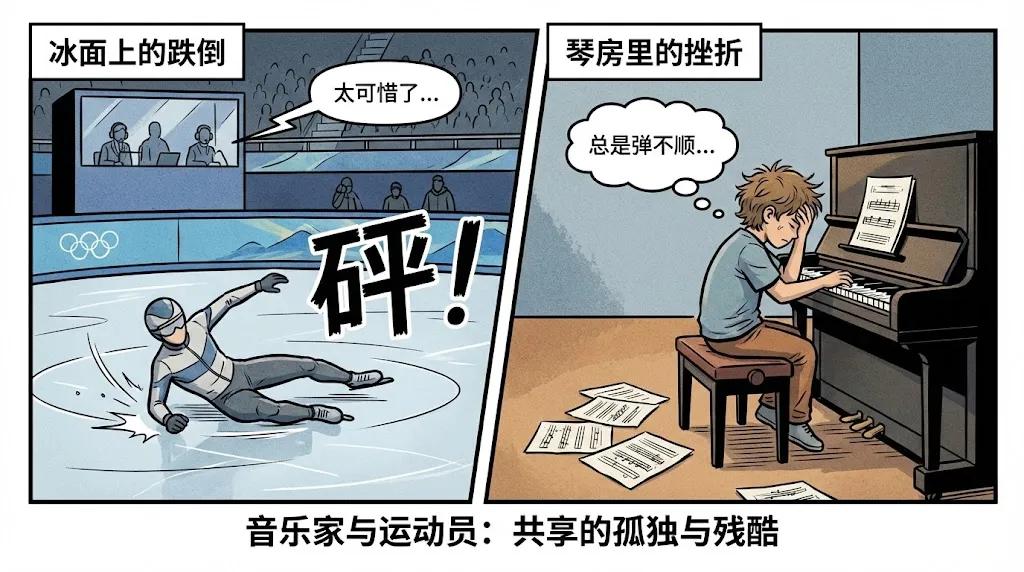
On the Winter Olympics ice rink, a celebrated figure skater glides at full speed. Jump, spin, land —
Crash. He falls. The commentator lets out a long sigh: “What a shame. His center of gravity was probably off by just a few millimeters at takeoff.”
Meanwhile, in countless practice rooms around the world, a similar scene may be unfolding: a child, frustrated by a passage that just won’t come together, slams the sheet music onto the floor.
This isn’t a child being dramatic. In this world, perhaps only athletes truly understand the loneliness and harshness that musicians face.
01 The Invisible “0.1”
We sit in the audience (or in front of the TV) and see graceful movements and beautiful melodies. But inside their brains and bodies, a war of astonishing precision is being waged.
The Body on “Autopilot”
When your daughter’s fingers fly across the keys, she actually can’t think anymore. Just as a short-track speed skater rounding a corner can’t possibly be thinking “how many degrees should I bend my left knee.” Conscious thought only issues the intention — execution is handed entirely over to the body.
What musicians ultimately practice isn’t the brain — it’s the muscles’ absolute obedience.
The Cruel Game of Elimination
If you asked a world-class pianist, “What do you practice for every day?” They wouldn’t say “for artistic enrichment.” They’d tell you: “To not make mistakes.”
Athletes and musicians are doing the same thing: pushing the limits of the human body’s precision. The gap often comes down to an invisible 0.1 seconds, 0.1 millimeters, or 0.1 of a pitch. To fix that tiny 0.1, they need thousands upon thousands of hours of tedious, repetitive, boring practice.
The “Fate” of Performing Live
The most heartbreaking part is that sense of inevitability. No matter how many times you’ve practiced backstage, on the competition floor (or the concert stage), you only get one shot. A slight shift in the wind, a blinding spotlight, even a single cough from the audience — any of these can trigger a psychological tsunami that throws everything off.
So-called “clutch performance” is really the stability of mind and body working together under extreme pressure.
02 Why Children Break Down: The Brain Science Behind It
When your child breaks down crying during practice, please don’t blame them for being fragile. A storm we can barely imagine is raging inside their mind.
Procedural Memory
This is the core survival mechanism for musicians and athletes alike. It’s a type of long-term memory responsible for storing how to execute motor skills. When a child is struggling with a wrong note, they’re actually trying to rewrite the “program code” in their brain. Every incorrect repetition writes a new “bug” into the system. This pursuit of “perfect code” instinctively creates an enormous cognitive load.
The Yips
In both sports and music, there’s a dreaded phenomenon called “the yips.” It refers to athletes or musicians who, at critical moments, experience involuntary muscle contractions due to psychological barriers — making them unable to perform actions that would normally be effortless. When a child’s hands shake or they forget the music while being watched by a parent, that’s often a small-scale version of the yips — pressure blocking the body’s automated pathways.
03 Don’t Be the “Referee” — Be the “Team Doctor”
Since piano practice can be just as demanding as competitive sports, how should we, as parents (coaches), provide support?
Scenario: Your child hits a wrong note and starts banging on the keys.
| The “Referee” Parent (adds pressure) | The “Team Doctor” Parent (provides support) |
|---|---|
| Parent: “Wrong again? Didn’t you just play it right? Do it five more times!” | Parent: (handing over a glass of water) “That staccato slipped a bit — kind of like that skater whose blade didn’t land cleanly, right? Let’s watch the slow-motion replay.” |
| Subtext: I don’t care how you feel; I only care about results (the gold medal). | Subtext: I know it’s hard. Let’s figure out the problem together. I’m on your side. |
| Result: The child’s anxiety escalates, muscles tense up more, and they make even more mistakes. | Result: The child steps out of the emotional spiral and starts analyzing the technique rationally. |
The top performers who sustain long careers are extremely attuned to their bodies — highly vigilant about fatigue and emotional shifts. What we need to teach our children isn’t to “push through no matter what,” but rather “self-management” — learning to sense physical fatigue and regulate emotional ups and downs.
04 Turning the “Arena” into a “Magical World”
The cruelty of the Winter Olympics is that it compresses all your effort into a few decisive minutes. But childhood shouldn’t be only about harsh competition.
What if we could turn “tedious repetition” into “an exciting game,” and transform “the fear of mistakes” into “the thrill of conquering challenges”?
This is exactly what Wonder Piano is designed to do.
-
Fighting the Battle Against Boredom: In Wonder Piano’s world, every repetition is no longer a mechanical exercise — it’s a quest to collect magical energy. That 0.1-second improvement in precision is no longer an invisible gap, but a dazzling magical effect lighting up the screen.
-
Visual “Slow-Motion Replay”: Just like a coach analyzing movements with a high-speed camera, Wonder Piano’s AI correction feature can precisely detect even a 0.1-beat rush or drag. It never scolds — it simply marks the spot objectively and tells your child: “The little monster here got away — let’s try again!”
-
A Safe Harbor for Building Confidence: Here, there’s no stern referee — just a supportive companion. Play a wrong note, and Wonder Piano offers encouragement. Play it well, and the screen fills with fireworks. It protects your child’s tender heart while they push their limits.
Conclusion
On TV, the fallen skater gets up, smiles, and finishes the routine. The arena erupts in applause.
I walk into the study and give my daughter — still sulking — a hug. “It’s okay,” I say. “That passage was really hard — like a triple axel. Let’s take a break and try again in a little while.”
Music, like sports — a gold medal (or a grade certificate) matters, but what’s even more precious is the child who, through those long days of tedious practice, has learned to listen to their own body and make peace with failure.
FAQ
Q1: Is it normal for my child to lose their temper over small mistakes during practice? Absolutely. It shows your child has high standards and is experiencing the psychological pressure that comes with striving for perfection. It’s just like athletes getting frustrated over training errors. At these moments, parents should offer empathy, not criticism.
Q2: How can I build my child’s willpower for practicing? Willpower isn’t something you can force — it’s nurtured through positive reinforcement. Break big goals into small milestones (like Wonder Piano’s level-based challenges), and make sure every small improvement is noticed and celebrated. Willpower grows naturally from there.
Q3: Can Wonder Piano replace a real teacher? Think of it more as your child’s “24/7 intelligent practice partner” or “team doctor.” It handles the tedious fundamentals — pitch accuracy, rhythm training, and error correction — so that when your child sits down with their human teacher (the coach), they can perform at their best.