Only Mentally Healthy Children Can Endure a Decade-Long Piano Journey
Summary: Over 90% of young piano students quit before reaching an advanced level, and the root cause is emotional burnout rather than lack of ability. This article shares three essential emotional support habits every piano family needs, helping children build the psychological resilience to stay on the piano journey and reach the finish line that truly belongs to them.
At the end of 2025, a quote from Yin Jianli — a bestselling Chinese parenting author whose books have sold over ten million copies — sparked heated discussion among parents: “Don’t plan out your child’s future. What matters in the years ahead isn’t academic credentials — it’s mental health.”
For piano families, this hits especially hard.
So many parents are busy mapping out a “grading roadmap” for their children: start at age 5, pass one level by age 7, reach an intermediate level by 10, and push for advanced by 12. Yet large-scale music education surveys consistently show that of all the children who begin grading exams, fewer than one in ten ever reach the most advanced levels.
Where does the problem lie? Not enough technique? Not enough talent?
Neither. The real answer is painful but simple: Most children don’t fail because they can’t play well enough — they fail because their emotions can’t take it anymore.
The Overlooked Truth: It’s Not About Ability — It’s About Emotions
The Silent Sufferers on the Piano Bench
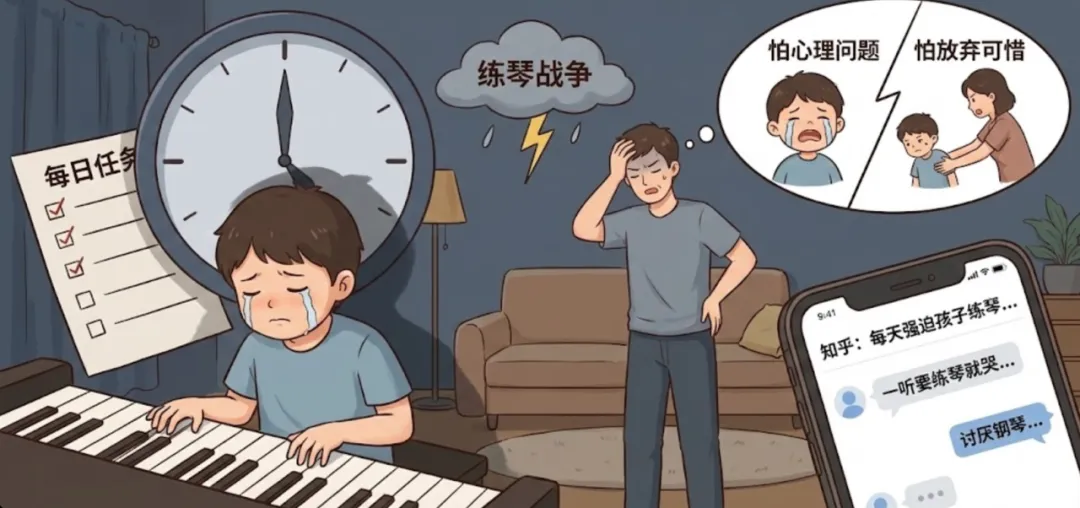
In online discussions, one parent’s dilemma is all too common: “My husband says forcing our child to practice piano every day will cause psychological problems. What should I do?”
The responses were full of shared frustration:
- “My child cries the moment practice time comes up, but I’m afraid if we stop, all the effort will be wasted”
- “Every practice session is a battle — I yell, they cry”
- “My child says she hates piano, but she used to love it”
This isn’t an isolated case. A study on music performance anxiety found that 44.9% of respondents experienced stage fright-related psychological issues, with 8.4% at a severe level. And what’s even more heartbreaking: Most children learning piano are “enduring” rather than “persevering” — they sit on the bench feeling miserable, their initial spark of interest long extinguished, with nothing left but a nightly obligation.
Three Warning Signs of Emotional Breakdown
When your child shows these behaviors, it’s not a technique problem — it’s a psychological alarm:
- Stalling before practice: Finding every excuse not to start (getting water, going to the bathroom, claiming a stomachache)
- Meltdowns during practice: Crying after a mistake, banging the keys, saying “I’m just stupid”
- Dejection after practice: Even after completing the task, feeling no sense of accomplishment — only more anxiety
If these negative emotions build up over time, they lead to timidity, reduced focus, and loss of patience and curiosity — the very qualities that learning piano requires most.
Research shows that parental impatience directly increases a child’s level of performance anxiety. In other words, often it’s not that the child can’t learn — it’s that the emotional environment has gone wrong.
Redefining Practice Support: What Is “Emotional Coaching”?
What does traditional practice supervision look like? Watching the rhythm, correcting fingering, pointing out mistakes.
What does emotional coaching look like? Stabilizing emotions, creating a sense of safety, and protecting the child’s intrinsic motivation to learn music.
Education expert Yin Jianli has repeatedly emphasized that parents should be companions and supporters, not navigators. Applied to piano learning, this means: A parent’s posture, tone of voice, and facial expression during practice matter more than correcting wrong notes.
Why Emotions Matter More Than Technique
A 2025 empirical study of 240 children aged 8–10 provided the answer: after 16 weeks of music education, the children’s emotional regulation skills improved significantly —
- Use of cognitive reappraisal strategies increased by 32%
- Emotional suppression decreased by 28%
- Empathy emerged as a key mediating factor
What does this mean? Learning music is itself a form of emotional training — but only if the process isn’t filled with negative emotions.
If every practice session comes with shouting, blame, and criticism, what the child learns isn’t music — it’s fear, frustration, and avoidance.
Three Essential “Emotional Coaching” Habits for Piano Families
Habit 1: Describe Instead of Criticize
Why it works: Describing facts without judging character protects the child’s self-esteem and motivation to keep learning.
How to do it:
- Wrong: “How did you get that wrong again? Didn’t I just tell you!”
- Right: “I noticed the rhythm was a bit fast in that section — want to try it slower?”
- Wrong: “It’s so simple and you still can’t get it right. Are you even trying?”
- Right: “You played that chord correctly three times already — just a bit more consistency and it’ll be perfect”
Habit 2: Allow an “Emotional Pause Button”
Why it works: Emotions that build up will eventually explode. Proactive breaks actually improve efficiency while teaching children emotional self-management.
How to do it:
- Place a small prop next to the piano (like a little stuffed animal)
- Tell your child: “If you’re feeling frustrated, you can press the ‘pause button’ and take a 3-minute break”
- During breaks, no criticism, no lectures — just be present
Habit 3: Use Protective Language Before and After Exams and Competitions
Why it works: The words spoken at critical moments deeply shape a child’s attitude toward music. Research shows that children with patient parents have significantly lower levels of performance anxiety.
How to do it:
- Before a competition: Wrong: “You have to win a prize — Mom believes in you” (pressure) → Right: “Go enjoy the stage and play your favorite part for everyone” (experience)
- After a setback: Wrong: “It’s your fault for not practicing enough” (rejection) → Right: “You were nervous today, right? I used to feel the same way at your age. Next time will be better” (empathy)
- After a success: Wrong: “Amazing! Next time you’ll definitely win an even bigger prize” (creating new pressure) → Right: “Your smile on stage was beautiful — I could tell you were really enjoying it” (reinforcing the positive experience)
The Long-Term Payoff: From Dreading Practice to Expressing Through Music
Mental Health Is the Real “Piano Journey Capital”
One parent shared online: her daughter cried every day during practice at age 8. They stopped for a year, and when she started again at 9, she became “the one who wants to play every day.”
What changed? It wasn’t a sudden breakthrough in technique — it was that she was psychologically ready.
Research in developmental psychology has found that improvements in emotional regulation strategies significantly enhance adolescents’ performance under pressure. For piano learning, this means:
- Being able to push through tedious technical drills
- Performing steadily in exams and competitions
- Not giving up after a single failure
- Ultimately, turning music into a lifelong emotional outlet
If You Can Only Do One Thing
If parents could change just one habit, here’s what I’d suggest:
At the end of every practice session, ask your child one question: “Was there a moment during practice today when you felt good?”
Not “what did you play well,” but “was there a moment when you felt good.”
What is this question doing? It shifts the child’s attention from “task completed” to “emotional experience.”
Over time, the child will remember: playing piano is something that can make me feel good.
Closing Thoughts: Don’t Let Music Leave a Shadow on Childhood
Education expert Yin Jianli got it right: what matters in the future isn’t academic credentials — it’s mental health.
For piano families, we can put it this way: What matters isn’t the grade certificate — it’s whether your child can carry music with them for a lifetime.
Millions of children around the world are learning piano, but only a tiny fraction will become concert pianists. For most children, the real value of learning piano isn’t “one more certificate” — it’s having a steady emotional outlet as they grow up. When they face academic pressure, social challenges, or uncertainty about the future, they can sit at the piano and have a conversation with themselves through music.
But all of this depends on one thing: Don’t let music leave a shadow on their childhood.
A study on music therapy for disadvantaged children found that music can help regulate children’s negative emotions and maintain a healthy psychological state. But if music education itself becomes a source of stress, the whole endeavor defeats its own purpose.
So, dear piano parents:
Next time you sit with your child during practice, try spending less time watching their fingers and more time watching their face.
When you notice your child can practice with a smile, can spontaneously say “this piece sounds so beautiful,” and can adjust on their own after a mistake instead of falling apart —
That’s when you’ll know: You’re not raising a “grading machine.” You’re raising a mentally healthy child who loves music.
And that is the most precious reward of a decade-long piano journey.
FAQ
Q1: My child already hates practicing. Is it too late to switch to emotional coaching?
It’s not too late. As long as your child is still willing to sit at the piano bench, there’s an opportunity to rebuild positive experiences. Start by removing exam pressure, and spend 2–4 weeks playing only pieces your child enjoys, letting them rediscover the feeling that “playing piano is fun.”
Q2: Do I need to practice all three habits? What if I don’t have time?
You don’t have to do all three. If you can only pick one, go with “describe instead of criticize” — changing the way you speak doesn’t take extra time, yet it can immediately improve the practice atmosphere. The other habits can be introduced gradually.
Q3: What if my child uses the “emotional pause button” to avoid practicing?
Genuine emotional breaks and avoidance can be distinguished: after an emotional break, the child calms down and returns to practice, while avoidance means they keep finding excuses not to come back to the bench. If your child is pressing “pause” frequently, it’s a sign that the practice goals are set too high — lower the difficulty rather than take away the right to rest.
Discussion
What “emotional meltdown” moments have you experienced while sitting with your child during practice? How did you handle them? Feel free to share your story in the comments.
Sources
- Family Education: Yin Jianli’s Guide to Avoiding Parental Anxiety
- The Role of Music Education in Promoting Children’s Emotional Regulation: An Empirical Study Based on Emotion Regulation Theory and Empathy Training
- Music Therapy in Mental Health Education for Migrant Children
- Music Performance Anxiety: A Musician’s Lifelong Adversary
- Half of All Children Are Learning Piano — Who’s Creating the Anxiety?
- My Husband Says Forcing Our Child to Practice Piano Will Cause Psychological Problems. What Should I Do?
- When Your Child Doesn’t Want to Practice Piano
- Research on Changes in Adolescent Emotion Regulation Strategies Under Global Stressors (Journal of Child Psychology and Psychiatry)