Your Child’s Hands Shake, They Make Mistakes, and Can’t Sit Still at the Piano? Here’s How to Help Them Relax
“They play so well at home, but the moment a lesson starts, their hands start shaking.”
“The night before the exam, everything sounded fine. Then they sat down at the exam venue and it all fell apart.”
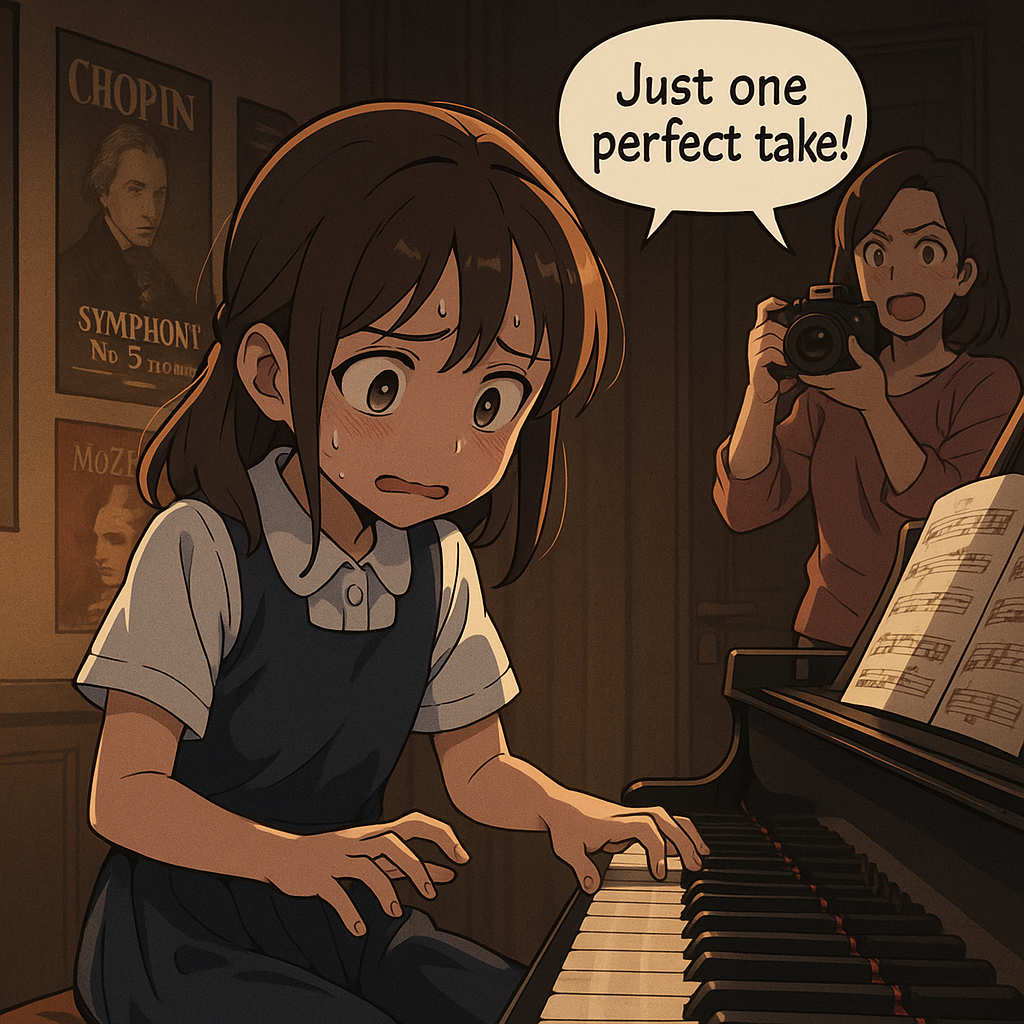
I see feedback like this from parents all the time. Sometimes a child has spent two solid weeks practicing a Sonatina in C Major — left and right hands coordinating well, rhythm on point. But the second their teacher is watching, or a screen recording starts, it’s like they become a different person: fingers stiff, tempo completely off, face broadcasting four words: I am nervous.
It’s not a skill problem — it’s anxiety undermining their performance. We often say “the child is shy” or “just introverted,” but where does this “piano nervousness” actually come from? And how can we genuinely help them relax, rather than just pushing through with the old advice of “just perform more and you’ll get used to it”?
Let me break this down. I welcome your thoughts and feedback.
1. Nervousness Isn’t Stage Fright — It’s a Loss of Control
The first layer of why children get nervous at the piano isn’t “fear of making mistakes” — it’s “fear of being seen making mistakes.” This shows up most in three scenarios:
The teacher standing right beside them, watching intently
A parent turning on the camera, saying “Come on, let’s record one take for me”
Being reminded repeatedly in the days before a competition that “this is really important”
In these moments, the child’s attention is no longer on the keys — it’s floating outside their head: “What if I mess up?” “Are they watching my fingering?” “If I don’t play this part well, will I get criticized?”
Children aren’t robots. They can feel when the atmosphere shifts. The moment the environment gives them a sense of being judged, their body naturally goes into defense mode: heart racing, muscles tightening, palms sweating, mind wandering… Their playing becomes like a TV on mute — everything is running, but there’s no feeling behind it.
So the first step is to help your child “take back control.” Don’t say: “Just play it through once, and be serious about it.” Instead, try: “Think of this as practice — it’s okay to make mistakes.” Don’t force them to record take after take chasing the “perfect video.” Set a limit — say three takes — and pick the one that best reflects how they actually play.
The practice room shouldn’t be a courtroom — it should be a laboratory. Only when failure is allowed can success follow.
2. Shaky Hands, Wrong Notes, and Fidgeting Are the Body Sounding an Alarm
One mother shared that the night before her son’s grading exam, he practiced until nearly 11 p.m. When she recorded him, he said his hands felt “sticky.” At first she thought it was just the heat, but it turned out he was extremely nervous — his skin was sweating, his fingers were slippery, and his muscles couldn’t relax, causing him to stumble during the performance.
Many parents assume “wrong notes mean not enough practice.” But try this yourself: when you’re really anxious, don’t you tend to hit the wrong keys when typing? When a child “keeps making mistakes” at the piano — especially in passages they already know well — it’s usually not a technical issue. It’s anxiety taking over.
So how can we relieve physical tension?
A simple technique called “tense and release” training works well.
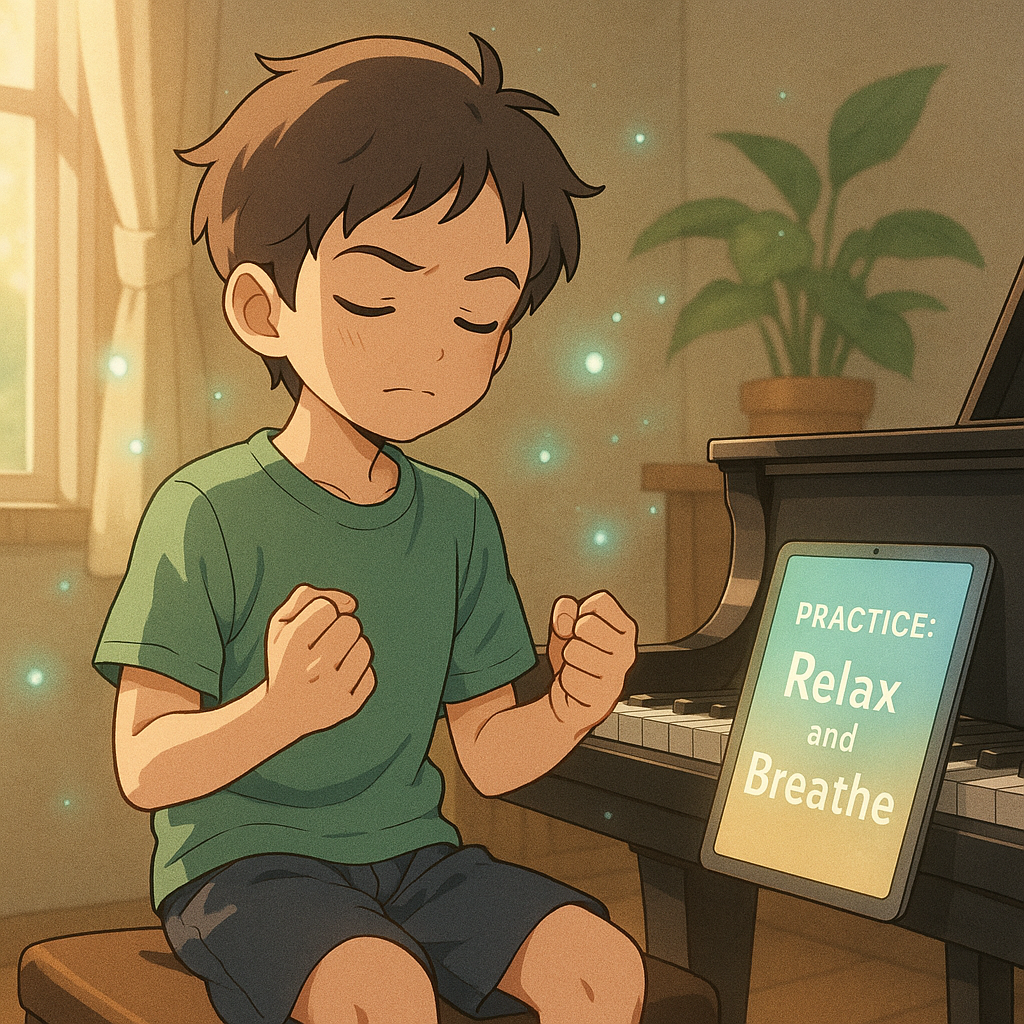
Have your child sit on the piano bench, take a deep breath, make fists, and tense their entire body for five seconds — then suddenly let go and exhale. It looks simple, but it quickly helps children experience what “relaxed muscles” actually feel like. Many kids aren’t unable to relax — they just don’t know that their body can feel that loose.
Here’s another method: the “pre-play pat-down.”
Before going on stage, recording a video, or starting practice, have them gently pat their arms, knees, and the backs of their hands in a slow rhythm — not too hard. This kind of rhythmic touch stimulation helps the brain shift from an anxious state into a “focus channel.”
3. Teach Your Child to Coexist with Nervousness, Not Fight It
Some children ask: “Can I ever not be nervous at all?” The answer is no — even professional pianists get sweaty palms before going on stage. What we need to teach children isn’t how to “eliminate nervousness,” but how to recognize and accept it.
Here’s a real story from a parent community. Last summer, a nine-year-old girl was preparing for a city-level competition. She had practiced for three weeks, and in the final week she broke down almost every day, saying “I can’t finish it, I don’t want to go.” Her mother didn’t pressure her. Instead, before each practice session, she had the girl write down: “I can go on stage with my nervousness.”
On competition day, the girl still trembled a little, but afterward she said: “It felt like I played the whole piece with a little bug sitting on my shoulder.” That’s what psychologists call “empathy-guided coping.”
Don’t suppress the nervousness. Instead, say: “You’re feeling your heart beat faster because this matters to you.” Treat nervousness as a friend, not an enemy. Don’t push it down — walk alongside it.
4. The Environment Is the Biggest Source of Relaxation — Don’t Overlook These Details
We tend to think practice needs to be quiet and focused. That’s true. But for some children, “too much silence” actually amplifies their anxiety.
Picture a child sitting alone at the piano. The room is eerily quiet. Parents are watching from behind. The lighting is cold white, curtains drawn tight. Two minutes in, Mom can’t help saying: “You just played that note wrong.” That’s not practice — that’s a psychological stress test.
Here are some ways to adjust the practice environment:
Play some soft background music nearby — not too loud, just enough to create a sense of gentle companionship
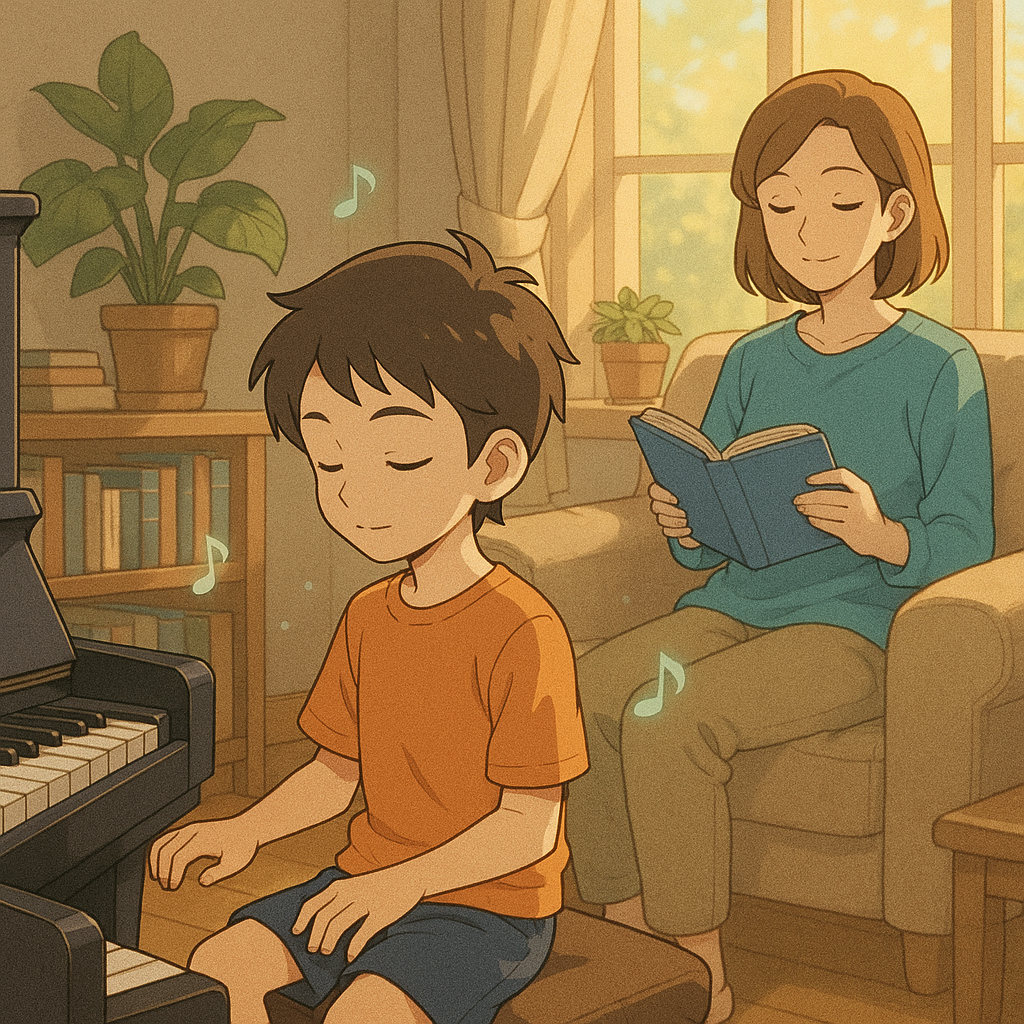
Sit beside your child reading a book or drinking tea — don’t say anything, but let them feel your presence
Use a desk lamp with warm lighting, open the curtains — natural light is even better
Use playful prompts: “After you finish this run-through, let’s see who remembers more of the lyrics”
Practice shouldn’t feel like an escape room. The friendlier the environment, the easier it is for children to focus.
5. In the Long Run, Building a Positive Feedback Loop Is the Real Solution
Where does nervousness come from? It comes from “I have to perform well, or I’ll be rejected.” So the ultimate way to ease anxiety is to build a stable expectation: “After I play, I’ll receive a warm response.”
Have you ever praised your child by saying “Your dynamics were much steadier than yesterday”? Have you ever said, when they made mistakes, “You made three fewer errors than last week”?
This isn’t empty praise — it’s specific, genuine, and tangible feedback. Compared to “That sounded nice,” a comment like “The way you ended those last two notes was really clean” carries so much more weight.
Positive feedback isn’t just the words “good job” — it’s helping your child build an internal compass: I’m making progress, and my effort is being seen.

A Note on Helpful Tools
Some parents say: “I understand all of this, but in actual practice sessions it’s so hard to manage, and my child still gets nervous.” In that case, you might consider using a supportive practice tool.
Take Wonder Piano, for example. Its practice system isn’t one of those high-pressure AI setups that interrupts and restarts every time the child makes a mistake. Instead, it uses gentle feedback — even when a child plays a wrong note, the system doesn’t crush their confidence. It offers a soft prompt after the mistake and gives the child time to think.
It also features a “Magic Adventure” storyline where playing unlocks new chapters of a story. Sometimes a child will pause mid-practice to ask: “Mom, when does the Fire Spirit show up?”
Parents in our community have shared that after trying many apps, Wonder Piano is the one where their child can actually settle down and stay focused — with its calming background music. Other parents report that since starting with Wonder Piano, their child has voluntarily practiced every day for a week straight. Practice is no longer a chore — it’s a joyful experience of “interacting with a magical world.”
Not all nervousness can be solved by “talking it through.” But a practice system with a friendly environment and gentle feedback can gradually teach a child something important:
“You’re not performing for someone else — you’re playing with the music.”