
Why Does Your Child Keep Making the Same Mistake in the Same Spot?
Many parents notice that their child keeps getting stuck at the same measure during practice — the more they play it, the worse it gets, until they start dreading the whole piece.
The truth is, most children aren’t defeated by difficulty itself. They’re tripped up by a single stubborn knot. Every time they reach those two measures, their fingers tangle up like knotted string — the more they rush, the messier it gets.
The good news? This isn’t a talent problem. It’s how the brain is wired by default. Once you understand the mechanism, you can untie that knot.
Why Does the Brain “Cling to” the Same Mistake?
These “stubborn error zones” form because of how our brains handle memory consolidation and neural plasticity. Here are several key scientific findings that explain why mistakes keep coming back.
- Memory needs repetition: it’s not just “remembered” — it’s “drilled in”
A study led by researchers at UCLA and published in Science found that skill acquisition is not a one-time event — it requires the brain to repeatedly build and strengthen specific neural pathways.
Research shows that when learning a new skill, the neural connections in the brain’s cortex gradually strengthen, but this process requires multiple, repeated stimulations before it finally solidifies.
This means that when your child plays a passage correctly for the first time, it’s only a preliminary success signal — the neural pathway is still fragile. Without enough repetitions, the pathway can’t become stable, and the next time they encounter it, the brain falls back on the old, error-prone pattern.
- The nature of “practice”: the brain learns better from getting it right
Researchers at MIT published a study on “reinforcement learning” in Nature Neuroscience. They found that when the brain performs a correct action and receives a reward (even an internal sense of accomplishment), neurons release more dopamine — a chemical that effectively strengthens the corresponding neural circuits. Incorrect actions, by contrast, don’t trigger this powerful reinforcement signal.
This finding tells us something crucial: “Perfect practice makes perfect.” If your child keeps repeating the same mistake during practice, their brain is actually reinforcing the wrong movement pattern rather than the correct one.
We need to find ways for children to practice the correct version as often as possible.
- Spaced repetition: spreading practice out beats powering through
The classic psychological finding known as the “Spacing Effect” was first proposed by German psychologist Hermann Ebbinghaus in the late 19th century. Through a series of memory experiments, he demonstrated that spaced learning and review produces better results than cramming everything into a short period.
Later studies confirmed this theory. For example, one study of over 2,500 students found that spreading study time across several days improved memory retention by 30% to 50% compared to learning everything in one sitting.
For piano practice, this means that instead of having your child spend a solid hour hammering away at a tricky passage, it’s better to split that hour into 15-minute sessions spread over four days. This not only consolidates memory more effectively but also prevents the repetitive errors that come from fatigue.
- The “Testing Effect”: active recall is the catalyst for memory
Psychologist Robert Bjork proposed the concept of “Desirable Difficulty,” and one key part of it is the “Testing Effect.”
This theory holds that actively retrieving a piece of knowledge strengthens memory far more than passively re-reading or re-practicing it. When your child practices piano, having them try to recall and play a passage from memory — even if they make mistakes — creates a “retrieve-and-correct” process that deeply engages the brain’s memory circuits.
Compared to purely mechanical repetition, having your child first “test” themselves, spot the errors, and then practice those spots with focus is a far more effective way to convert short-term memory into long-term memory — truly turning mistakes into stepping stones.
Practical Strategies: How to Help Your Child Break Through Effectively
Now that we understand the principles, we can design smarter practice strategies to help children escape those “stubborn error zones.”
- Pinpoint and isolate the problem:
Stop practicing from beginning to end blindly. Instead, like a doctor targeting a specific ailment, extract the tricky measures and break them into smaller units — say, 2 to 4 measures. Have your child practice just those measures until they can play them correctly and smoothly, then put them back into the full piece. This “locate-isolate-consolidate” method helps the brain focus on the correct movement pattern.
- Build a feedback loop to reinforce correct actions:
Every practice session should include a clear feedback loop. If your child plays a passage correctly 3 times in a row, offer verbal praise or a small reward and say, “You got it right — keep it up!”
This gives the brain positive reinforcement, creating a virtuous cycle of “get it right — feel recognized — want to get it right again.”
- Use “distributed” practice to avoid fatigue:
Break practice time into shorter segments. For example, split a one-hour session into three 20-minute blocks with breaks in between. This not only helps your child stay focused but also leverages the Spacing Effect, giving the brain enough time to digest and consolidate new skills.
- Add “test-style” practice:
Before starting practice, have your child put the sheet music away and try to play a tricky passage from memory. After they finish, compare it with the score, find the mistakes, and then practice those spots with focus. This “test first, then correct” approach effectively activates the brain’s active recall mechanism, making the memory stick.
Putting It into Daily Practice
By now you might be wondering: I understand the principles and methods, but how do I actually make this happen in everyday practice? My child practices every day — is there a more convenient tool that can help us apply these “scientific practice strategies”?
That’s exactly why we designed the Wonder Piano app: to combine scientific understanding, practice psychology, and smart technology — truly applying the “knot-untying method” to every practice session. The goal is to help your child succeed repeatedly with the right approach, build confidence, and break through stubborn errors:
AI Real-Time Correction: Provides instant feedback on wrong notes and rhythm during practice, preventing the “drilling in the wrong way” problem.
Demo Audio + Sheet Music Library: Listen first, then play — giving your child a correct reference so it’s easier to build on the right path.
Separate Hands / Hands Together Workflow: The curriculum supports a scientific sequence of single-hand foundation, then hands-together confirmation, reducing “hands-together meltdowns.”
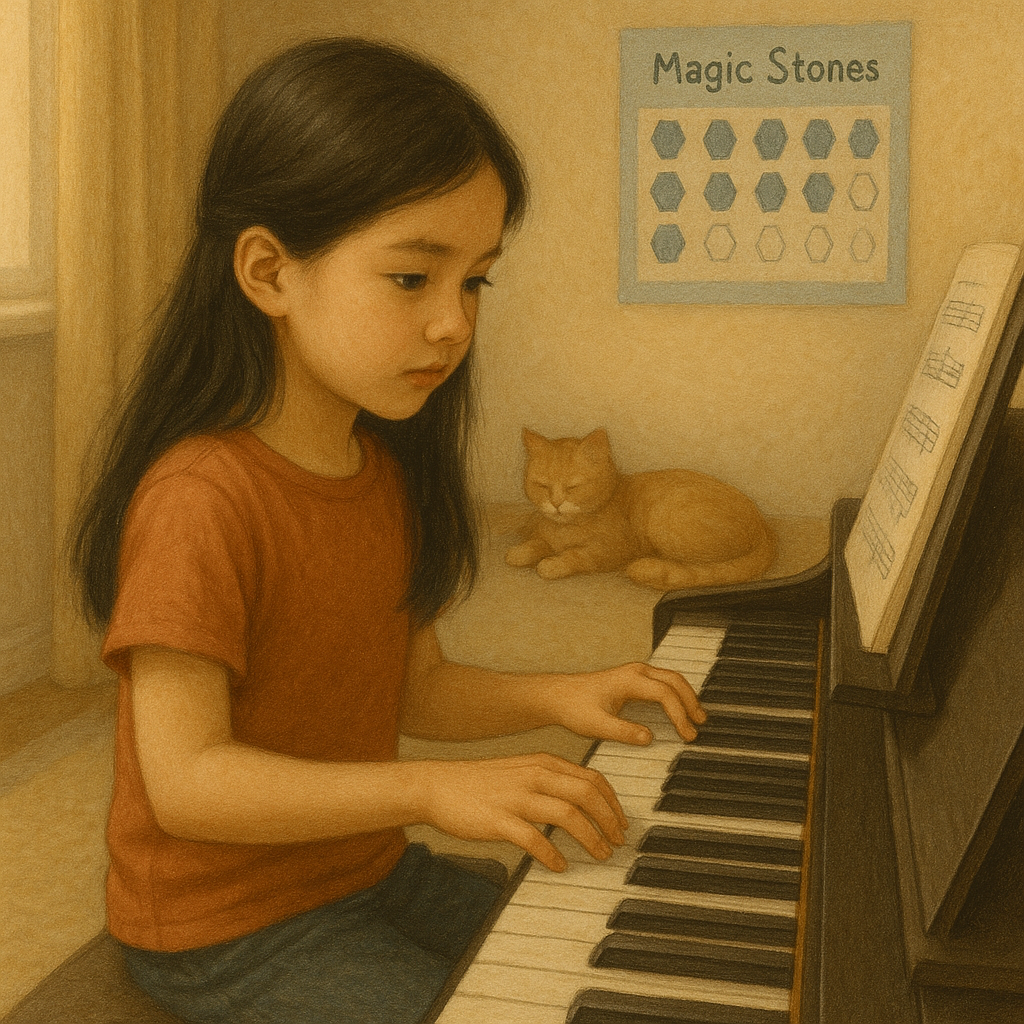
Gamified Progression: Uses levels, magic stones, and magic points as positive reinforcement, turning “play it right 3 times” into “level complete!”
Visual Practice Records (for parents): Parents can see practice duration and session records, making it easy to schedule short, frequent practice sessions.
Slow Practice Friendly: Encourages a slow-down-and-build-up approach, aligned with the “steady first, then fast” progression.
The design philosophy is simple: make it easier for children to succeed repeatedly with the correct version — break challenges into smaller pieces, spread practice out, and replace anxiety and brute force with gentle reminders and a sense of achievement.
Every “stubborn error zone” is like a tightly pulled knot. You don’t need to yank or wrestle with it — find the loose end, pull gently, and it will come undone. When your child learns to walk the right path steadily three times through, they haven’t just conquered one measure — they’ve learned a way to solve problems.
If you’re looking for a gentler, more effective practice rhythm, give Wonder Piano a try: let AI handle real-time reminders, let demo audio provide a model to follow, let the separate-hands/hands-together flow simplify the hard parts, and let levels and magic stones turn “play it right 3 times” into visible victories, one after another.
Mistakes aren’t walls — they’re door handles. Turn them, and they open the way to the next piece of music.