Stop Measuring Your Child Against “Genius” Standards — You’re Killing Their Love of Music
Late one night, I came across a piano performance video. A six-year-old was playing Chopin’s Fantaisie-Impromptu with effortless fluency. The comments were bursting with amazement: “A genius!” “Born with a gift from the gods!”
I closed the video and glanced over at the living room out of habit. My eight-year-old son was wrestling with a Beyer exercise piece, hitting the same wrong note for the seventeenth time, his face a mix of frustration and hurt.
In that moment, a familiar wave of helplessness washed over me. Trust me — this feeling is part of daily life for nearly every parent of a piano student. On one hand, you scroll through videos of “someone else’s little genius.” On the other, you watch your own child struggle, silently asking yourself that ultimate question: Does my child actually have musical talent?
We become anxious gold panners, sifting through the gravel of our children’s daily practice, desperate to catch even a tiny glimmer of “talent.”
But we rarely realize that this obsession with “genius” is exactly what digs three deep traps for our children. These traps don’t help us find talent — they systematically bury the most precious seed in a child’s heart: the seed called “interest.”
Trap One: The “Speed” Trap — When Progress Becomes the Only KPI
“How long has your child been learning? What pieces are they playing now?”
“We’re getting ready for Grade 5. How about you?”
These conversations are the social currency of piano parents. Without even noticing, we turn our children’s music education into an arms race over progress. Six months in, they should be playing “Für Elise.” After a year, they need to pass Grade 5. As if that ever-thickening exam book were the only proof of talent.
And so the most common question we ask our children becomes:
“When will you be able to play this piece all the way through?”
“How many exercises did you finish today? Were you faster than yesterday?”
Under these “speed” expectations, children are forced into fast-forward mode. Their brains and fingers scramble to keep up with that KPI called “progress.”
But the real magic of music is precisely what cannot be fast-forwarded
Trap Two: The “Comparison” Trap — Using Others’ Highlights to Cast a Shadow on Your Own
If “speed” is self-imposed pressure, then “comparison” is a relentless external blow.
Today you see a classmate’s child winning a gold award on social media. Tomorrow you watch a same-age kid showing off advanced skills on an app. Every click sprinkles salt on your anxiety. And in the end, all of that anxiety gets passed on — unchanged — to the child sitting at the piano.
“Look at your friend — he started at the same time as you, and now he can play Beethoven’s Pathétique!”
“Stop dawdling! If you don’t try harder, everyone is going to leave you behind!”
We think these words are motivating. To a child, they’re the deepest kind of rejection. They carry a cruel subtext: “You’re not good enough. You’re less than others.”
The frame of reference for learning music should be the child alone: Am I a little bit better today than I was yesterday? But once we fall into the “comparison” trap, the benchmark shifts to that unreachable “someone else’s child.”
What children gain from constant comparison isn’t motivation — it’s defeat. They start to doubt themselves: “Am I really just not smart enough?” The joy of practicing is completely replaced by the shame of “I’m not as good as them.” To escape that pain, the most natural response is: avoidance, resentment, and eventually quitting.
Trap Three: The “Error-Hunting” Trap — When Accompaniment Turns into Eagle-Eyed Surveillance
Many well-meaning parents choose to sit with their child during practice. But before they know it, that companionship turns into something else entirely.
We become inspectors armed with infrared scanners, eyes locked on the child’s fingers, ears tuned like radar, ready at every moment to catch any wrong note, any unsteady rhythm, any collapsed finger joint.
And so the most common words heard in the practice room become:
“Wrong!”
“That’s not the right note!”
“Your hand! Your hand collapsed again!”
We think we’re helping the child build a solid foundation. In reality, we’re constructing a practice environment filled with fear, built on criticism and blame. In this environment, practicing = being judged. Every time the child hits a wrong key, it comes with a wave of negative emotion from a parent.
To avoid mistakes, the child becomes increasingly tense — and the more tense they are, the more mistakes they make, creating a vicious cycle. To avoid criticism, they become afraid to attempt difficult passages, or even to truly “play” — they can only cautiously “touch” the keys.
This is exactly how the flame of interest gets doused — one bucket of “error-correction” cold water at a time
How Can the Right Tools Help Us Gracefully Escape These Traps?
We understand the theory, but putting it into practice is genuinely hard. Especially as parents who aren’t trained musicians ourselves, it’s nearly impossible to offer objective, emotion-free guidance.
This was something I struggled with for a long time — until I started using the Wonder Piano app, recommended by a friend. I discovered that technology really can serve as a “buffer zone” and “translator” between parents and children, precisely addressing these challenges.
First, its “magical adventure” game system tackles both the “speed” and “comparison” traps at once
At its core, Wonder Piano transforms tedious practice tasks into a story-driven adventure game that children genuinely enjoy. Kids no longer practice to “keep up with a schedule” for their parents — they practice because they want to unlock the next chapter of the story and collect “magic stones.”
The motivation for practicing shifts from the external “I have to practice” to the internal “I want to play.” When a child’s attention is fully immersed in their own “magical world,” they naturally break free from the race for speed, and they have no interest in comparing themselves to “someone else’s child.” Their sense of achievement comes from instant rewards within the game — not from external judgment — and that’s precisely what protects the most precious thing of all: intrinsic motivation.
Second, its “gentle AI practice partner” completely freed me from the role of eagle-eyed supervisor
The feature that gave me the most relief is the app’s real-time AI recognition system. It accurately identifies pitch and rhythm errors.
The key is its “gentle feedback” approach: when a child plays a wrong note, it doesn’t harshly interrupt or blare an alarm. Instead, it uses clear prompts to guide the child toward self-correction. It’s like having a practice partner who is endlessly patient and emotionally steady.
This was a total liberation for me. The AI handles objective error feedback, and I can finally sit comfortably nearby — transforming from an anxious “supervisor” into what the app’s philosophy encourages: a relaxed “appreciator” and “encourager.”
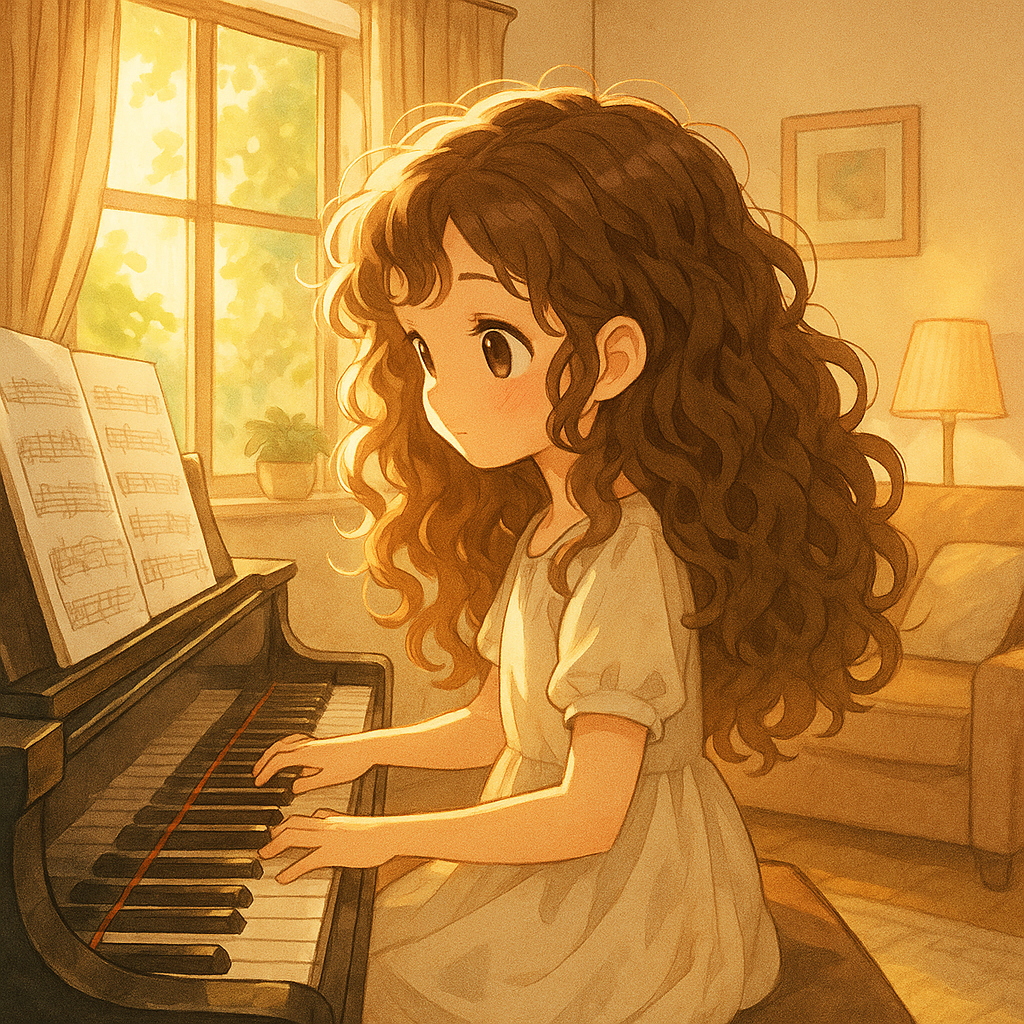
Music education was never a gamble on “talent” — it’s about planting the seeds of a life experience
We don’t need to hold our children to “genius” standards. We simply need to carefully help them avoid the traps that could hurt them. With the right tools, we can give them more opportunities to experience the joy of music, more chances to measure themselves only against who they were yesterday, and more moments of supportive companionship filled with encouragement.