5 Mistakes 90% of Parents Make That Drive Kids to Quit Piano
How many evenings have you lived through a moment like this: the living room light is still on, and the sound of the piano keeps breaking the silence. Your child’s hands are trembling, and each note comes out more jumbled than the last.
You clench your jaw, reminding them of corrections while holding back your frustration. Then comes that final cry — “I don’t want to do this anymore!” — and it stings like a needle in your heart. You only want what’s best for your child, so why does trying harder seem to push them further from loving music?
The problem isn’t actually with your child. It’s with us — the adults who want so desperately for our kids to succeed.
Over the years, we’ve seen countless families where a child ends up quitting piano. Drawing from that experience, here are the five traps parents most commonly fall into that cause 90% of kids to give up halfway through.
Avoid these pitfalls, and your child’s piano journey will look completely different.
Mistake 1: Treating Note Reading as a Short-Term Task Instead of a Lifelong Skill
Here’s a real story from a practice coach: A mother brought her child to the teacher to discuss note-reading problems. The child played a passage wrong, and the mother was so anxious she was practically stomping her feet.
“But she can play it!” the mother insisted. The teacher covered the sheet music and asked the child to play from memory. After a few measures, the child froze.
The teacher asked, “Are you ‘reading’ the music, or ‘memorizing’ it?” The child answered timidly, “Memorizing it…” And that was the key issue.
She wasn’t reading the score — she was memorizing finger patterns. The moment her memory failed, the entire piece fell apart. The real goal of note reading isn’t just “recognizing notes” — it’s building an instant connection between the printed note, the key, and the sound in your child’s brain.
Here’s what parents can do:
Spend 10 minutes a day playing a “find the note” game: see a note on the page, find the right key within 3 seconds.
When they play a wrong note, don’t just say “wrong” — guide them with a story or analogy they can relate to.
When note reading becomes a detective game, your child’s brain learns through play.
Mistake 2: Turning Hand Position Into Boot Camp
“Curve your fingers! Don’t let them collapse! Lift your wrist higher!” Sound familiar? The problem is: you think you’re “correcting,” but your child is just “stiffly imitating.”
We’ve seen too many kids whose hands look like clamps while playing — wrists locked, fingertips jabbing at keys, faces more tense than the music. That “perfect hand position” often ends up training what we call “fear muscles.”
Here’s what parents can do:
Let your child “play” their way to good form first: put a ping-pong ball in their palm and let their hand curve naturally around it.
Let the wrist swing freely, like a pendulum on a swing.
Replace “stand at attention hands” with “bubble hands” — imagine holding a soap bubble gently in the air.
When the body relaxes, the music starts to flow.
Mistake 3: Treating Practice as a Task Instead of Self-Expression
Some parents count every day: “How many minutes did you practice today?” But they rarely ask: “What story did you hear in the music today?” Music isn’t about finishing a piece — it’s about expressing emotion.
When a child’s heart isn’t invited into the music, practice becomes soulless labor.
Here’s what parents can do:
After each practice session, ask one question: “Did that piece feel happy or sad to you?”
Play a little game: perform the same piece with different emotions — angry, happy, scared…
Let your child “perform” the music, not just “recite” it.
Mistake 4: Your Anxiety Is Scarier Than a Wrong Note
Your child hits a wrong note — you frown. A second wrong note — you sigh. By the third, your child is already sweating. The truth is, they’re not afraid of practicing — they’re afraid of your reaction.
Here’s what parents can do:
During practice, say less and observe more. Try to give just one piece of feedback at a time.
When they catch their own mistake, say sincerely: “Making mistakes is totally fine — that’s what practice is for.”
Give wrong notes a playful nickname — like “the mischief note” — to lighten the mood.
When the air around practice time stops feeling tense, the music can breathe again.

Mistake 5: Focusing Only on Results, Not Growth
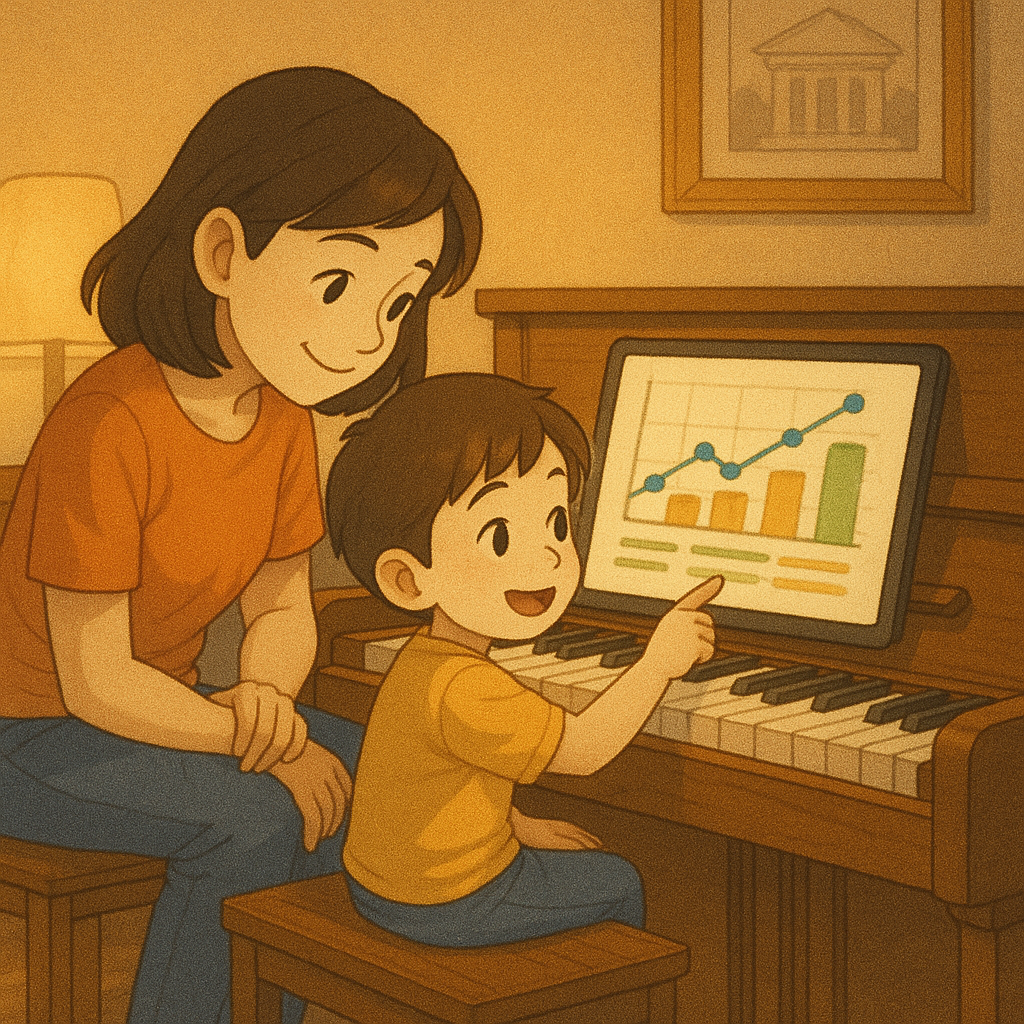
“She’s been playing for six months — how can she still not play this piece?” Many parents measure effort by results alone. But musical growth is never a straight line.
Sometimes a small breakthrough is built on countless moments of “I can’t hear it” and “I can’t get it right.”
Here’s what parents can do:
Write down your child’s “music discovery of the week” — no matter how small.
Record a video and compare it to one from three months ago. You’ll be amazed at how much progress they’ve made.
Growth never happens overnight. It hides inside every moment of “let me try one more time.”
Learning piano isn’t about raising a “perfect child.” It’s about helping them learn persistence, focus, self-expression, and gentleness through music.
When parents shift from being a “supervisor” to a “partner,” children go from “being forced to practice” to “wanting to practice.” In the Wonder Piano app, we help kids find joy in practicing through gamified challenges and a real-time feedback system that makes every session feel like leveling up in an adventure.
We help children rediscover “I can do this” through the world of music. Sometimes all it takes is one moment of patient, gentle support.
Starting today, let’s turn “practice” into “magic” — together.