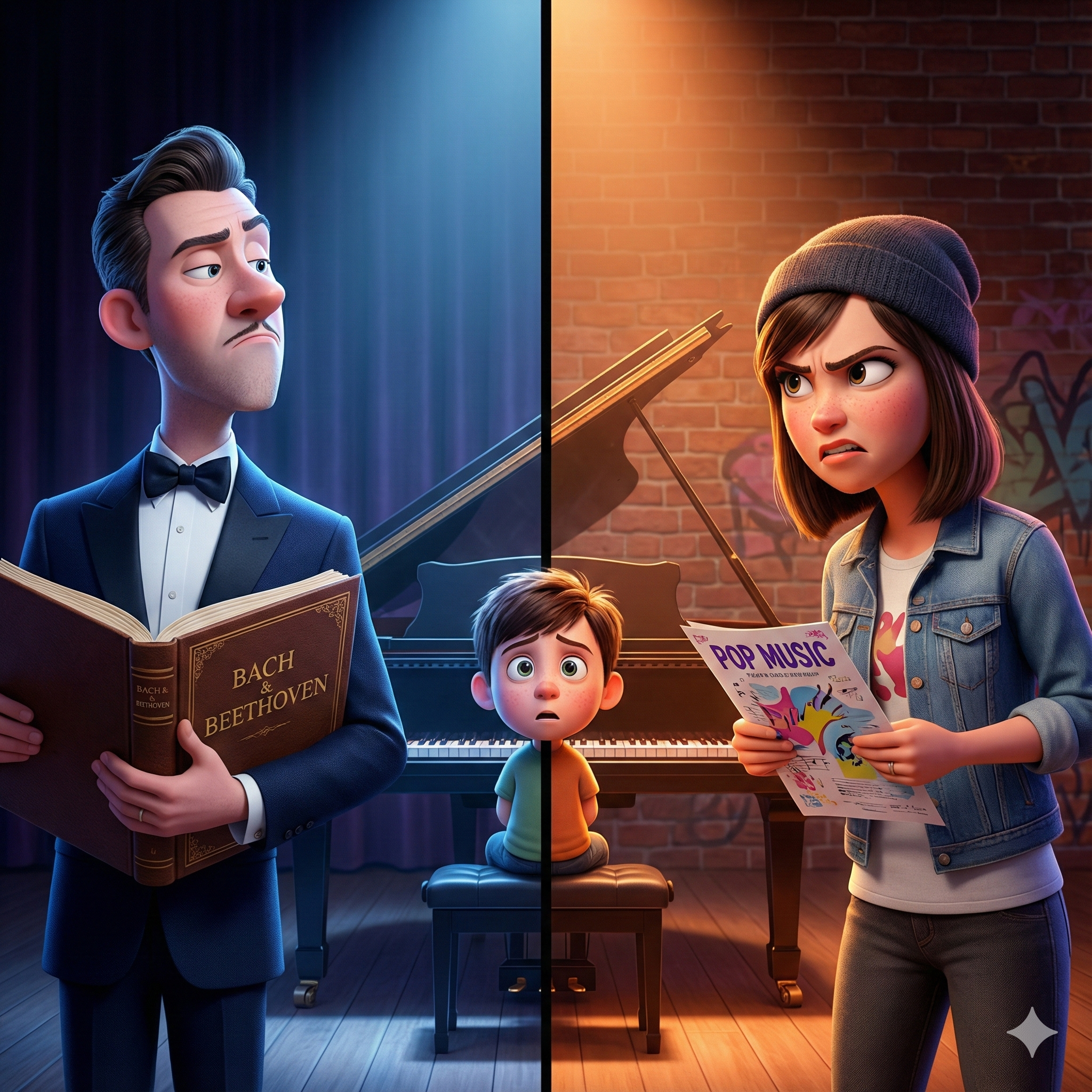
ABRSM vs. Local Exams? Mozart vs. Pop Songs? The Snobbery Hierarchy in Piano Education
The moment a piano enters your home, you’re no longer just a parent — you automatically earn a new title: “piano parent.” And within this seemingly refined circle, there’s actually a strict, unspoken caste system at work.
The social currency here isn’t your neighborhood or your car — it’s the vocabulary you drop in conversation. Parents who talk about “ABRSM” tend to look down on those who mention “local grading exams.” Families devoted to Bach usually think those playing Joe Hisaishi pieces are just messing around. Even the height of the piano bench and the angle of a child’s fingers can become battle lines between rival camps.
Music is supposed to know no borders, but in the piano parent world, there are not only borders — there are nearly uncrossable chasms of snobbery.
As long as your child is still practicing, you’ll inevitably get drawn into this game of taste and allegiance.
The “Game of Thrones” of Piano Exams: ABRSM vs. Local Grading
If you ask a piano parent, “Which exam system is your child doing?” — that’s not just small talk. It’s an identity check. At the top of the pecking order (or so they believe) are the “ABRSM loyalists.”
In their eyes, ABRSM isn’t just an exam — it’s synonymous with “comprehensive musicianship.” Theory, sight-reading, ear training — all of it matters. They tend to label families doing local grading exams with tags like: short-sighted, only grinding through pieces, chasing pass rates instead of understanding music.
“You know how much padding is in those Level 10 certificates, right? Our ABRSM Grade 5 — you can’t even get the certificate without passing the theory exam.” This sense of superiority usually comes bundled with hefty registration fees, English-language materials, and an obsession with “international standards.”
But do the local exam families just take it lying down? Not a chance. In their view, the ABRSM crowd is all show and no substance.
“These are the credentials that count! When schools look at extracurricular achievements, they want nationally recognized standards!”
“Forget all that theory fluff — if your fingers can’t keep up, all the theory in the world is just armchair musicianship. Our Level 10 certificate? That’s real, hard-earned technique.”
You see — one side thinks the other “lacks sophistication,” while the other thinks they’re “out of touch with reality.” If parents from these two camps ever meet outside the music studio, the sparks flying between their gazes would rival Beethoven’s Fifth Symphony.
The “Cold War” of Repertoire: Classical Purists vs. Pop Improvisers
Exams are just the first battlefield. The deeper conflict is about: what does your child play?
“Classical purist” parents believe the soul of piano exists only in the Baroque, Classical, and Romantic periods. To them, the piano is the very definition of refinement.
When they see a child playing a pop song on the piano, they’re visibly pained: “This is an insult to the instrument!” “You haven’t even mastered Bach’s Well-Tempered Clavier and you’re doing chord accompaniments? Playing pop songs before the fundamentals are solid — your hand position is ruined, and fixing it later is nearly impossible.”
And the “pop improviser” parents? They look at the classical camp like they’re watching a group of monks on a vow of suffering. “Eight years of lessons, and when relatives ask for a tune at a family gathering, all they can play is etudes — can’t even accompany ‘Happy Birthday.’ What’s the point of all those lessons?”
“Music is for expressing emotions, not for putting on a pedestal. My kid plays pop songs and loves it — bobbing along, genuinely enjoying the music. Is turning a child into an emotionless metronome really the goal?”
On one side, defending “the sanctity of art.” On the other, pursuing “the usefulness of music.” The gap between them seems wider than any ocean.
Why Do We Fall Into These Hierarchies?
Why does learning piano have to come with a ranking system? It’s not just about parents being competitive — there are deep sociological and psychological forces at play.
The renowned French sociologist Pierre Bourdieu, in his book Distinction: A Social Critique of the Judgement of Taste, introduced the concept of “cultural capital.” He argued that people use their consumption of different cultural products — whether it’s playing Bach or pop, taking ABRSM or local exams — to draw social class boundaries and establish their identity and status.
In plain terms: I look down on your choices to prove that mine are superior
Industry data shows that the number of children learning piano is enormous, and beneath those numbers, “educational anxiety” has become the engine driving these hierarchies.
The massive difference in costs: Raising a child on the professional classical track — between tuition, instrument costs, and masterclasses — averages 3 to 5 times more than the casual hobby route.
When parents have invested enormous sunk costs, they need to emphasize “the prestige of classical” to psychologically justify the spending. “I’ve spent this much money — I have to prove this is the legitimate path.”
The psychology of exclusion: When people are in high-pressure competitive environments (like school admissions and talent selection), “in-group favoritism” intensifies. Parents huddle together — ABRSM groups praising each other, local exam groups encouraging each other — while simultaneously putting down the other side. It’s a collective defense mechanism for managing anxiety.
So when you’re looking down on someone else’s choices, it’s not really because they’re doing something wrong — it’s because you’re too anxious.
At the End of the Pecking Order, Everyone Has the Same Meltdown
Though parents argue fiercely online, battling over “legitimacy” versus “practicality,” when night falls and they’re back home, behind the closed door of the practice room… everyone faces the exact same struggle.
Whether you’re a proud ABRSM loyalist or a practical local exam advocate — whether your child plays Mozart or Jay Chou — the moment a kid sits on that bench and starts dragging their feet, every parent’s frustration resonates at the same frequency.
“Agreed to practice for half an hour, but bathroom breaks, water, and daydreaming ate up 20 minutes.”
“Corrected the same wrong note a hundred times, and on the hundred-and-first try, it’s still wrong.”
“Cries the moment practice is mentioned, smiles the instant the lid closes.”
When faced with the ultimate challenge of “children who don’t want to practice,” the entire pecking order crumbles. We spent all that time arguing about whose path is more prestigious, but we overlooked the most fundamental issue: if a child doesn’t want to play, even the most prestigious path is a dead end
The data speaks for itself: industry research shows that the dropout rate among young piano students is highest in the first three years — more than half give up before or right after completing their exams.
The reason isn’t choosing the wrong exam board or the wrong genre — it’s that practicing is too painful, and the spark of interest gets snuffed out.
As an editor at Wonder Piano and someone who has witnessed countless children’s tears at the keyboard, I want to say: in children’s eyes, there’s no difference between ABRSM and local exams, no line between classical and pop. In their small world, there’s only “fun” and “boring.”
If you don’t solve the problem of intrinsic motivation, all the pecking-order debates are just parents arguing with themselves.
When Wonder Piano first gave its product to beta-testing families, the feedback was immediate — children were more willing to practice, and parents didn’t need to nag the way they used to. How does the Wonder Piano app get kids to willingly sit down at the piano?
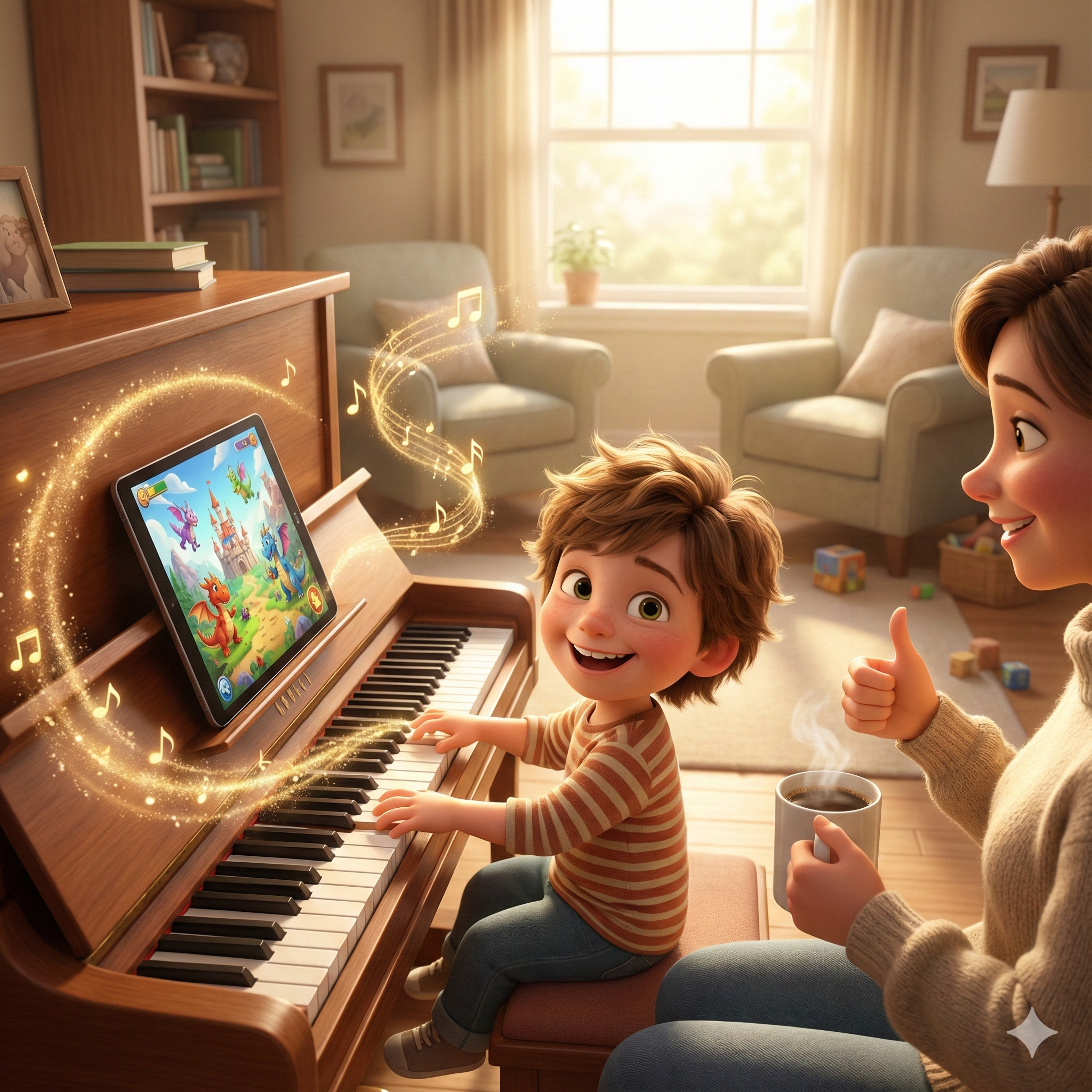
We tried a different approach — stepping outside the hierarchy and returning to children’s nature: what if practice wasn’t a chore, but a game?
We turned tedious exercises into story-driven adventures. Children no longer practice to pass an exam — they practice to collect “magic stones” and unlock the next chapter of their “magical adventure.”
This gamification approach directly replaces the traditional task-based model, reducing resistance at its root. Kids tell us: “It’s like playing a video game while playing piano.” That kind of genuine enjoyment is worth more than any certificate.
What if instead of parents hovering, AI listens? Whether your child plays classical or nursery rhymes, our real-time AI recognition system picks it all up accurately. Just place a tablet or phone nearby — the microphone captures the sound. Pitch, rhythm, dynamics — what’s right and what’s wrong, all crystal clear.
Our feedback is gentle and encouraging, guiding children to self-correct rather than coldly interrupting — protecting that fragile sense of confidence.
What if parents became fans instead of supervisors? This is the change we most want to see. Wonder Piano lets parents who don’t know music understand their child’s progress through clear practice records. When parents shift from strict supervisors to appreciative cheerleaders, the tension at home fades, replaced by a warm atmosphere of parent-child collaboration.
Wonder Piano’s vast sheet music library covers children’s songs, classical introductions, and pop arrangements. We support children in choosing for themselves, because we believe interest is the best teacher.
The world of music is vast — big enough for Bach’s precision and jazz’s freedom. But the world of music is also small — small enough for just one smile from a child.
Whether it’s ABRSM or local exams, the best piano education is the one that keeps your child smiling while they play
Dear parents, stop exhausting yourselves in these pecking-order wars. Tonight, try setting aside the judgments and just listen to your child play — just the sound of the music, nothing more.