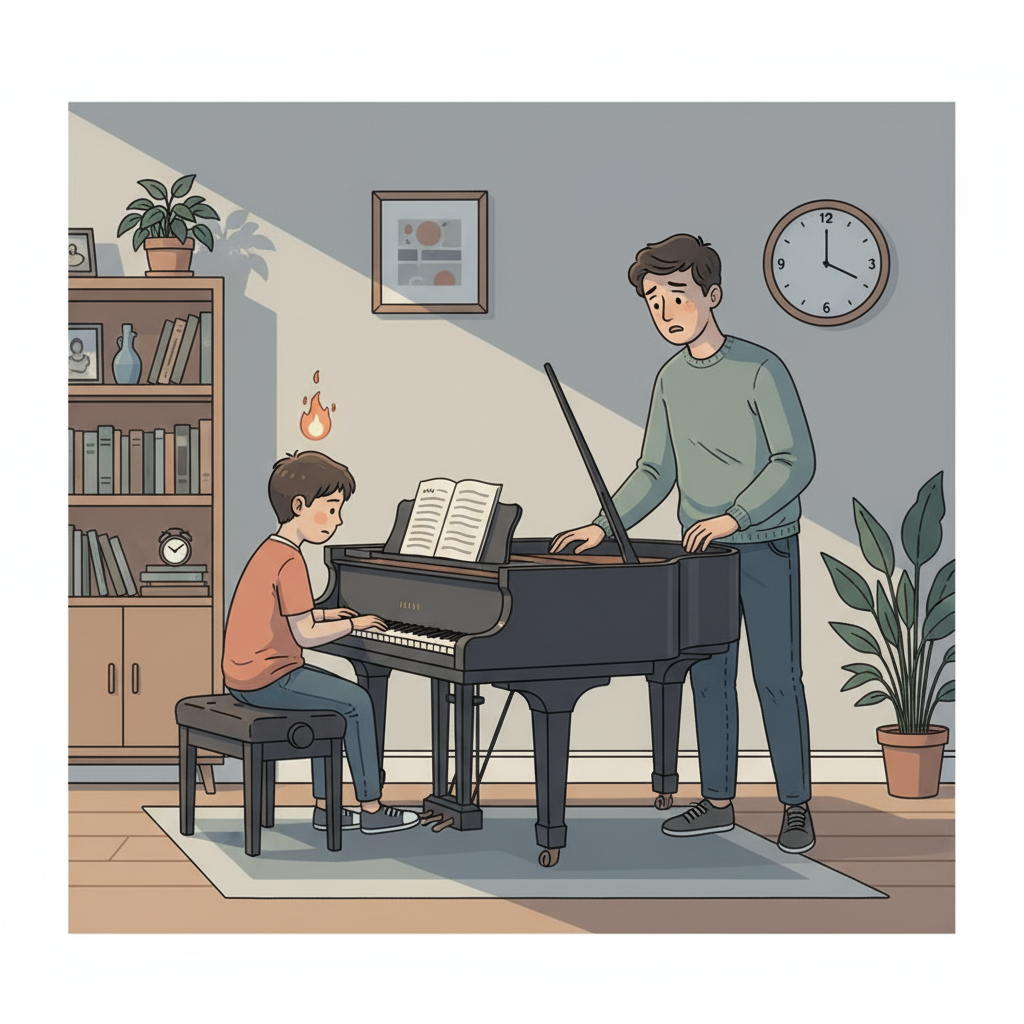
It’s Not Parents Who Are Impatient — It’s the World We Live In
A parent who hasn’t been “hijacked by the era” trades patience for their child’s intrinsic motivation, trades companionship for their child’s sense of achievement, and becomes a “gardener” in their child’s growing world.
A parent who has been “hijacked by the era” trades anxiety for their child’s resentment, trades KPIs for their child’s burnout, and becomes a “supervisor” in their child’s world at their own emotional cost.
What Does It Mean to Be “Hijacked by the Era”?
Being “hijacked by the era” is essentially a form of survival anxiety in education. Parents treat external competitive pressure — including the possibility of failure — as their only reference point, and rapidly iterate their approach to pushing their children.
Our generation of parents seems to be firmly labeled as “obsessed with quick results.” We understand “joyful learning,” “respecting children,” and “letting them bloom at their own pace” better than anyone. But we also fear our children “losing their competitive edge” more than anyone.
But here’s what I want to say: to every mom and dad who has broken down in tears late at night, please give yourself a hug first.
Because it’s not us who are impatient — it’s a world that simply won’t let us slow down.
The Other Side of the Data: Millions of Parents Who “Know Better but Can’t Do Better”
Our generation of parents is the most informed and scientifically minded in history, but also the most conflicted. A 2024 family education report published a set of data that precisely captures our “split between knowledge and emotion”:
In terms of awareness, 75% of parents agree they should express love through physical gestures like hugs, and 65% believe children should be allowed to make their own decisions.
But emotionally, a staggering 80% of parents feel anxious about their children’s academic performance, and 60% constantly worry about their children’s safety.
This anxiety ultimately turns into real behavior: 45% of parents admit they frequently “interfere too much” in what their children do.
Why can’t we “practice what we know”? Because the “reality” we see is too harsh: surveys consistently show that the vast majority of parents hope their children will attend college, yet admission to top-tier universities remains fiercely competitive. In many education systems, students face high-stakes sorting at a young age.
This coexistence of “high expectations” and “high elimination rates” is like a giant pressure cooker, and we parents are standing right on the pressure valve. We’re not the “creators” of anxiety — we’re merely the “transmitters” of the anxiety of our times.
Behind this apparent impatience lies our deepest love and our deepest fears.
The Cost of “High Pressure”: The Flame Inside Our Children Is Going Out
We thought that if we pushed hard enough, our children would run fast enough. But we seem to have overlooked something: when this anxiety — born of our era — is passed on to our children without any filter, what is the cost?
The answer is: the depletion of children’s mental health, and the loss of intrinsic motivation.
Recent data is alarming:
Mental health risks higher than adults: Research shows that adolescents face higher depression risks than adults. Large-scale surveys have found that roughly 15% of teenagers show varying degrees of depression risk.
A massive affected population: UNICEF estimates that globally, one in seven adolescents faces emotional or behavioral challenges.
Loss of motivation: A 2024 report revealed the direct link between mental health and learning motivation: among adolescents at high risk of depression, over 40% “frequently” or “daily” had thoughts of “not wanting to go to school”; among those with no depression risk, this figure was under 5%.
This is the truth. When we turn “piano practice” and “homework drills” into pure KPIs — into tools for relieving our own anxiety — we may not be raising a prodigy, but instead raising an “empty” child.
They might be “performing” as a good student, performing as an “obedient” piano student, but that inner flame of “I want to learn” and “I’m willing to try” is being extinguished little by little by our anxiety.
We trade impatience for our children’s “fake effort” and “real burnout.”
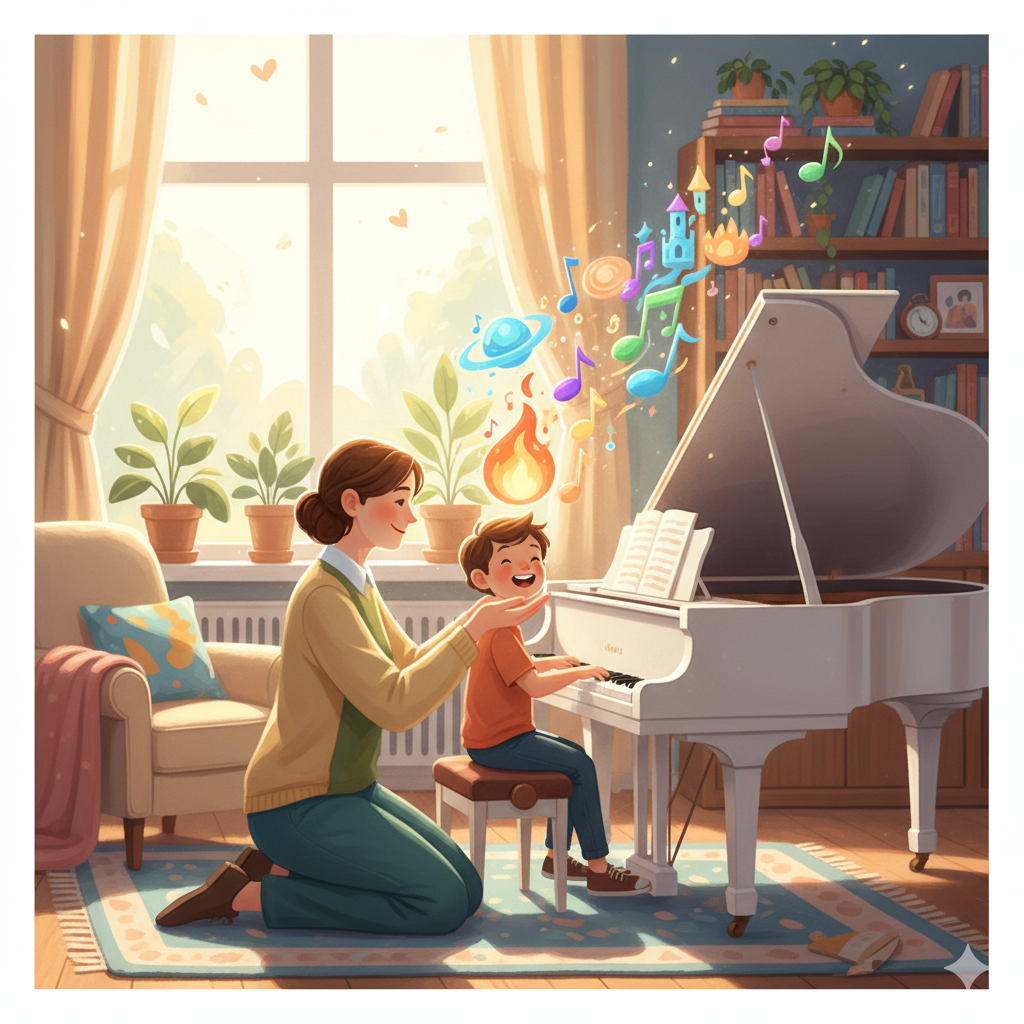
Changing the “Micro-Environment”: We Can’t Change the Era, but We Can Change the Space Around Our Children
By writing this, I’m not suggesting we all give up. We can’t change this hyper-competitive era, just as we can’t stop a storm. But we can hold up an umbrella for our children in the midst of the storm. We can change the “micro-environment” of our family.
The heart of this “micro-environment” isn’t how many tasks we give our children, but whether we protect their intrinsic motivation — especially when it comes to learning piano.
Piano is practically the poster child for impatient, results-driven education: it’s tedious, requires long-term commitment, and has a clear outcome-oriented benchmark (grading exams). For exactly this reason, it has become the biggest “battleground” in parent-child relationships.
How many children have completely lost interest in music after day after day of being told they hit the wrong note, told to start over, and scolded for not paying attention?
When our Wonder Piano team first began developing our product, we were thinking about one core question: are we building an “enhanced metronome” and “error-correcting supervisor,” or are we building a “guardian of intrinsic motivation”?
We chose the latter.
Because we firmly believe that this era is “rushed” enough already. Our homes and our products shouldn’t add more pressure on children — they should be an outlet for relieving pressure. Our core mission is to make children “want to practice on their own” and to let parents “enjoy the journey of accompanying them.”

How did we weave this philosophy into Wonder Piano?
We replaced “task-driven” practice with “game-driven” practice.
We know children resist practicing piano, so we completely abandoned the traditional model of “you must play this 10 times today.” We designed a “magical adventure” story-based level system. Every practice session unlocks a new story and collects magical items. This way, we connect tedious practice with positive feedback like fun and a sense of accomplishment.
We use “gentle feedback” to reduce children’s sense of frustration.
Many products on the market respond to a wrong note with a jarring buzzer sound, immediately interrupting the child. That’s no different from a parent yelling — it only deepens frustration. Our AI real-time recognition system uses “gentle feedback” when it detects wrong notes or rhythm issues. It gives the child a hint but encourages them to self-correct, rather than abruptly interrupting. What we want to protect is that spark of “let me try again” — the curiosity and sense of achievement.
Finally, and most importantly, we want to change the parent’s role. In traditional practice supervision, parents are forced to become “monitors.” You have to read sheet music and constantly watch for wrong notes, which multiplies parental anxiety.
But with Wonder Piano, parents don’t need any musical background to understand practice records. The AI system handles all the detection and correction. This finally frees parents from the role of “supervisor” and lets them truly become an “appreciator” and “encourager” — boosting the positive parent-child cycle and reducing the burden of hovering over practice sessions.
We can’t change this impatient era, but we can choose to use “unhurried” tools to protect a childhood where children are allowed to take their time.
The essence of education is not about “filling up” — it’s about “lighting a fire.”
Lighting the fire of intrinsic motivation in a child, so they genuinely “want to practice,” and so parents can “enjoy the journey” — that may be the greatest gift we can give our children.
At Wonder Piano, we don’t promise shortcuts. We only wish to protect that flame of love for music and the world inside every child’s heart, and let it burn a little longer, and a little longer still.