A Decade Later — Has Piano Education Really Gotten Better?
Summary: Over the past decade, the direction of piano education has shifted dramatically — yet many families are still using outdated methods to push their children. The emergence of smart practice tools is helping families break free from the old cycle of forced practice and burnout, making piano learning truly scientific and enjoyable.
Recently, a question went viral in online discussions: “What real progress in education have you personally witnessed?”
Thousands of parents jumped in. Some pointed to reduced homework policies giving kids more free time. Others praised online learning for breaking down geographic barriers. But one area of change stood out above the rest — piano education.
Many parents have noticed: the way children learn piano today is completely different from ten years ago.
What Changed Inside the Piano Studio
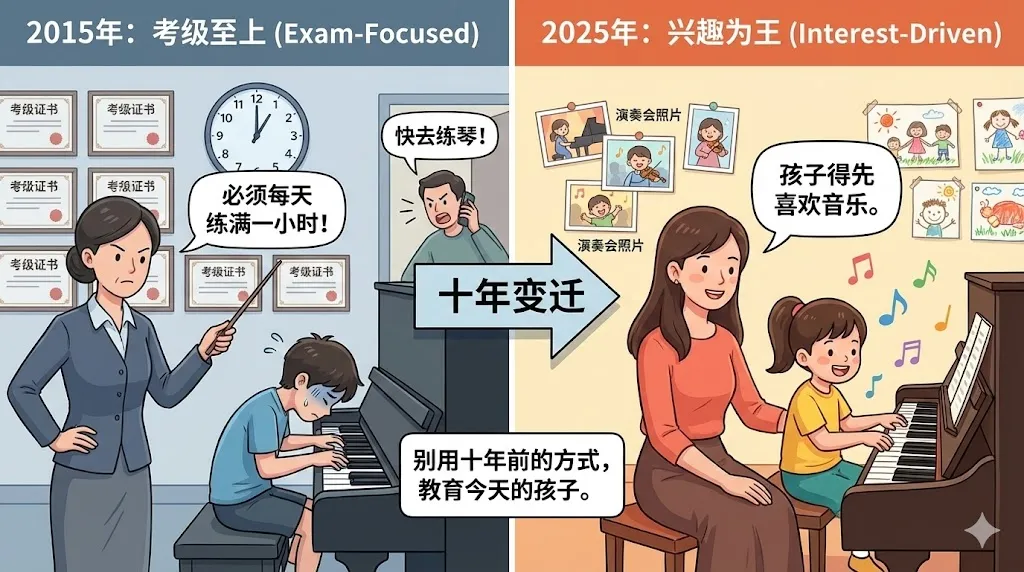
In 2015, I walked into a piano teacher’s home for the first time and saw the walls covered with grading certificates. The teacher told parents sternly: “If you want to pass the exam, you need at least one hour of practice every day.”
In 2025, a different teacher in the same neighborhood had replaced those certificates with photos from student recitals. She smiled and said: “Children need to love music first — that’s the only way they’ll stick with it.”
Over the past decade, the winds of piano education have shifted. But many parents haven’t realized that their familiar refrain of “Go practice now!” might be applying a decade-old approach to a child growing up in 2025.
Today, let’s look at three key comparisons to see what has actually changed in piano education — and how these changes are reshaping this generation’s experience of learning music.
Comparison 1: Teaching Goals — From “Passing the Exam” to “Musical Appreciation”
Ten Years Ago: Exams Were the Only Goal
In 2015, nearly every piano parent asked the same question: “When can my child take the next grading exam?”
Back then, piano education had one clear, singular goal: passing grading exams (such as ABRSM or similar national systems). Every summer, long lines formed outside music schools as children clutched the same exam pieces, drilling them over and over. Parents compared notes: “What level is your child at?”
The system had its advantages — it was standardized, with a clear learning path and measurable results. But the problems were just as obvious: many children quit piano the moment they passed Level 10, because they had never truly enjoyed music.
Now: Musical Appreciation Is the New Priority
A 2025 survey found that 62% of parents say “developing musical appreciation” matters more than “earning a grading certificate.”
Behind this shift is an evolution in how parents think about education. They’re beginning to realize: exams are a means, not an end. The real goal should be giving children the ability to appreciate music and find joy and growth in it.
Today’s piano teaching focuses more on:
- Diverse repertoire: from classical to pop, from Chinese to global music
- Musical understanding: not just playing the right notes, but grasping emotional expression
- Student choice: children can pick pieces they actually enjoy
The most visible sign of this change? Kids no longer only play Czerny etudes. They’ll play Joe Hisaishi’s “Castle in the Sky” for their friends, or perform confidently at a school talent show.
Supporting data: According to one music education platform, 7 of the top 10 most-practiced pieces by children in 2025 were pop arrangements — in 2015, that number was nearly zero.
Comparison 2: Practice Support — From “Yelling and Supervising” to “Scientific Guidance”
Ten Years Ago: Parental Anxiety and Helplessness
“You hit the wrong note again!” “Sit up straight! Your hand position is wrong!” “You can’t eat dinner until you’ve played through it three times!”
This was the daily practice routine in countless households in 2015. Parents didn’t understand music, but teachers insisted they “must supervise practice every day.” And so, practice sessions became a channel for transmitting anxiety:
- Parents couldn’t tell right from wrong, so they measured progress by repetition count alone
- Every mistake made parents tense, their tone growing harsher
- Daily practice time became a minefield for the parent-child relationship
One mother wrote on a forum: “Every practice session felt like a battle. My child cried, I yelled, and by the end we were both exhausted.”
Now: Technology-Enabled Scientific Practice
By 2025, the practice scene in more and more homes has changed completely.
One working mom shared: “Now I only need 15 minutes of companionship time each day. My child practices independently, and I’m just there to encourage and hug.”
The key to this transformation is the introduction of technology tools. Take AI practice apps as an example — technology can now deliver:
- Precise recognition: AI identifies the accuracy of every note and corrects errors in real time
- Instant feedback: after each passage, children immediately know what was right and what wasn’t
- Gamified motivation: through levels, collectibles, and story-driven mechanics, practice becomes fun
Products like Wonder Piano turn traditional “repetitive drilling” into “magical adventures.” Children no longer see practice as a chore — instead, they explore a magical world with their AI companion. Parents shift from being “supervisors” to being “cheerleaders,” and family relationships naturally improve.
Real story: One parent says that since using an AI practice tool, her son went from being nagged into practicing 2-3 times a week to practicing on his own every day, with sessions growing from 15 minutes to 45 minutes. Most importantly, “We don’t fight about practice anymore.”
Comparison 3: Family Dynamics — From “Conflict” to “Collaboration”
Ten Years Ago: Practice Was a Family Flashpoint
A survey found that 67% of piano families experienced serious arguments over practice.
The typical pattern:
- Children found practice boring and resisted it
- Parents worried about wasted tuition fees and forced compliance
- Both sides grew increasingly adversarial, often leading to quitting altogether
Many parents recall: “We enrolled our child in piano to develop a talent. Instead, it became the start of a family war.”
Now: Practice Becomes an Opportunity for Shared Growth
In 2025, progress in piano education shows up not just in teaching methods, but in how it reshapes family relationships.
A shift in roles:
- Parents are no longer “supervisors” but “supporters”
- Children are no longer “reluctant participants” but “active learners”
Behind this transformation is an evolution in educational philosophy: the goal of learning piano isn’t perfection — it’s progress.
Modern piano education tools like Wonder Piano make this philosophy real:
- Children can learn at their own pace
- Every bit of progress is visible and celebrated
- Parents don’t need to understand music to provide effective support
One piano teacher observed: “Students using the new tools come to lessons in a completely different state. Their eyes light up, their fundamentals are solid, and most importantly — they genuinely love music.”
Supporting data: A platform satisfaction survey shows that families using scientific practice tools have an NPS (Net Promoter Score) of 72 — far above the industry average of 30.
Seeing the Progress — and the Concerns
These advances in piano education are worth celebrating. But we should also stay alert to some emerging issues:
Technology Dependence vs. Human Connection
Technology can solve many problems, but it can’t replace human connection. AI can correct wrong notes, but it can’t replace the mentorship of a great teacher. Gamification can spark interest, but it can’t replace a deep understanding of what music truly is.
The ideal approach is: technology + human touch working together. Let technology handle the repetitive, standardized tasks, and save time for more meaningful guidance and companionship.
Musical Appreciation vs. Technical Fundamentals
The shift from exam-focused to appreciation-focused learning is a good thing, but solid technical fundamentals still matter. Building genuine musical appreciation requires a strong technical foundation.
Smart parents and teachers find a balance: use engaging methods to train fundamentals, and let solid technique support musical expression.
A Final Thought: This Generation’s Good Fortune
Ten years ago, children learned piano for certificates. Today, children learn piano for the music itself.
Ten years ago, parents supervised practice sessions through anxiety. Today, parents accompany their children as witnesses to growth.
This generation of young piano learners is fortunate. They’re growing up in an era with more scientific educational philosophies and more advanced tools. They don’t have to persevere through yelling and tears the way the previous generation did.
But that good fortune comes with a condition: parents need to see this progress and choose to embrace it.
If you’re still using decade-old methods to guide your child’s practice, it might be worth pausing to ask:
- Do we want a certificate, or a child who loves music?
- Are we building a skill, or destroying an interest?
- Are we supervisors, or fellow travelers on this journey?
Education is advancing. Tools are evolving. But what matters most will always be seeing your child and respecting their growth.
Frequently Asked Questions
Q1: Will using AI practice tools make my child overly dependent on technology and unable to think independently?
No. A well-designed AI tool is a “scaffold,” not a “crutch.” These tools use gamification and instant feedback to help children build confidence and habits. Once a solid foundation is in place, children naturally transition to more independent learning. The key is for parents and teachers to provide thoughtful guidance rather than relying entirely on the tool.
Q2: Will shifting from exam preparation to musical appreciation leave my child’s fundamentals weak?
No. Musical appreciation and technical training aren’t in conflict. The real progress in modern piano education is about training fundamentals in more scientific, more engaging ways — such as gamified exercises that break down technical challenges — rather than through tedious repetition. Data shows that children using these new methods actually progress faster, learning about 3 pieces per month compared to 1 piece per month with traditional approaches.
Q3: I don’t know anything about music. Without AI tools, how can I support practice effectively?
Three suggestions: 1) Trust your teacher’s professional guidance and take careful notes during lessons; 2) Focus on encouragement rather than correction — help build your child’s sense of accomplishment; 3) Create a relaxed practice atmosphere so your child can find joy in music. Remember, the best practice support is “companionship,” not “supervision.”
Let’s Talk
In your experience supporting your child’s practice, have you gone through the shift from “yelling and supervising” to “scientific guidance”? What do you see as the biggest improvement in piano education over the past decade? We’d love to hear your story in the comments.