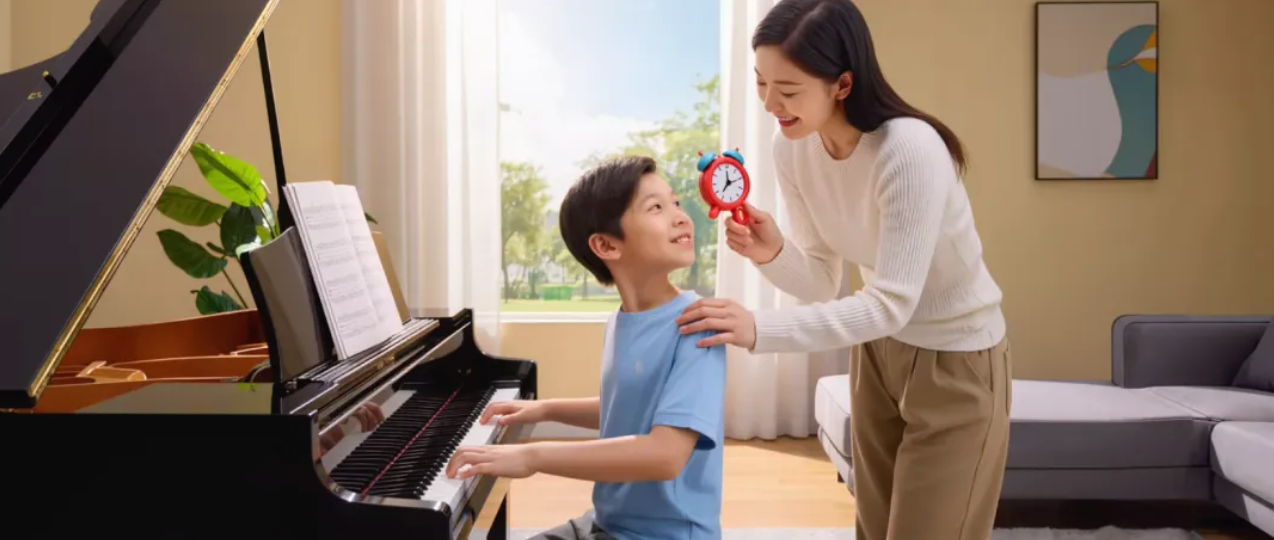
Why Does Your Child Always Say “Just 10 More Minutes”? Understanding How Kids Perceive Time to End Piano Practice Battles
Summary: When it’s time to practice piano, children constantly bargain for “just 10 more minutes.” This isn’t simply defiance or a bad attitude — their brains perceive time completely differently from adults. This article breaks down the real psychology behind practice procrastination in plain language and offers a set of practical tools to help parents gently but firmly put an end to the daily piano practice tug-of-war.
Introduction: Why Is Playtime Fine but Piano Practice Isn’t?
“Just one more episode and then I’ll practice”… “Just 10 more minutes of building blocks”… In countless homes with piano-learning children, “10 minutes” feels like a black hole that never actually arrives.
Many parents lose their temper in these moments, concluding that their child simply lacks self-control or refuses to listen. But from a psychological perspective, this kind of bargaining is completely normal.
When you’re pushing your child to go practice, you’re not really fighting the child — you’re fighting the enormous gap between “easy fun” and “hard work.”
Breaking It Down: What Your Child Is Really Thinking When They “Procrastinate”
1. The Never-Ending “Just One More Round” (Instant Gratification Is Too Easy)
- What you see: Your child can never stop playing games or watching cartoons.
- What’s really happening: Cartoons and games are designed to deliver instant pleasure. Asking children to switch from this “effortless joy” to something that demands intense concentration — like piano practice — is like slamming the brakes on a car going full speed. It’s genuinely difficult.
2. Pre-Practice Stalling (Fear of Difficulty at Work)
- What you see: The moment they’re told to sit at the piano, they suddenly need water, a bathroom break, or to find an eraser.
- What’s really happening: Piano practice is hard. All those trivial excuses are actually an instinctive avoidance response to difficulty. Subconsciously, children are trying to delay the challenging task as long as possible, buying themselves a little buffer time.
3. The Countdown That Backfires (Emotional Pushback)
- What you see: The parent loses patience and shouts, “I’m counting to three — turn off the TV and go practice right now!”
- What’s really happening: Yelling and countdowns make children tense and afraid. Even if fear gets them to the piano bench, they’re sitting there full of negative emotion. Practicing in this “forced” state is not only ineffective — it teaches children that “piano = getting scolded,” making them resent music more and more.
Going Deeper: Your Child’s Brain Processes Time Differently
Why is getting kids to practice on time so hard? Because the “time manager” in their brain is still developing.
- “Ten minutes” is abstract: For adults, “ten minutes” is a clear mark on a clock. For children, the toy in their hands is real, while “ten minutes from now” is vague and intangible — they genuinely don’t know how long ten minutes is.
- Delayed gratification is tough: Piano is a classic case of “work now, enjoy later.” You have to put in long stretches of tedious practice before you can play a beautiful piece. But children are naturally drawn to things that feel good right now.
Since this is simply how children are wired, we can’t rely on forcing them. Instead, we need to build “stepping stones” — clever little tools that help them get over the hurdle.
Action Guide: Family Time-Management Tips to End the Tug-of-War
How can you set rules that work with your child’s nature instead of against it? Here are methods that many parents swear by:
| Stage | Common Mistake | Better Approach | Why It Works |
|---|---|---|---|
| Before practice: Transitioning | Abruptly interrupting: “Turn off the TV right now and go practice!” | Give a buffer period: Place a sand timer in front of your child 10 minutes early and offer a small choice: “When the sand runs out, we’ll start. Would you like to begin with scales or a piece?” | Gives the child time to mentally prepare. Replacing “you must” with “you choose” reduces resistance. |
| During practice: Setting goals | Rigid demands: “You’re practicing for a full hour today, no exceptions!” | Break time into small chunks: Young children have limited focus. Split one hour into two or three 20-minute “mini sessions” with water and rest breaks in between. | Smaller goals make children feel “I can do this,” which prevents feelings of overwhelm. |
| After practice: Giving feedback | Only pointing out mistakes: “You got that wrong again — why can’t you remember?” | Make progress visible: Use a smart assistant like Wonder Piano so your child gets instant feedback on right and wrong notes, plus a daily practice calendar to track streaks. | Like earning points and level-up effects in a game, it turns tedious practice into something with immediate rewards and a sense of achievement. |
Final Thoughts
Time management is really about understanding and working with your child’s nature.
When we set aside emotionally charged blame and replace harsh yelling with gentle rules and simple tools, our children can slowly learn to take charge of their own time — one key at a time.
Frequently Asked Questions
Q1: I’m using a sand timer and a clock, but my child still refuses to move when time is up. What should I do?
A: This is where parents need to be “warm but firm.” When the timer goes off, don’t lecture and don’t lose your temper. Simply walk over, take your child’s hand, and lead them away from the play area. Don’t give in. After a few times of consistently following through, your child will understand: when the timer goes off, that’s the rule — fussing won’t change it.
Q2: Won’t scheduling practice at a fixed time every day make my child feel like it’s just another chore and kill their love for music?
A: Actually, quite the opposite. When piano practice becomes a fixed habit — like brushing teeth before bed — children no longer have to spend mental energy each day debating “should I practice today? When should I practice?” A regular routine helps children settle in, and when practice becomes second nature, they actually have more mental space to enjoy the music itself.
Q3: Will using an AI tool on a phone or tablet for practice make my child dependent on screens or hurt their eyesight?
A: Many parents share this concern. In reality, professional practice tools like Wonder Piano are primarily based on listening — children don’t need to stare at the screen constantly. Think of it as a little “assistant teacher” sitting beside them, offering a helping hand during the beginner stage when mistakes are most frequent and frustration runs highest. Once children get through the hardest phase and build good habits, they’ll naturally become less reliant on the tool.