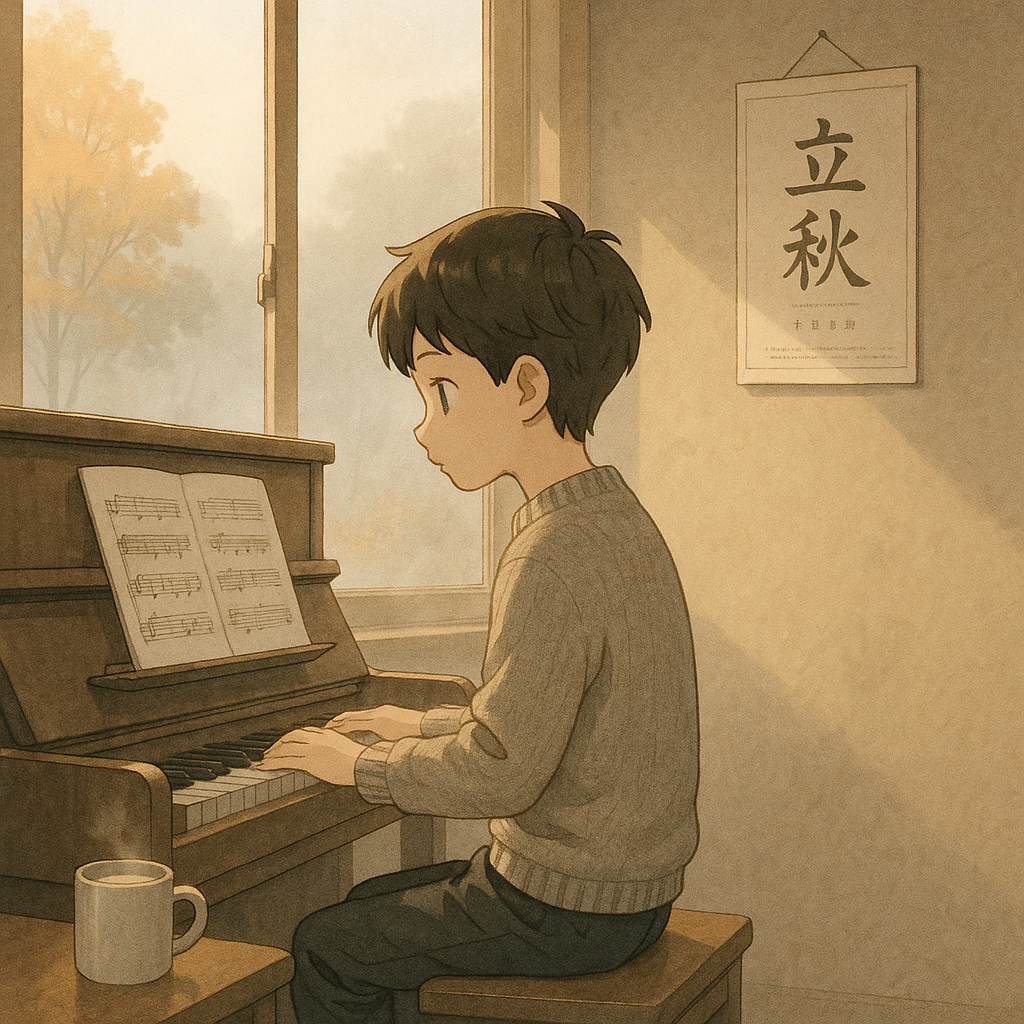
Mom, It’s the First Day of Autumn — Not a Good Day for Piano Practice
“Mom, today marks the start of autumn. The dry air is bad for the lungs, and playing piano takes a lot of breath control — it’s not good for my health. Let’s take the day off.”
When you hear something like this, you might briefly wonder: did I pay for piano lessons, or did my kid secretly enroll in a traditional wellness course?
It’s 95 degrees outside, the late-summer heat is still going strong, and your child is already using the changing seasons as a shield. You take a deep breath, ready to counter with logic and reason, only to realize you’ve already lost this debate before it started.
Because their argument is “I don’t want to practice,” and yours is “You have to.” This isn’t a conversation — it’s a tug-of-war of willpower.
Your Child’s Practice Excuses Are a True Art Form
Kids who learn piano have excuses far more colorful than any sheet music:
The Weather Excuse: “It’s too hot — my palms are sweaty and my fingers slip on the keys. It’s too cold — my fingers are stiff and I can’t play properly.”
The Health Excuse: “I just ate, so I shouldn’t play — it’s bad for digestion. My eyes are tired and I can’t read the music.”
The Mystical Excuse: “Mercury is in retrograde — I’ll definitely make mistakes. I feel like this piece just doesn’t match my zodiac energy.”
The Studious Excuse: “I have a math test tomorrow. I need to save my brainpower for problem sets.”
Each one sounds perfectly reasonable, right? But they all translate to the same three words: It’s boring.
The problem isn’t that your child is lazy or disobedient. It’s that in their eyes, piano practice falls into the same category as homework and memorizing textbook passages — just another tedious task. There’s no instant feedback, no excitement — just endless repetition under a parent’s watchful eye.
When something is defined as a “task,” a child’s natural instinct is to avoid it. They’re not incapable of perseverance — they just understand human nature all too well: they know exactly how to raise your blood pressure with arguments you can’t easily refute.
The Hidden Toll of “Practice Anxiety” on Parents
If your child’s excuses regularly make your heart rate spike, you’re probably fighting an emotional battle every single day:
You know yelling doesn’t work, but nothing happens if you don’t.
You know supervising practice is supposed to be quality time, but the moment you sit down, frustration takes over.
You know consistency matters, but the process of maintaining it is exhausting.
Why do we keep losing our temper? Because what you see isn’t just one skipped practice session — it’s the fear that “if this keeps up, all that effort will be wasted.”
You worry the interest will fade, the foundations will crumble, the progress will fall behind, and all the money and time you’ve invested will be for nothing. Piano practice has gone from a skill-building activity to an emotional flashpoint for the whole family.
The Root Problem: Practice Lacks a “Sense of Achievement”
If you look closely, you’ll notice:
Your child doesn’t completely hate the piano — they sometimes get lost in a beautiful melody.
They don’t entirely refuse to learn — they just hate the feeling of being forced to practice.
They’re not completely unmotivated — they just can’t see what practicing actually gets them.
This is the key: practice offers no positive feedback loop. You rarely hear a child say, “Wow, I played that better today than yesterday!”
Instead, you hear: “I messed up again!” “Why can’t I get past this part!” “Stop staring at me!”
We’ve gotten used to playing “error police” and “drill sergeant,” but we’ve forgotten that what truly drives children forward isn’t “you should” — it’s “I can.” Behind that feeling lies a sense of achievement, a sense of control, and the emotional value of being truly seen.

A Practical Plan: Making Practice Feel Voluntary, Starting with Three Small Steps
✅ Step One: Set “visible goals” — turn vague expectations into clear targets
Stop saying “practice well today.” Instead, be specific:
Play the first section smoothly three times in a row.
Work on those two tricky measures with the right hand until they flow.
Practice for 15 minutes and just focus on getting the rhythm right.
Children need to see tangible results — even something as small as “I made two fewer mistakes today than yesterday.”
✅ Step Two: Build in “instant rewards” — let the brain taste success
This could look like:
Earning a practice stamp for every completed piece.
Three consecutive days of practice earns a family movie night.
Using a gamified practice app where each level unlocked reveals a new story or mini-game.
These “instant rewards” aren’t about bribing with material things. They help your child’s brain build a pathway of “effort → results → recognition,” creating a positive cycle.
✅ Step Three: Redefine the practice relationship — turn “supervising” into “supporting”
Consciously shift your role from “commander” to “audience” or “teammate”:
Record a short video of your child practicing, then watch it together and point out: “That passage was really steady!”
Instead of interrupting constantly, wait until they finish and offer feedback all at once.
When they do well, don’t say “Finally, you’re playing normally.” Say: “That section just gave me chills!”
When your child feels your genuine appreciation, they’ll be more willing to keep practicing — even if it’s still technically a “task,” the atmosphere is completely different.
Smart Tools: Taking the Battle Out of Practice Time
The three steps above sound simple, but they require enormous patience and energy from parents. Often, it’s not that we don’t want to be a “teammate” — we’re just stretched too thin and end up defaulting to “commander.”
That’s where a smart AI practice assistant becomes invaluable. Just as you wouldn’t expect an elementary schooler to solve advanced math problems alone, we can’t expect a six-year-old to manage their own practice schedule and push through frustration purely on willpower.
With an app like Wonder Piano, you get real help:
A tireless error-spotter: It catches pitch and rhythm mistakes in real time — more accurate and more patient than any parent’s ear.
A clever game designer: It turns dry practice into an adventure with level-based story unlocks, so kids learn while they play.
An objective progress tracker: It records practice data and makes improvement visible. Seeing their own daily growth motivates a child far more than a hundred reminders to “try harder.”
When practice transforms from a chore that needs policing into something fun, with real feedback and a sense of accomplishment, your child won’t need seasonal excuses anymore.
Don’t Win the Argument and Lose the Relationship
The goal of learning piano isn’t “technical mastery” — it’s “genuine enjoyment.” When your child doesn’t want to practice, it’s not necessarily weakness of will. It might be a quiet cry for help: I’m tired, I’m stuck, I need real support and understanding.
Instead of arguing louder, try sitting closer.
Instead of battling willpower, try improving the method.
Next time your child uses the change of seasons as an excuse, maybe you can smile and say: “Alright then — let’s give our practice routine a fresh start too.”
The harvest of autumn isn’t found only in the fields — it’s also in the patience and wisdom we bring, waiting for the music to truly bloom at our children’s fingertips.