AI Won’t Replace Piano Teachers, But Kids Who Use AI Are Pulling Ahead: Here’s Why
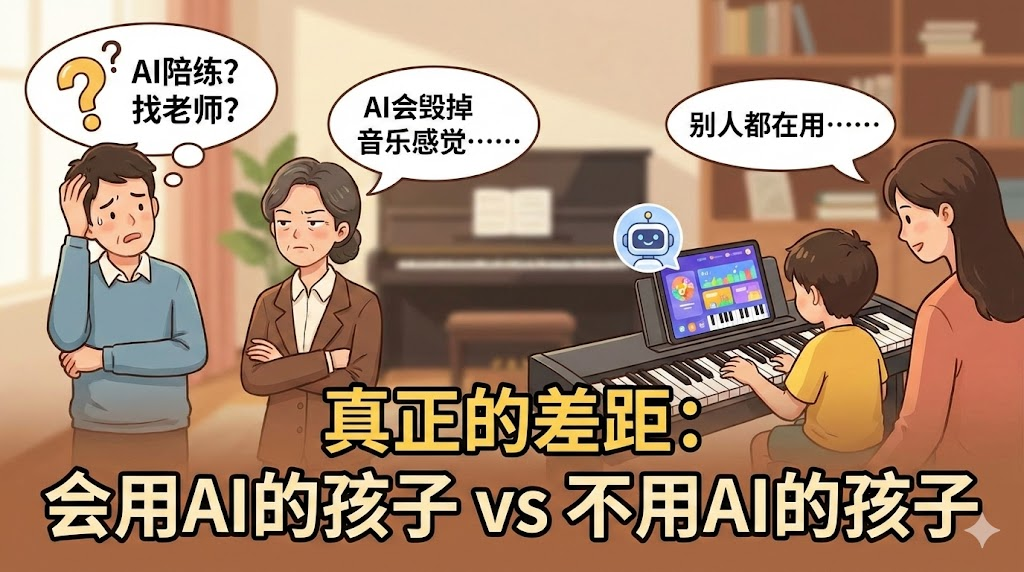
“I heard there are AI practice tools now — do we still need a teacher?”
“Our teacher says AI will ruin a child’s musical sense…”
“But other kids are already using it — will mine fall behind?”
These conversations happen every day among piano parents. On one hand, there’s curiosity about AI technology; on the other, trust in traditional teaching. Parents are caught in the middle. Meanwhile, many piano teachers are worried too: will AI practice tools put them out of a job?
But the real question isn’t “Will AI replace teachers?” — it’s “How big is the gap growing between kids who use AI and those who don’t?”
AI and Teachers Aren’t Competitors — They’re Teammates
The rise of AI practice tools has certainly made many people nervous. But if you think about it calmly, AI and teachers are good at completely different things.
Where does AI shine? Standardized training.
Was a note played correctly? Is the rhythm accurate? Is the tempo too fast or too slow? AI can achieve 95% recognition accuracy and provide instant feedback. In Wonder Piano, for example, the system identifies every note the moment your child plays it, immediately flagging errors and offering guidance. This kind of “someone watching every single note” practice density is something a human teacher simply can’t match.
Then there’s data tracking. How long did the child practice today? Which measures keep tripping them up? How much progress have they made? AI records all of this precisely. Parents no longer have to guess whether “today’s practice went well,” and teachers can review a full week of practice data before each lesson, making their teaching far more targeted.
But what AI can’t teach is music itself.
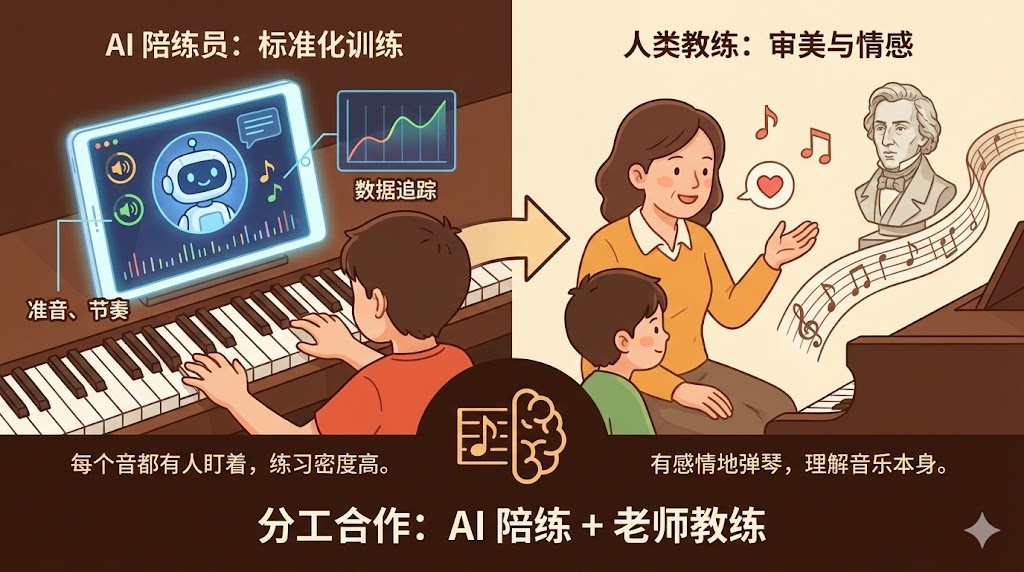
What does it mean to “play with feeling”? What’s the difference between Chopin and Liszt? Why should this passage get softer? These things require aesthetic understanding and emotional connection — something AI simply can’t provide. When a child tenses up and their wrist goes rigid, or when they lose interest because a piece doesn’t speak to them, they need a teacher’s face-to-face observation and guidance.
Put simply, AI is the practice partner; the teacher is the coach. The practice partner watches your push-ups and tracks your stats. The coach tells you why you’re training and how to train smarter. It’s a division of labor, not a replacement.
The Real Gap: Where Do AI-Using Kids Actually Win?
Kids who started using AI practice tools early already have a clear advantage.
Gap #1: Practice Frequency
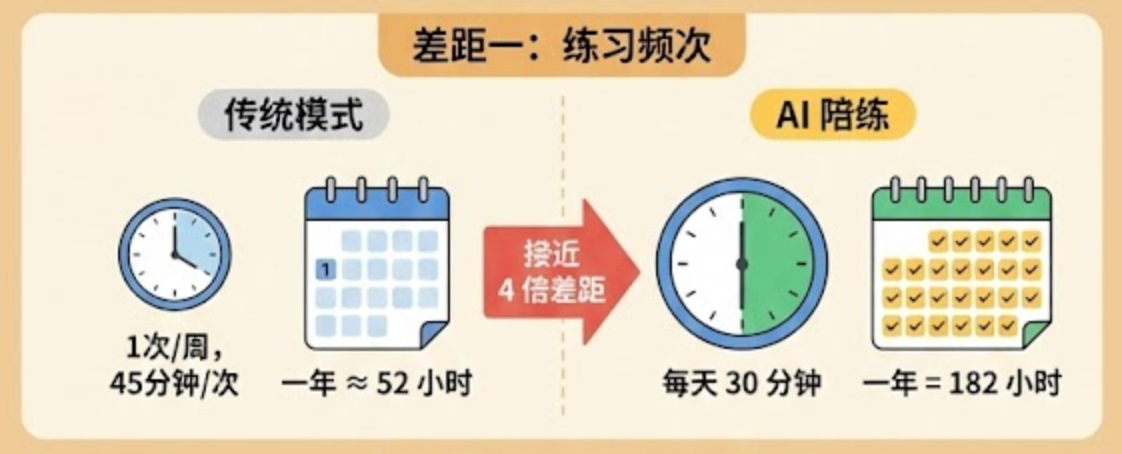
In the traditional model, a child takes one piano lesson per week, about 45 minutes each. That adds up to roughly 52 hours a year. But a child with AI practice tools? Practicing 30 minutes a day at home adds up to 182 hours a year. That difference alone is nearly 4x.
More importantly, with traditional lessons happening just once a week, there’s no one to correct mistakes during home practice. Children easily turn errors into habits. By the time the teacher spots the problem at the next lesson, it’s already too late.
Gap #2: Error Correction Speed
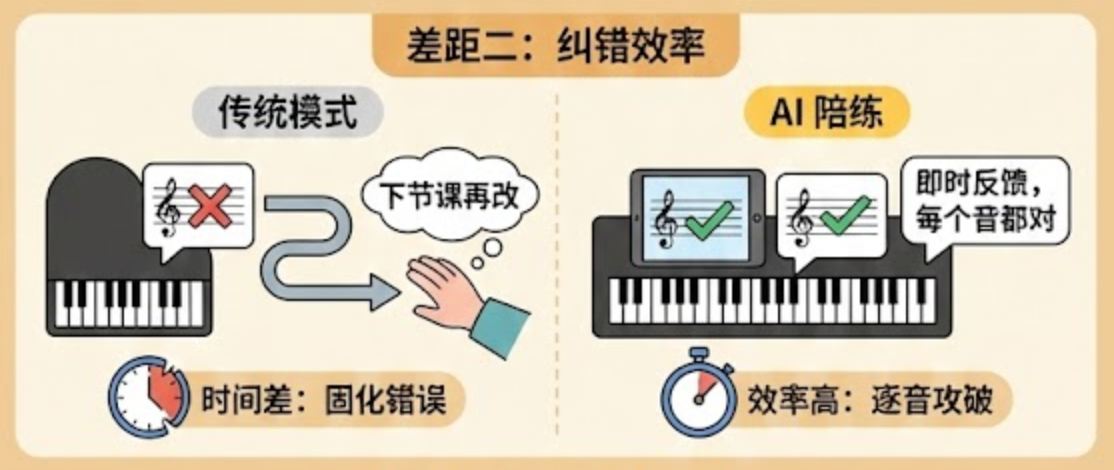
A child using AI knows the instant they play a wrong note. A child without AI might not find out until the next lesson, when the teacher finally points it out. That time gap is exactly when muscle memory locks in the mistake.
Wonder Piano’s “Magic Quest” mode, for example, breaks a piece into small challenges. Children conquer it note by note, phrase by phrase, with real-time feedback on every note. This “get it right as you go” efficiency is far superior to “practice wrong for a week, then spend another week fixing it.”
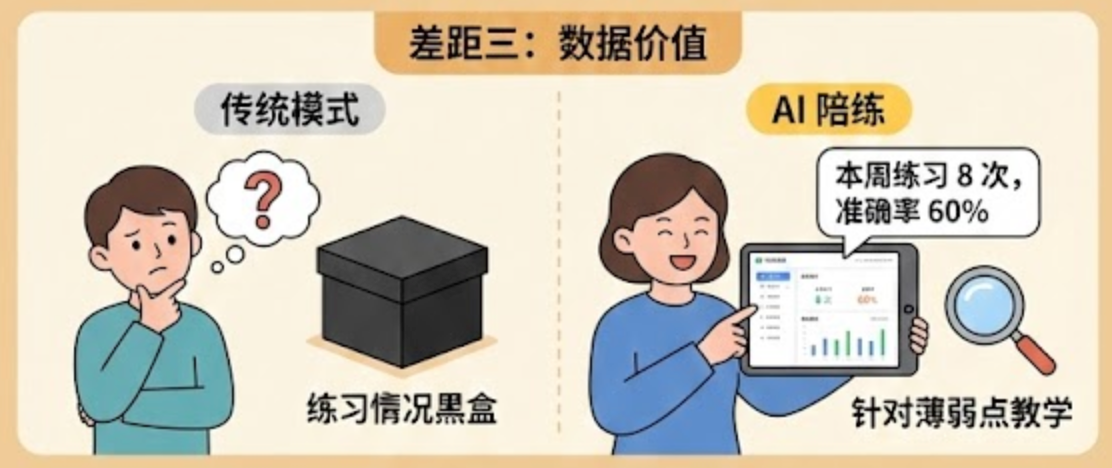
Gap #3: Data-Driven Insights
Parents without AI often ask the teacher, “How is my child actually doing with practice?” The teacher can only judge based on what they see in class. Exactly which days the child practiced, how many times they ran through a piece, and where they keep stumbling — it’s all a black box.
Parents with AI can open the app and see a detailed practice report. For example: this week, “Twinkle, Twinkle, Little Star” was practiced 8 times, but the left hand in measure 3 only has 60% accuracy — that’s the area to focus on. Teachers can then use this data to target weak spots directly, instead of wasting lesson time on assessment.
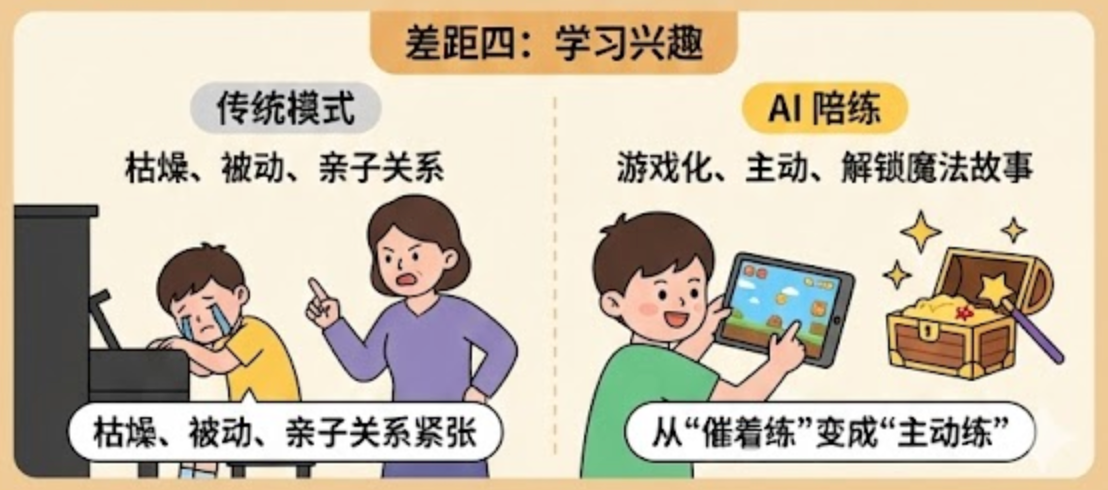
Gap #4: Keeping the Fun Alive
Traditional practice means playing the same piece from sheet music over and over. It’s so boring it can bring a child to tears. Many parents find themselves nagging their kids to practice every day, straining the parent-child relationship.
Gamified AI practice tools are a completely different experience. In Wonder Piano, practicing piano feels like playing a video game — clearing levels, unlocking magical stories, and collecting power stars. Parents have reported that their children went from “needing to be pushed every time” to “asking to practice a little longer,” with practice sessions increasing from 15 minutes to 30–45 minutes.
Motivation might seem intangible, but it determines whether a child sticks with piano. Among kids who quit, the reason is rarely “I can’t learn it” — it’s almost always “I don’t want to.”
AI Makes Teachers More Valuable, Not Less
Some teachers worry that AI will take their jobs, but in reality, AI is making teachers more valuable than ever.
Previously, teachers spent a huge chunk of lesson time correcting wrong notes and rhythm problems from home practice. Now, with AI practice tools handling basic error correction at home, teachers can spend their lesson time on higher-level instruction: explaining the background of a piece, demonstrating emotional expression, and guiding children to truly understand music.
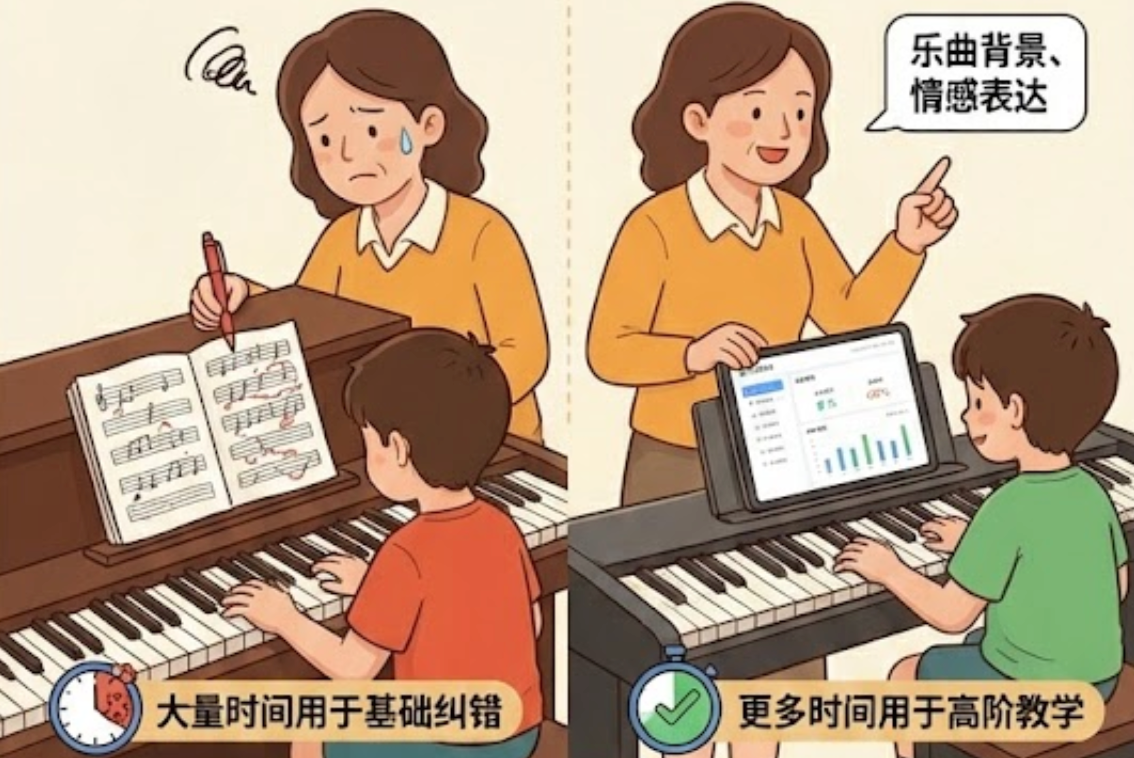
That’s where a piano teacher’s real value lies.
And the data that AI records helps teachers understand their students more precisely. Before, teachers could only judge a child’s issues based on in-class performance. Now, through practice reports, they can see a full week of practice history — where the child got stuck, how fast they’re progressing, and whether they’ve been slacking off. It’s all right there.
It’s like medicine: doctors used to rely solely on observation and conversation. Now, with CT scans and MRIs, diagnoses are more accurate and treatments more targeted. Technology doesn’t replace doctors — it makes them better.
Technology Is an Amplifier, Not a Replacement
Back to the original question: Will AI replace piano teachers?
The answer is clear: No.
But the more important question is: Are you using AI?
Technology has never been about replacing people — it’s about amplifying their abilities. Kids who use AI practice more efficiently, stay more engaged, and progress faster. Kids who don’t are still repeating the same inefficient routines with outdated methods.
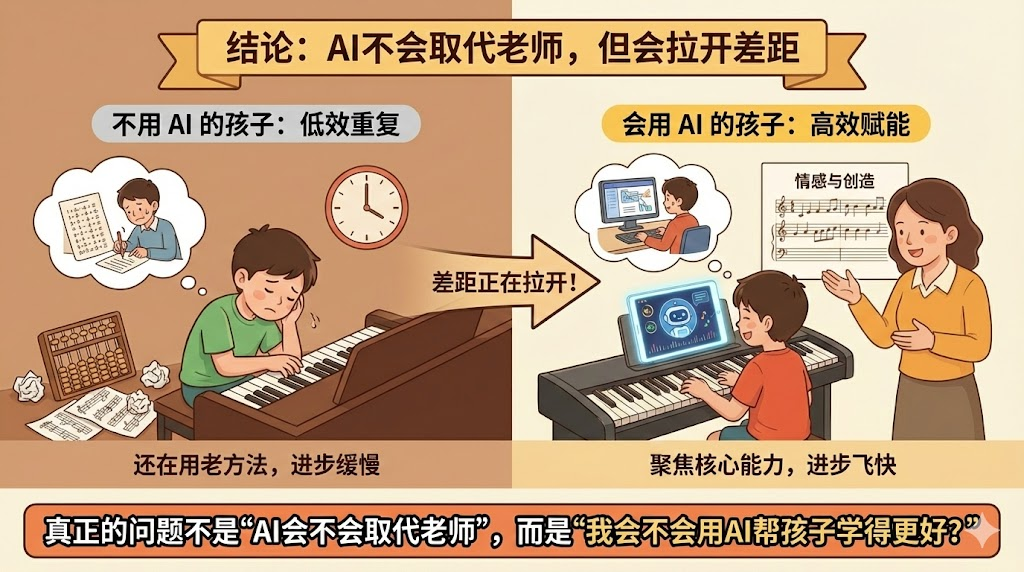
That’s how the gap opens up.
Think about when calculators first appeared — people worried they’d destroy math skills. But in reality, people who used calculators could spend their time on more complex mathematical thinking, while those who didn’t were still doing basic arithmetic by hand.
AI piano practice tools work the same way. They’re not here to replace teachers — they’re here to help children build a stronger foundation, so teachers can focus their time on what truly matters.
So the real question isn’t “Will AI replace teachers?” — it’s “Am I using AI to help my child learn better?”

If your child is struggling with practice, frustrated by wrong notes, or suffering through boring repetition, consider trying an AI practice tool like Wonder Piano. At around $80 a year — less than 25 cents a day — you get a child who practices willingly, parents who can step back, and more productive lessons with the teacher.
Don’t let your child fall behind simply because they didn’t have the right tools.
Q&A
Q: Can AI practice tools really replace a piano teacher?
A: No. AI handles basic practice supervision and instant feedback, while teachers handle musical understanding, technique development, and aesthetic growth. They complement each other — like a doctor and a CT scanner.
Q: Is there really a big difference between kids who use AI and those who don’t?
A: The difference is clear. Kids using AI practice more consistently, correct errors faster, and have trackable data. Add in gamification, and they’re far more likely to go from “forced to practice” to “wanting to practice.”
Q: What should I look for in an AI piano practice tool?
A: Three things. Look for high recognition accuracy (90% or above), genuine gamified motivation features, and good value for money. It’s best to let your child try a free trial before deciding.
References
User data analysis (2016–2024)
Research report on piano-learning family practice behavior