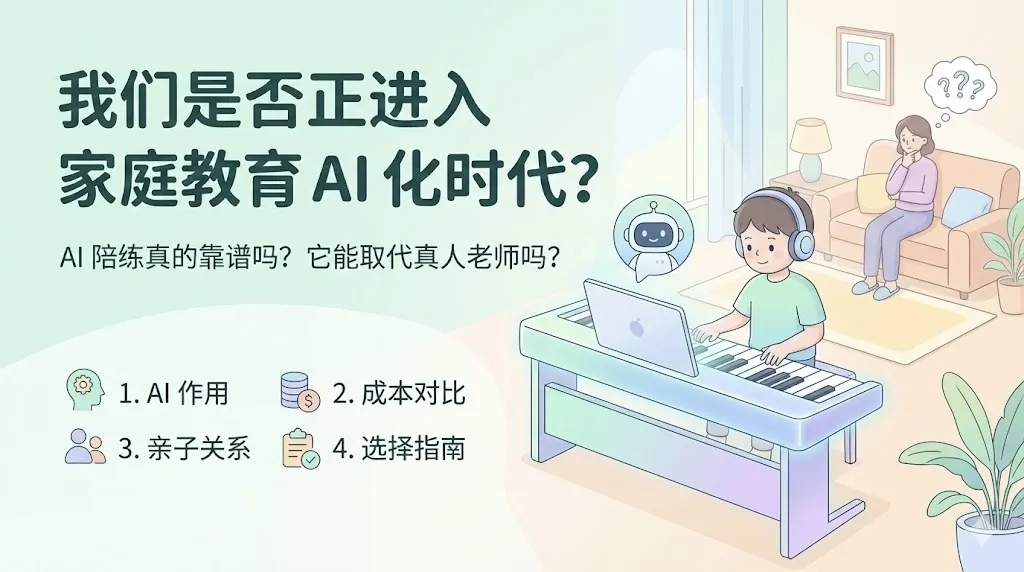
Piano Education in the AI Era? Answer These 7 Questions First
Summary: AI practice assistants have become the choice of hundreds of thousands of piano families, but they are not meant to replace teachers. Instead, they solve the weakest link in piano learning: daily practice after lessons. This article breaks down 7 key questions about what AI practice tools can and cannot do, helping parents cut through the marketing hype and make informed decisions.
“Are we entering an era of AI-powered education at home?”
For parents of piano students, this is far from a distant question. When your child needs to practice every day, when hiring a human practice coach is expensive, and when parent-child relationships are strained by practice battles, AI practice assistants have quietly become the choice of hundreds of thousands of families.
But are AI practice tools really reliable? Can they replace a real teacher? With so many products on the market, how do you choose? These 7 questions will help parents take a clear-eyed look at what AI actually does in piano learning.
Question 1: What Is the Core Purpose of an AI Practice Assistant?
An AI practice assistant is not a “teacher replacement.” It solves the weakest link in piano learning: what happens after the lesson.
The golden formula of piano learning is: 1 hour of lesson instruction + 20 hours of independent practice. Yet 90% of families struggle with that practice time. Children resist boring repetition, parents lack the musical knowledge to guide them, and the parent-child relationship suffers under the pressure of supervising practice. A human practice coach is ideal, but the cost of 5 to 7 sessions per week, 30 to 60 minutes each, is out of reach for most families (typically around $15 to $40 per hour).
The value of an AI practice assistant lies in its availability around the clock, real-time audio recognition, instant corrective feedback, and affordable cost. It is not a “teaching tool” but a “practice companion” that helps children complete high-quality independent practice after lessons, truly absorbing and internalizing what the teacher taught.
Question 2: Does AI Recognition Accuracy Really Matter?
Accuracy directly affects your child’s practice experience and rate of improvement.
AI recognition accuracy varies widely across the industry. Leading products achieve 90% to 95%, while others only manage 70% to 80%. When accuracy falls short, the consequences are real: wrong notes go undetected, correct playing gets flagged as mistakes, children grow frustrated, and bad habits get reinforced.
Even more important is how the system handles errors. Traditional AI practice tools stop at every wrong note, breaking the flow of playing. Next-generation products with auto-follow algorithms can continue tracking when a child plays a wrong note without interrupting, finding a balance between accuracy and musical continuity. This is crucial for developing a sense of rhythm and flow.
Tip for choosing: During your trial period, focus on testing three scenarios: fast passages, soft playing, and repeated or skipped notes. See whether the AI can accurately recognize and follow along.
Question 3: Is Gamification a Gimmick or a Real Need?
For children aged 5 to 13, gamification is not just a nice extra. It is the core driving force behind getting kids to practice willingly.
Traditional utility-focused practice tools emphasize “feature completeness” but overlook how children’s minds work: repetitive practice is boring, instant feedback is missing, and long-term goals feel impossibly far away. Truly effective gamification works on three levels:
- Surface-level motivation: Points, badges, and leaderboards (most products stop here)
- Mid-level design: Stage-based progression, gradually increasing difficulty, and visible achievements
- Deep immersion: Complete storylines, character companions, and emotional connection
The data speaks for itself. User data from one deeply gamified product showed that the percentage of children practicing voluntarily rose from 15% to 78%, and average daily practice time increased from 18 minutes to 42 minutes. The essence of gamification is not “playing games” but transforming “a boring necessity” into “an engaging choice.”
Question 4: Is a Bigger Sheet Music Library Always Better?
Quantity is a baseline, but quality, organization, and how quickly new pieces are added matter more.
Leading products offer sheet music libraries ranging from 3,000 to 90,000 pieces. For piano families, what really matters is whether grading exam repertoire is covered (such as ABRSM and other major grading systems), whether popular pieces are updated promptly (anime soundtracks, film scores that kids love), and whether difficulty levels are well-organized to match different skill levels.
An even more practical feature is “song requests.” When you cannot find a piece you want, can you submit a request and have it added quickly? That is far more valuable than simply piling up numbers.
Question 5: What Explains the Price Differences?
Annual subscriptions for AI practice products range from around $30 to around $400, with the differences reflecting technology investment, content quality, and depth of service.
Price comparison (annual):
- Around $30 to $70: Basic AI recognition, simple incentive systems, suitable for budget-conscious families
- Around $70 to $200: Advanced AI algorithms, gamification features, rich sheet music library
- Around $280 to $400: Brand premium, celebrity endorsements, but user feedback suggests value for money is not always the best
A rational approach: First, identify your child’s core need (motivation? technical correction? expanding repertoire?), then match the right price range. Price is not the only factor. The trial experience and your child’s own preference matter more.
Question 6: How Can You Tell If a Product Is Right for Your Child?
Three hands-on tests that are more reliable than any advertisement.
Test 1: Your Child’s Reaction (Most Important)
- Let them try for 3 to 5 days and watch whether they open the app on their own
- Track changes in practice duration (passive vs. voluntary)
- Ask your child what they like and dislike about it
Test 2: Technical Capability
- Test AI recognition accuracy with pieces your child is currently learning
- Deliberately play wrong notes, repeat sections, or skip ahead, and observe how the system responds
- Check whether feedback is timely and instructions are clear
Test 3: How Much It Frees Up Parents
- Compare your practice supervision time before and after using the product
- Evaluate whether practice-related conflicts decrease
- Check whether the practice reports are detailed and easy to follow
Question 7: Will AI Practice Tools Make My Child Dependent?
Used properly, they will not create dependency. In fact, they can build independent learning skills.
Parents’ concern is understandable: if a child gets used to AI encouragement and instant feedback, can they still practice well without it? Here is what actually happens:
- Short term: AI helps children get through the most painful beginner phase, building muscle memory and foundational skills
- Medium term: Children develop a daily practice habit through AI, gradually experiencing the satisfaction of real progress
- Long term: Once a child genuinely falls in love with music, AI becomes a “helpful tool” rather than the “only motivation”
The key is how parents guide the process:
- Position AI as a “practice assistant,” not a “teacher replacement”
- Communicate regularly with the piano teacher to ensure the learning path stays on track
- Encourage your child to perform at school events, family gatherings, and other occasions to build a broader sense of achievement
A Practical Approach: Three Steps to Choosing the Right Product
With over a dozen AI practice products on the market, here is a three-step method combining elimination, trial runs, and a simple decision framework:
Step 1: Eliminate the Clearly Unqualified
- AI recognition accuracy below 85%
- No free trial or trial period shorter than 3 days
- User reviews with widespread complaints about after-sales support
Step 2: Narrow Down to 2 or 3 Candidates
- Price within your family’s budget
- Core features match your child’s needs (gamification, technical correction, music library)
- Relatively stable brand reputation
Step 3: Let Your Child Try Them and Decide
- Have your child try 2 to 3 products at the same time and see which one they prefer
- Track practice frequency, duration, and mood during the trial
- Respect your child’s choice (the product they enjoy is the one they will actually keep using)
FAQ
Q: Can an AI practice assistant completely replace a real teacher? A: No. AI practice assistants address the “daily practice” challenge, while real teachers handle “instruction and musical expression.” The two complement each other rather than compete.
Q: What age is best to start using an AI practice assistant? A: Children aged 5 and up who have already started learning piano can benefit. The key requirement is that the child can read sheet music independently and has basic playing ability.
Q: What should I focus on during the free trial? A: Three things: Does your child open the app voluntarily? Is the AI recognition accurate? Has your practice supervision time decreased?
If your child had to choose between a traditional utility-style practice tool and a gamified AI practice assistant, which do you think they would prefer? We would love to hear your family’s piano practice story and experience.