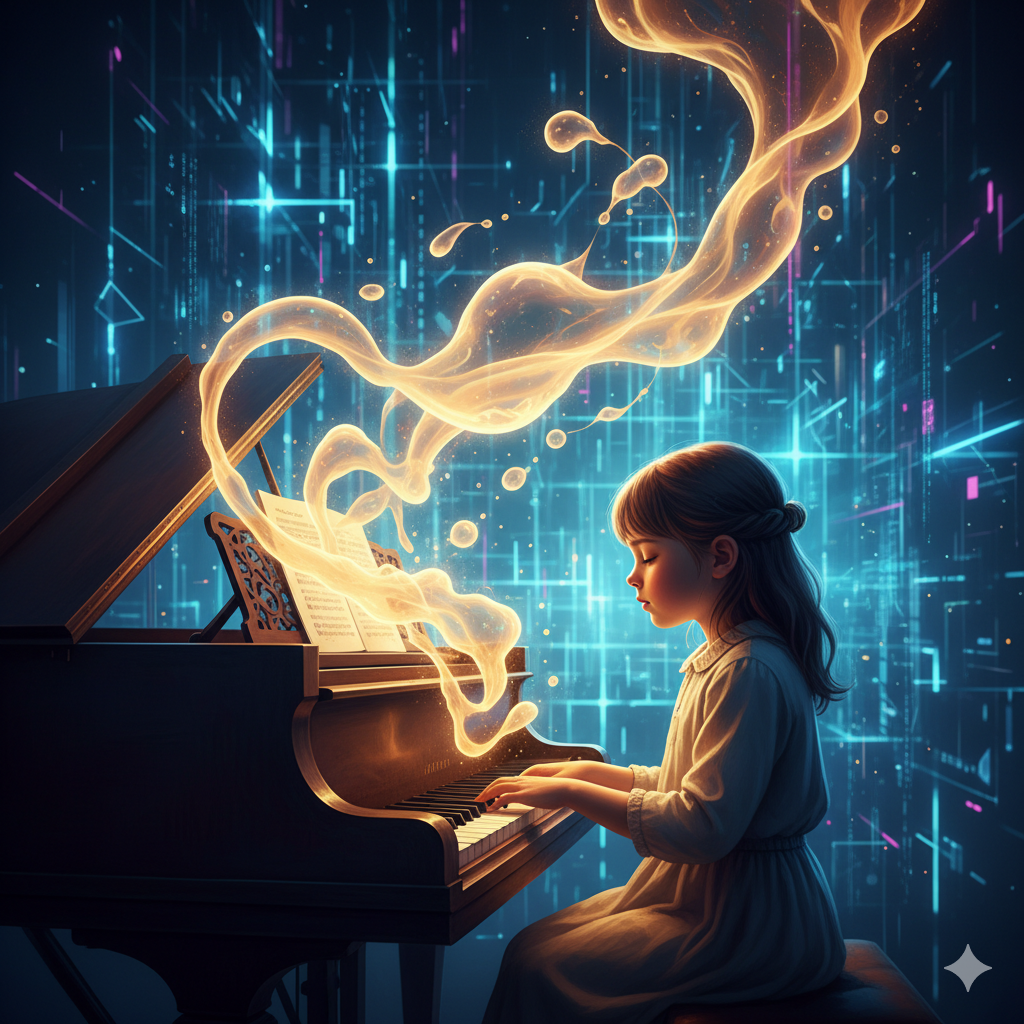
AI Can Compose Music Now — Is There Still a Future in Piano?
The tech world keeps dropping bombshells. The arrival of AI music generation tools like Sora and Suno has hit piano parents especially hard. Type in a few words and AI can produce a beautiful, fully orchestrated piece in seconds.
Parents have been messaging me, full of anxiety: “If AI can already compose this well, what’s the point of our kids grinding away at the piano, note by note? By the time they grow up, will they not even be able to work as a ‘music technician’?”
This anxiety over “return on investment” combined with the fear that “AI will replace everything” is perhaps the ultimate parenting dilemma of our time.
Today, let’s talk facts about why we should still have our children learn piano in the age of AI.
Let’s Be Honest: AI Has Won on the Technical Front
We have to face reality: when it comes to raw technical skill and efficiency, the human brain simply cannot compete with AI.
How does AI “learn” to compose? Through deep learning, it has consumed virtually every piece of music in human history — from Bach’s rigorous counterpoint, to Mozart’s grace, to Chopin’s romanticism. The volume of scores it can analyze in seconds would take a human musician an entire lifetime to study.
It deconstructs the “formulas” behind music — chord progressions, melodic patterns, rhythmic structures. When you ask for “a relaxed, cafe-style jazz piece,” it instantly draws from its database and assembles something that “sounds pretty good.”
But notice the words I used: “assembles” and “formulas.”
What AI does is high-level “imitation” and “calculation.” It can generate a piece that sounds “like” Chopin, but it can never become Chopin. Why? Because it has no humanity.
The Real Value: What AI Cannot Replace Is Exactly What Piano Lessons Develop
Many parents worry about career prospects in a narrow sense — “Can my child make money with this skill?” If that’s all you’re looking at, any technical skill could be threatened by AI in the future.
The real value of piano lessons is investing in your child’s mental “operating system” and depth of character. These are things AI can never generate.
AI Has No Aesthetic Judgment, But Piano Develops Taste
AI can generate 1,000 pieces of music, but it doesn’t know which one is “beautiful” or which one is “sophisticated.” That power of judgment always belongs to humans. As children progress through their piano studies — from beginner method books to etudes to more advanced repertoire — every piece they encounter represents the finest distillation of human aesthetic achievement.
They learn to ask: Why does the music get louder here? They learn to feel: Why does this chord sound “sad” while that one sounds “bright”?
This is a decade-long immersion in beauty — a sustained, deliberate practice of developing taste. This aesthetic sensibility becomes internalized as their future sense of style, creativity, and even their judgment in choosing a life partner.
What will always be truly scarce in the future are analytical thinking, creative thinking, and emotional intelligence. The more AI takes over repetitive tasks, the more scarce — and valuable — these higher-order human abilities become. Piano lessons happen to be a comprehensive vehicle for training all of them.
AI Has No Emotional Experience, But Piano Connects Children to Their Feelings
This is the most essential point. What is music at its core? It is the expression and sharing of emotion. AI can “calculate” a sad melody (minor key, slow tempo), but it has never “felt” sadness itself. It has never experienced loss, longing, or overwhelming joy.
Humans are different.
A child playing the “Turkish March” might be imagining themselves as a triumphant general. A teenager playing the “Moonlight Sonata” might be channeling their adolescent restlessness.
As listeners, we are moved by music because we sense the performer’s intent and soul. We are moved by the emotion, not the sound itself.
When children pour their own joys, sorrows, and frustrations into the music through the force, speed, and touch of their fingers, that music becomes uniquely theirs
This ability to express emotions without words is something AI can never learn. And this ability will help children better understand themselves, heal themselves, and build deep connections with others throughout their lives.
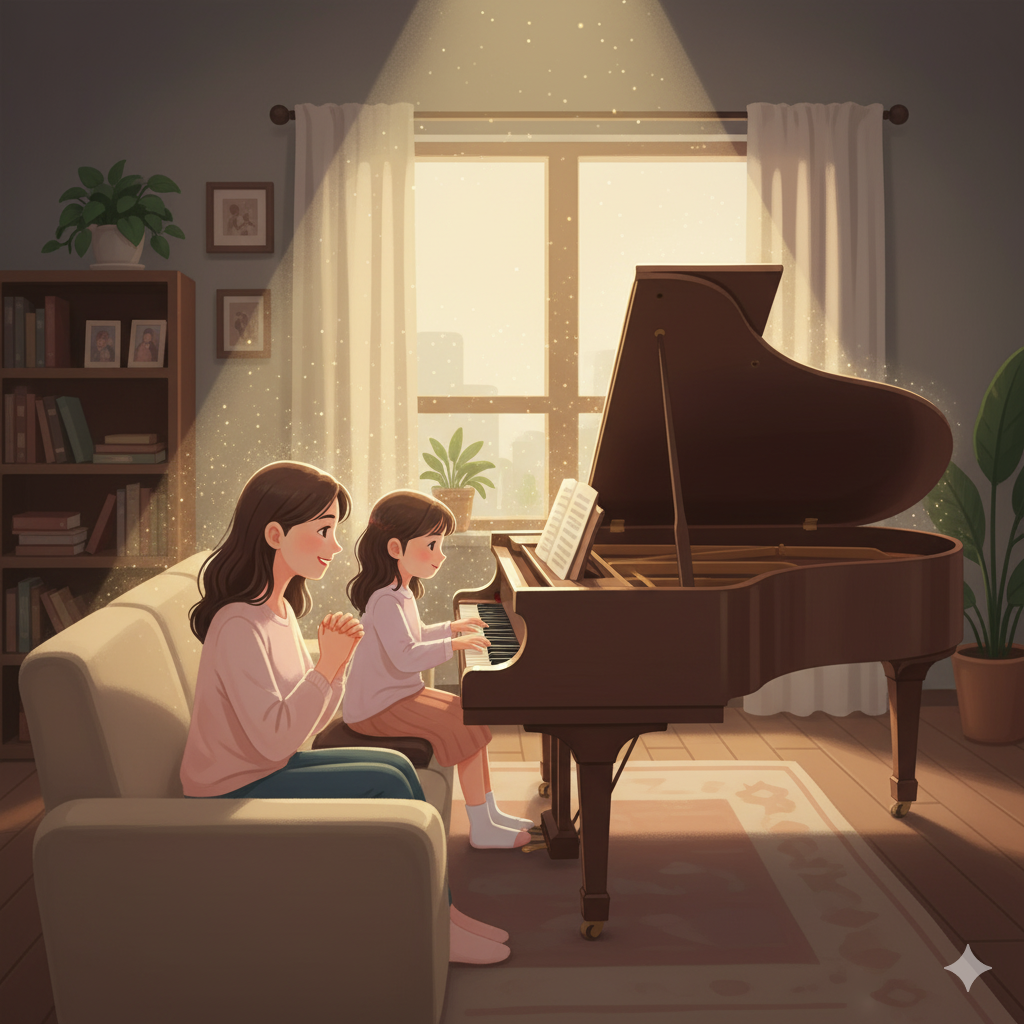
Don’t Fear AI “Stealing Jobs” — Fear Your Child Losing Interest
By now, it should be clear: in the age of AI, what we should worry about isn’t “piano being useless.” What we should worry about is “learning piano the wrong way.”
If our approach to music education is still stuck in “high-pressure supervision,” “mechanical repetition,” and “passing grade exams,” then we are essentially training our children to be a “budget version of AI.”
AI can achieve 100% precision, yet we demand children never miss a single note. AI can keep perfect time down to the millisecond, yet we use metronomes to police our children’s rhythm. This approach produces “piano technicians,” not “people who can play piano.” And these “technicians” will be the first ones AI replaces.
What’s even worse is that this high-pressure approach completely kills the most precious things a child can have about music — intrinsic motivation and curiosity. When a child starts to hate practicing, you have essentially shut the door to their development of taste, emotional depth, and creativity.
Embrace AI: let humanity stay human and tools stay tools. This is exactly what Wonder Piano has been doing. We never see AI as a “teacher” — AI is simply a “fun, patient, encouraging” practice companion.
We use AI to reduce frustration and protect curiosity. Why do children hate practicing? Because it’s “boring” and they “keep making mistakes.” Wonder Piano’s AI system doesn’t interrupt or scold like a traditional teacher would. It provides gentle, real-time feedback, recognizing pitch and rhythm as you play. Play correctly and the story progresses; make a mistake and it patiently waits for you to self-correct.
This transforms practice from “passively taking criticism” into “actively progressing through an adventure.”
We use AI to free parents and improve family relationships. The last thing we want to see is parents and children fighting over practice sessions, draining precious family bonds.
Our philosophy is that parents should be “appreciators” and “cheerleaders,” not “supervisors.” It’s okay if you don’t know anything about music — AI will track your child’s practice for you. What we want is a positive family cycle, not emotional exhaustion.
We use AI to spark intrinsic motivation so children fall in love with practicing
We’ve designed practice as a “magical adventure.” Children aren’t “completing tasks” — they’re “collecting magic stones” and “unlocking stories.” When practice connects with fun and a sense of achievement, children shift from “I have to practice” to “I want to practice.”
Parents have told us that their children sit still longer and are more willing to practice with Wonder Piano. This is the real value of AI as a tool: it’s not here to “replace” children — it’s here to help them fight boredom, build confidence, and protect that most precious spark of humanity.
In the wave of AI, the most valuable gift we can give our children isn’t teaching them a “skill” — it’s helping them build a “rich inner life.” A child who can appreciate Beethoven’s grandeur and Mozart’s lightness, who can express complex emotions through music, has a deeply enriched foundation for life.
A child who has learned through daily practice to sit with boredom and make peace with setbacks has powerful inner resilience. In the age of AI, the child who can play with soul will always be rare and irreplaceable.
Don’t worry about AI composing music. In a world of AI, we need people who can cry, laugh, love, and play the piano — because that person is the one who will truly master AI as a tool.